Battery Park City Real Estate Guide: Living, Buying & Investing in Battery Park City, NY
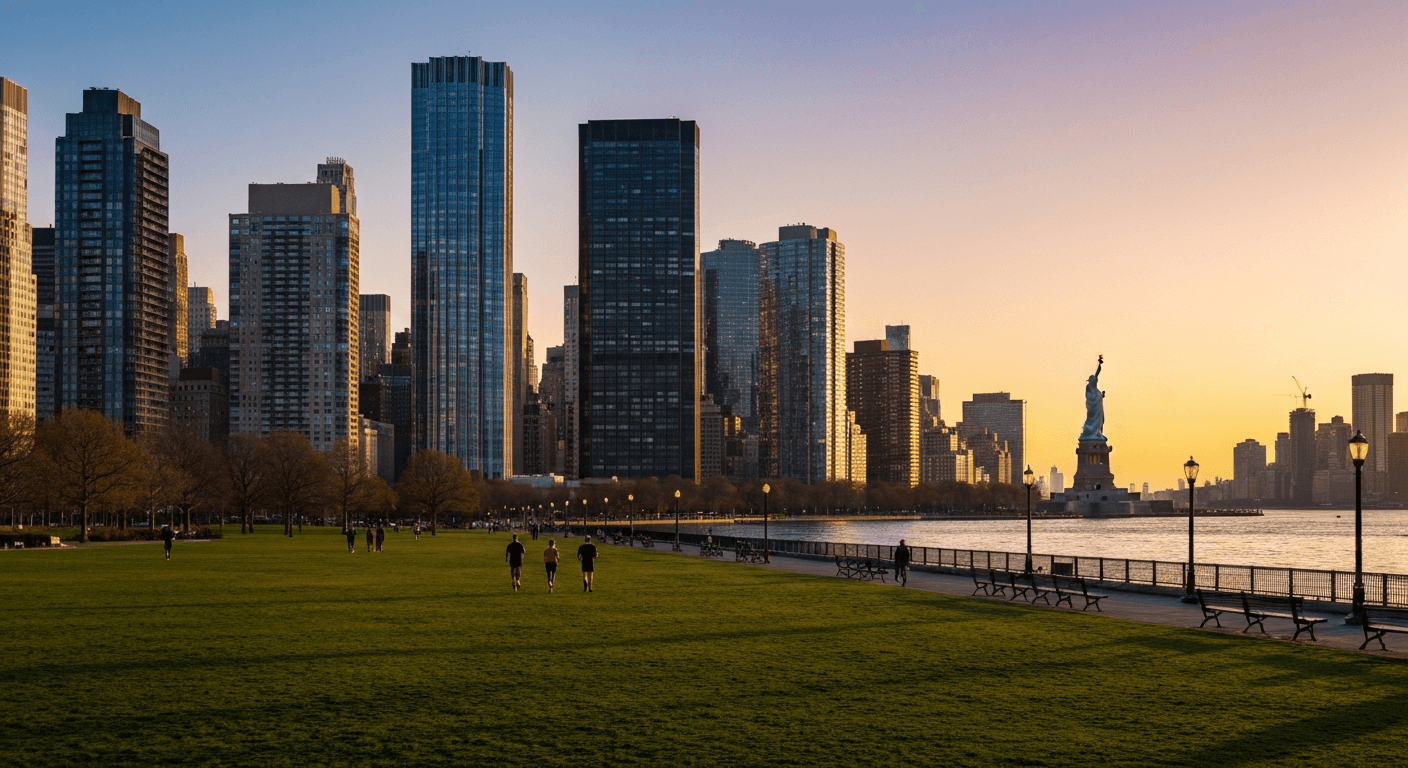
Battery Park City occupies a singular position in the New York City real estate landscape: a planned community built entirely on 92 acres of landfill on the western edge of lower Manhattan, designed from scratch to create an urban neighborhood that balanced high-density residential living with generous public open space. The result is something rare in New York: a neighborhood that feels genuinely livable in the classical sense — where children can ride bikes safely, residents know their neighbors, dog owners have dedicated parks, and the Hudson River is not merely visible from certain windows but is the defining presence in daily life. If you have ever walked the Battery Park City Esplanade on a summer evening, watching sailboats navigate past the Statue of Liberty as the sun drops behind the New Jersey Palisades, you understand immediately why this neighborhood commands such deep loyalty from its residents.
For buyers and investors, Battery Park City presents an unusual combination of characteristics: it is one of the most family-friendly neighborhoods in Manhattan, one of the most environmentally thoughtful (the community has long championed green building and sustainability standards), and one of the most resilient real estate markets in the city. The neighborhood's permanent residential character — built around actual community infrastructure rather than incidental amenities — means that Battery Park City attracts long-term owner-occupants rather than speculative buyers, which historically supports price stability and steady appreciation.
This comprehensive guide explores every dimension of life in Battery Park City, from its origin story as a bold urban planning experiment to the practical considerations every buyer needs to weigh before making an offer.
Battery Park City was created from the earth and bedrock excavated during the construction of the original World Trade Center in the late 1960s and early 1970s. The fill material was deposited into the Hudson River along the western edge of lower Manhattan, creating a new peninsula that was eventually stabilized and prepared for development. The Battery Park City Authority, established by the State of New York in 1968, was given jurisdiction over the site with a mandate to create a mixed-income, mixed-use neighborhood that would reinvigorate lower Manhattan's residential base.
The master plan, revised in 1979 and largely implemented over the following three decades, was a triumph of urban planning philosophy. Unlike typical large-scale developments that prioritize building density above all else, the Battery Park City plan mandated that 30% of the total site area be dedicated to public open space — an extraordinary commitment that produced the 1.2-mile Esplanade, Rockefeller Park, the Irish Hunger Memorial, Teardrop Park, South Cove Park, and numerous smaller green spaces and plazas.
The neighborhood's architecture reflects the planning philosophy of contextual urbanism that was fashionable in the early 1980s. Buildings like Gateway Plaza (the original residential complex, completed in 1983), the Rector Place residential neighborhood, and the later developments along North End Avenue and River Terrace were designed to echo the scale and vocabulary of traditional Manhattan streetscape, with buildings meeting the sidewalk, retail on the ground floor, and a human-scaled public realm between them.
The September 11 attacks devastated Battery Park City. Thousands of residents were evacuated, many permanently displaced, as toxic debris blanketed the neighborhood. The community's extraordinary recovery — more complete and faster than many feared — was a testament to both the physical resilience of the neighborhood's infrastructure and the determination of its residents and the Battery Park City Authority. Today, the community is fully rebuilt, and the new developments that have risen in the years since September 11 represent some of the most thoughtfully designed residential buildings in Lower Manhattan.
Battery Park City's real estate market is distinct from the rest of Manhattan in one critical structural respect: the land beneath virtually all residential buildings is owned by the Battery Park City Authority, a state entity, rather than by the building owners themselves. Most properties are sold with ground leases rather than traditional fee-simple ownership, meaning buyers purchase their unit while paying an annual ground rent to the Authority. This arrangement has important implications for pricing, financing, and long-term planning that every buyer must understand before proceeding.
Condominiums are by far the dominant ownership structure in Battery Park City, with rental apartments and a small number of co-operative buildings rounding out the inventory. Major condominium buildings include Gateway Plaza (300 Gateway Plaza), 200 Rector Place, 300 Rector Place, The Solaire (20 River Terrace) — which was the first green residential high-rise in the United States when it opened in 2003 — The Verdesian (211 North End Avenue), The Visionaire (70 Little West Street), and One River Place, among many others. Most buildings were developed in collaboration with private developers selected by the Battery Park City Authority through competitive processes.
Price ranges as of mid-2026 reflect the neighborhood's premium positioning within lower Manhattan. Studios typically range from $650,000 to $900,000. One-bedrooms run from $950,000 to $1.6 million, with River-facing units commanding the top of that range. Two-bedrooms list from $1.5 million to $2.8 million, and three-bedrooms with Hudson River views can reach $4 million and above. The price-per-square-foot averages $1,500 to $1,800, higher than FiDi proper but somewhat lower than Tribeca, reflecting both the premium quality of the buildings and the ground lease discount that sophisticated buyers can sometimes negotiate.
A note on ground leases: most Battery Park City ground leases run for long terms (many extending to 2069 and beyond) and include periodic rent resets. Buyers should review the specific ground lease terms for any unit under consideration, as rent reset provisions can affect future costs substantially. Buildings with leases that include favorable reset terms or capped rent adjustments will generally command premiums over those with more aggressive reset schedules. It is strongly advisable to work with a real estate attorney experienced specifically in Battery Park City ground lease transactions.
Despite the ground lease complexity, investment demand for Battery Park City properties remains strong. Rental rates for one-bedrooms run $4,000 to $5,500 per month, with premium river-view units achieving $5,000 to $6,500 monthly. The neighborhood's consistent rental demand — driven by finance professionals, United Nations staff, and families seeking the community's school quality — provides reliable income for investor-owners.
The lifestyle in Battery Park City is defined above all else by the relationship with the Hudson River and the neighborhood's extraordinary park system. The Battery Park City Esplanade stretches 1.2 miles along the waterfront from Battery Park to Chambers Street, providing a continuous pathway for joggers, cyclists, and evening strollers. On weekends, the Esplanade fills with families, dog walkers, and fitness enthusiasts enjoying what amounts to a linear park with one of the world's great urban water views.
Rockefeller Park at the northern end of the neighborhood contains baseball and soccer fields, a community garden, playgrounds, and ample lawn space for casual recreation. Teardrop Park, tucked between residential buildings at River Terrace, is a masterpiece of landscape architecture — a small, intimate park designed by Michael Van Valkenburgh with a playful water feature, a sandy slide embedded in a rock face, and plantings that create genuine seasonal interest. It is widely considered one of the most beautifully designed small parks in New York City.
The Irish Hunger Memorial at Vesey Street is a powerful piece of public art and history — a quarter-acre installation that recreates an Irish landscape, complete with stone walls, fallow fields, and interpretive passages about the Great Famine. It anchors the northern stretch of the neighborhood with a cultural gravity that complements its natural beauty.
Dining and everyday shopping in Battery Park City have improved substantially over the past decade. The Brookfield Place complex at 250 Vesey Street includes a food hall with outposts of Le District (French market-style dining), Hudson Eats (a curated fast-casual food hall with Umami Burger, Blue Ribbon Sushi Bar & Grill, and other favorites), and the restaurants and bars that have colonized the building's stunning atrium. The complex also includes a Saks Fifth Avenue, fitness facilities, and event space. The Battery Park City Farmers Market, held on Tuesdays and Saturdays from June through November, provides seasonal produce and artisan goods directly to the community.
For everyday groceries, residents rely primarily on the Whole Foods at 4 Washington Place (a short walk away) and various convenience shops within the neighborhood. Additional restaurants along North End Avenue, including North End Grill and various Asian and American casual spots, serve the neighborhood's dinner crowd.
Education is one of Battery Park City's genuine competitive strengths in the New York City context. PS 276 Battery Park City School (serving pre-K through 8th grade) is located at 55 Battery Place and is consistently one of the highest-performing public schools in Community School District 2, which is itself among the most academically competitive districts in Manhattan. The school has a strong parent community, excellent test scores, and a dedicated teaching staff that has remained relatively stable over time. For families prioritizing public school quality, Battery Park City competes directly with the Upper West Side, Park Slope, and Cobble Hill as one of the most attractive neighborhoods in the city.
For high school, the screened and specialized options available to Manhattan students are all accessible, with Stuyvesant High School at 345 Chambers Street being particularly proximate — a 15-minute walk or a few subway stops away. Private school options within reasonable commuting distance include Trinity School, The Dalton School, and various Catholic schools, though the strong public school performance means many Battery Park City families are content with PS 276 through middle school.
Battery Park City has convenient transit access, though it is somewhat less served by direct subway lines than the Financial District immediately to its east. The 1 train on Rector Street provides the most direct subway link, connecting residents to the rest of the 1 line corridor running through the West Village, Chelsea, Hell's Kitchen, and the Upper West Side. The 4/5/2/3 lines at Fulton Center are a short walk away, and the A/C/E at Chambers Street provides additional options.
The World Trade Center PATH station, a few blocks east, connects Battery Park City residents to Jersey City, Newark, and Hoboken — a particularly valuable link given that many BPC residents work in the financial services industry with offices in both Lower Manhattan and New Jersey.
The neighborhood's most distinctive transit asset is the NYC Ferry system, with a terminal at Pier 26 (just north of the neighborhood, at North Moore Street in Tribeca) providing service to Brooklyn, Queens, and the Rockaways. Water taxis and private ferry services also operate from various Hudson River piers, providing scenic commuting alternatives to the subway.
Cycling infrastructure is exceptional, with the Hudson River Greenway's dedicated protected lane running directly through the neighborhood and connecting to the citywide bike network. Many Battery Park City residents commute by bike to nearby jobs in lower Manhattan or Tribeca, and Citi Bike docking stations are conveniently located throughout the community.
The buy-versus-rent decision in Battery Park City is complicated by the ground lease structure in ways that require more sophisticated analysis than in other Manhattan neighborhoods. The bottom line for most buyers: if you plan to stay five years or more, the combination of equity accumulation, the neighborhood's track record of price appreciation, and the premium quality of the residential product makes buying a compelling choice. If your horizon is shorter, renting in the neighborhood — which is readily available across a range of building types and price points — is a more conservative approach that allows you to enjoy the lifestyle without the complexity of a ground lease purchase.
For investors, Battery Park City's rental demand is consistent and the tenant quality is generally strong, with finance professionals, diplomats, and young families making up the bulk of the tenant pool. Net operating income analyses should carefully account for ground rent expenses, building common charges, and property taxes when evaluating cap rates and cash-on-cash returns.
Battery Park City's ideal resident is someone who places genuine value on a curated, livable neighborhood environment over the frenetic energy of more commercially dense Manhattan communities. Families with young children will find the school quality, park access, and safe, pedestrian-friendly streetscape unmatched in lower Manhattan. Finance and legal professionals who work in the area and prioritize short commutes and a calm residential environment represent the largest buyer cohort. Empty nesters and retirees who want the cultural and dining access of Manhattan without the density and noise of Midtown are increasingly present, drawn by the relative quiet, the waterfront, and the community's genuine neighborliness. International buyers value Battery Park City for its security, building quality, and proximity to the United Nations and global financial institutions.
Several specific considerations deserve attention for anyone buying in Battery Park City. First, understand the ground lease terms for any specific unit before making an offer — not just the expiration date, but the rent reset schedule, any caps or formulas governing future adjustments, and the Authority's track record on lease renegotiations. Buildings with particularly favorable lease terms (especially those with resets tied to CPI rather than market value) will command justified premiums.
Second, assess common charges carefully. Battery Park City buildings tend to have higher common charges than comparable buildings elsewhere in Manhattan, reflecting the cost of maintaining building amenities and the ground rent component that some buildings absorb in their common charge calculations. Monthly costs that look competitive at first glance can escalate quickly when full carrying costs are calculated.
Third, parking is a genuine amenity in Battery Park City in a way it is not in most of Manhattan. Many buildings have attached garages, and deeded or assigned parking spaces add meaningful value for residents who own vehicles. If driving is part of your lifestyle, factor parking access into your building selection.
Finally, flood risk and resilience infrastructure matter in Battery Park City, which was significantly impacted by Hurricane Sandy flooding in 2012. The neighborhood has undergone extensive flood mitigation improvements since then, including the installation of flood barriers, critical infrastructure elevation, and backup power systems. Review specific building resilience measures and flood insurance requirements as part of your due diligence process.
Battery Park City is one of New York City's most distinctive and genuinely livable neighborhoods — a planned community that has, against the odds, become a real one. Its combination of exceptional parks, strong schools, waterfront access, and high-quality residential product creates a lifestyle proposition that is difficult to match anywhere in Manhattan at remotely comparable prices.
Farva Scott, Associate Broker at The Real Brokerage, has deep expertise in lower Manhattan residential real estate and can guide you through the unique complexities of Battery Park City's ground lease market. Whether you're a first-time buyer, a growing family, or a seasoned investor, Farva brings the knowledge and dedication to help you make the right move. Contact her today at farvascott.com or call (914) 417-9215 — your Battery Park City journey starts here.