Brooklyn Heights Real Estate Guide: Living, Buying & Investing in Brooklyn Heights, NY
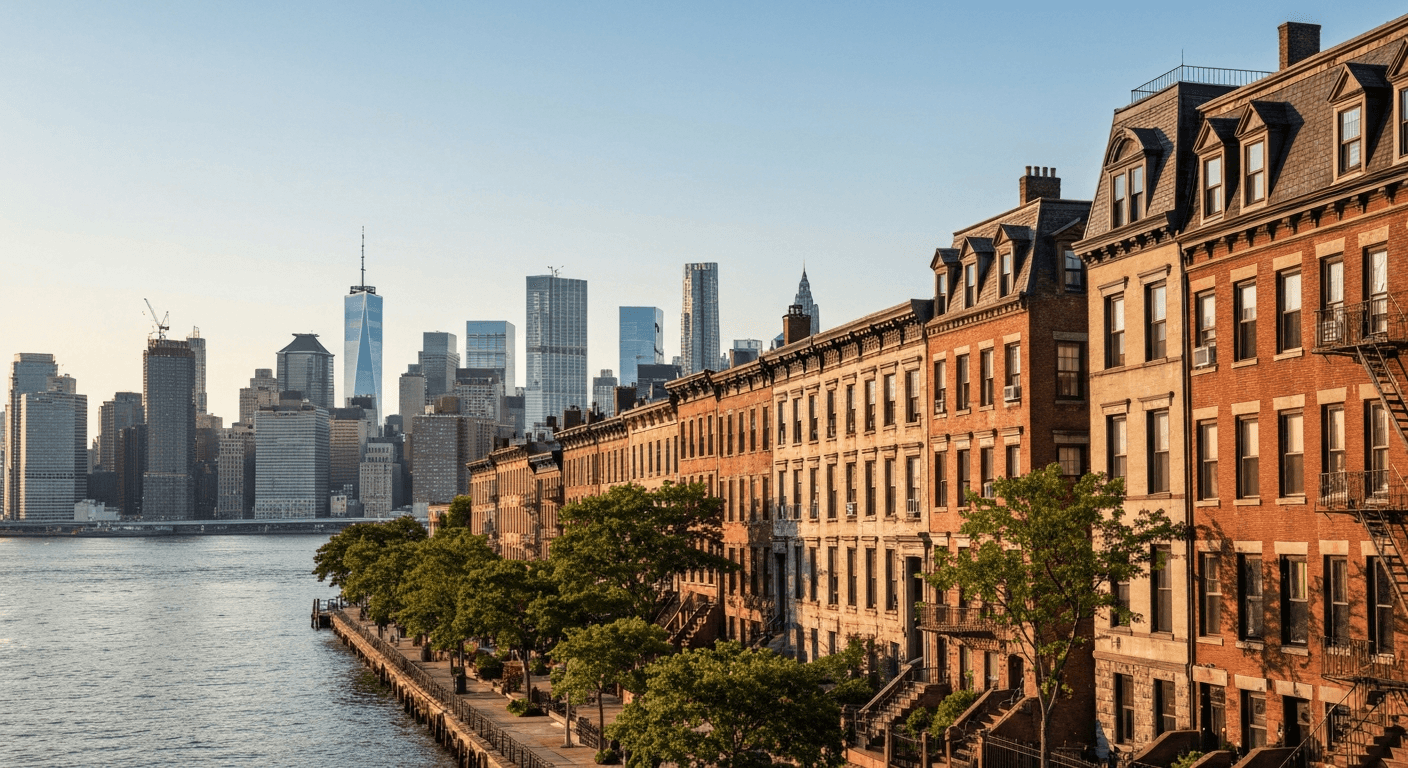
If you are searching for the quintessential New York City neighborhood — one that balances historic elegance with modern convenience, residential tranquility with world-class cultural offerings, and intimate scale with sweeping views — Brooklyn Heights is your answer. Perched on a bluff above the East River, Brooklyn Heights was New York City's very first historic district, designated in 1965, a testament to the extraordinary architectural and cultural heritage that its residents have long fought to protect. Walking the tree-lined streets of Willow, Cranberry, and Pineapple — streets bearing the names of trees and fruits from a colonial orchard that once occupied this land — is a genuinely transporting experience.
Federal and Greek Revival townhouses, Italianate rowhouses, and brownstones dating from the 1820s through the 1880s line block after block in immaculate condition, creating one of the finest concentrations of 19th-century residential architecture anywhere in the United States. The Brooklyn Heights Promenade, a landscaped esplanade cantilevered above the Brooklyn-Queens Expressway, offers what is arguably the most spectacular urban panorama on the East Coast: an uninterrupted view of Lower Manhattan, the Brooklyn Bridge, the Statue of Liberty, and New York Harbor stretching to the horizon. For buyers, Brooklyn Heights represents a stable, prestigious investment in a neighborhood that has been cherished for over two centuries.
Farva Scott, Associate Broker at The Real Brokerage, brings deep expertise in the Brooklyn Heights market. This comprehensive guide covers everything you need to know about buying and living in this iconic neighborhood — from the real estate market to lifestyle, schools, transportation, and the nuances that experienced buyers know to watch for.
Brooklyn Heights occupies the northwestern tip of Brooklyn, bounded by Fulton Street to the south, Court Street and Cadman Plaza to the east, and the East River to the west. Its history is inextricably linked to the founding story of both Brooklyn and New York. In 1636, Joris Jansen de Raplje became one of the first European settlers of the area, and for two centuries the Heights remained primarily agricultural land. The pivotal moment in American history most associated with Brooklyn Heights occurred on August 27, 1776, during the Battle of Long Island — the first major engagement of the Revolutionary War — when General George Washington led a desperate overnight retreat from Brooklyn across the East River to Manhattan, a withdrawal that arguably saved the Continental Army and changed the course of American history.
By the early 19th century, Robert Fulton's steam ferry service across the East River, operating from the foot of Old Fulton Street, transformed Brooklyn Heights into New York's first commuter suburb. Wealthy Manhattan businessmen built grand townhouses here, establishing the residential character that endures today. The streets of Brooklyn Heights read like a catalog of 19th-century architectural fashion: Willow Street features some of the finest Federal-style houses in New York, while Remsen, Joralemon, and Pierrepont Streets are lined with Italianate and Romanesque Revival brownstones. Grace Church on Hicks Street and Plymouth Church on Orange Street — where abolitionist preacher Henry Ward Beecher held sway and Abraham Lincoln once worshipped — anchor the neighborhood's deep civic and religious heritage.
The creation of the Brooklyn Heights Historic District in 1965 locked in these architectural treasures, making meaningful new construction within the core district effectively impossible. The housing stock of Brooklyn Heights is genuinely irreplaceable, and buyers consistently pay a premium for that permanence and protection. The neighborhood has attracted extraordinary residents across the centuries — Norman Mailer, Truman Capote, W.H. Auden, Arthur Miller, Hart Crane, and countless other literary and artistic figures called Brooklyn Heights home. That intellectual and cultural lineage permeates the neighborhood's atmosphere.
Brooklyn Heights occupies a distinct tier in the Brooklyn real estate market. The combination of historic designation, exceptional architecture, limited inventory, and unparalleled location has driven consistent appreciation that makes this one of the borough's most valuable ZIP codes. As of 2025-2026, median sale prices for brownstones and townhouses in Brooklyn Heights range from approximately $3.5 million to over $10 million for the finest full-width, multi-story brownstone mansions on streets like Remsen, Pierrepont, and Willow. Single-family townhouses — relatively rare in the Heights, as most have been converted to multi-family use — command $4 million to $7 million and up when available.
Two-to-four family brownstones — a popular buyer profile in which owners occupy one floor and rent out the others — typically sell in the $3 million to $5 million range, offering an appealing live-and-invest proposition. This structure allows buyers to offset carrying costs with rental income while building equity in a neighborhood with strong appreciation fundamentals. Condominiums represent a substantial portion of the market. Newer condo buildings and converted rowhouses on Monroe Place, Columbia Heights, and Remsen Street offer units ranging from $800,000 for a renovated one-bedroom to $3 million or more for a full-floor penthouse with Promenade or harbor views.
The Standish Arms building at 171 Columbia Heights — a landmarked Beaux-Arts building — is among the most prestigious addresses in the neighborhood, with renovated apartments commanding top prices and extraordinary views of the harbor and lower Manhattan. Co-ops are plentiful in Brooklyn Heights, particularly in the mid-century apartment buildings along Clark, Henry, and Montague Streets. Co-op prices are generally lower per square foot than condos, with studios starting around $400,000 and two-bedrooms ranging from $700,000 to $1.4 million depending on building, floor, and condition. Co-op boards in Brooklyn Heights tend to be formal and rigorous — expect to provide comprehensive financials and personal references.
The rental market reflects the neighborhood's premium standing. One-bedrooms in well-maintained buildings average $3,200 to $4,200 per month; two-bedrooms run $4,500 to $6,500 per month; and townhouse rentals can reach $10,000 to $25,000 per month for a full floor or entire building. For investors, Brooklyn Heights offers lower cap rates than more transitional Brooklyn neighborhoods but exceptional stability and a tenant pool of highly creditworthy professionals, lawyers, and financial executives. The neighborhood sees minimal vacancy risk and consistently attracts long-term tenants who value quality and stability.
Brooklyn Heights offers an unusually rich lifestyle for such a compact neighborhood. The Brooklyn Heights Promenade is the heart of neighborhood life — a quarter-mile esplanade stretching from Remsen Street to Pierrepont Street, where residents walk, jog, sit on benches, and simply drink in one of the world's great urban views. It is magical at sunrise, dramatic at midday, and transcendent at dusk when the Manhattan skyline ignites with light against the harbor. Cadman Plaza Park, at the neighborhood's eastern edge, provides green space, a farmers market on Saturdays and Wednesdays, and connections to the Brooklyn Bridge walking and cycling path.
Dining in Brooklyn Heights has evolved substantially over the past decade. Colonie on Atlantic Avenue is a standout for refined American cuisine in a beautifully designed space. Jack the Horse Tavern on Hicks Street is a neighborhood institution beloved for its seasonal American menu and warm atmosphere. Heights Café on Montague Street is a casual neighborhood staple open for brunch, lunch, and dinner — a meeting point for residents at all hours. Sahadi's Fine Foods on Atlantic Avenue — a James Beard Award-winning Middle Eastern market and eatery operating since 1948 — is a Brooklyn institution offering extraordinary prepared foods, cheeses, olives, and specialty goods from across the Mediterranean. Almondine Bakery on Water Street in adjacent DUMBO draws Heights residents for croissants, baguettes, and tarts worthy of Paris.
Montague Street is the neighborhood's main commercial corridor, offering a mix of cafés, restaurants, banks, a pharmacy, and small independent shops. The Brooklyn Public Library's Brooklyn Heights branch at 280 Cadman Plaza West is a beloved community anchor. For fitness, the neighborhood has boutique gyms and yoga studios, and the connections to Brooklyn Bridge Park — just steps from Columbia Heights — provide miles of waterfront running and cycling paths. Cultural life centers on BAM (Brooklyn Academy of Music, a short subway ride away in Fort Greene) and St. Ann's Warehouse, which stages internationally acclaimed performances in DUMBO. The neighborhood's scale — roughly 20 blocks at its widest — creates a genuine village atmosphere where residents know their neighbors, their local shopkeepers, and the rhythms of daily life on their street.
Brooklyn Heights is served by Brooklyn Community School District 13. PS 8 Robert Fulton School, located on Hicks Street within the neighborhood, is the anchor elementary school and consistently earns high ratings across academic performance, parent satisfaction, and school culture. It has a genuine community feel, strong arts programming, and a highly engaged parent-teacher organization that makes it one of the most sought-after elementary schools in Brooklyn. Many families also consider PS 29 on Classon Avenue in Clinton Hill for its strong academic programming.
The middle school landscape includes MS 447 in DUMBO and MS 131, accessible by subway. For high school, Brooklyn Technical High School in Fort Greene — one of New York City's elite specialized high schools, admitting students via the competitive Specialized High School Admissions Test — is a top choice for many Heights families. Stuyvesant High School in Manhattan and Bronx Science are also popular targets. Private school options near Brooklyn Heights are outstanding. Packer Collegiate Institute on Joralemon Street is directly in the neighborhood, offering Pre-K through 12th grade; it is one of Brooklyn's most prestigious independent schools, with strong college placement and a beautiful campus of landmarked buildings. St. Ann's School on Pierrepont Street is known for its distinctive arts-integrated approach and exceptional theater and music programs. Brooklyn Friends School is accessible in adjacent DUMBO. For higher education, Long Island University Brooklyn, NYU Tandon, and Manhattan's major universities are all easily accessible.
Brooklyn Heights is one of the best-connected neighborhoods in Brooklyn for Manhattan commuters. The 2 and 3 express subway lines stop at Clark Street, just one block from the Promenade, providing express service to Wall Street in approximately 3 minutes and to Times Square in approximately 20 minutes. The 4 and 5 trains stop at Borough Hall, a 7-minute walk from most Brooklyn Heights addresses, connecting to Midtown in about 20 minutes. The A and C trains stop at High Street on the southern edge of the neighborhood, with service to the West Side of Manhattan. The R train stops at Court Street/Borough Hall. For active commuters, the Brooklyn Bridge pedestrian path — accessible from the base of the neighborhood — provides one of the most exhilarating bike or walk commutes in the city, depositing riders in Lower Manhattan in 20 minutes on foot or 10 minutes by bike.
Citi Bike stations are well-distributed throughout the neighborhood. The NYC Ferry's Old Fulton Street landing in adjacent DUMBO connects directly to Pier 11/Wall Street, as well as Long Island City, Greenpoint, and other stops. Buses serve the neighborhood, including the B67 and B61 along Court Street. Walk Score for Brooklyn Heights is typically in the high 90s, and many residents manage comfortably without a car.
Brooklyn Heights is definitively a buyer's neighborhood for those with the resources and time horizon to justify the price premium. The rental market is strong, but the financial case for buying becomes compelling over a five-year or longer hold period, given the neighborhood's consistent appreciation, stability, and the scarcity premium attached to historic district property. For buyers considering a townhouse purchase with rental income from upper floors, the math often works well — rental income from two or three apartments can substantially offset mortgage and operating costs while the owner builds equity. Co-op buyers should carefully evaluate building financials, underlying mortgage obligations, and flip tax policies, all of which affect long-term cost of ownership. Condos offer more flexibility and tend to retain value better on resale relative to co-ops. If you are committed to Brooklyn Heights for at least five years, ownership is likely the superior financial choice.
Brooklyn Heights is ideally suited to several distinct buyer profiles. Established professionals and executives who value prestige, beauty, and low-drama neighborhood living find Brooklyn Heights exactly right — it offers Manhattan accessibility without Manhattan noise or pace. Families with children prize the excellent public and private schools, the park access at Cadman Plaza and Brooklyn Bridge Park, and the safe, tree-lined streets that feel worlds removed from the city's intensity. Empty nesters trading a suburban house for a brownstone or condo find Brooklyn Heights to be a sophisticated, culturally rich landing spot. History and architecture enthusiasts are drawn by the irreplaceable built environment.
International buyers seeking a prestigious, globally recognized New York address find Brooklyn Heights a compelling alternative to Manhattan's Upper East or West Sides, often offering more space for comparable prices. Writers, academics, and intellectuals have long gravitated here, continuing the literary tradition of Mailer, Capote, Auden, and Miller. Brooklyn Heights is not for buyers seeking nightlife and late-night energy — it is quiet, residential, and somewhat formal. It is for those who want to live beautifully and thoughtfully in one of New York's most carefully preserved historic landscapes.
Buying in Brooklyn Heights requires careful preparation. Co-ops are common and many have demanding boards — expect to provide two years of tax returns, a full financial statement, bank letters, and personal and professional references. Some buildings have primary residence requirements, prohibit subletting, or levy flip taxes on resale, all of which affect your flexibility and should be understood before making an offer. For brownstones, hire a building inspector who specializes in pre-war masonry construction — brownstone façades require ongoing maintenance, and delayed pointing, lintel repairs, and waterproofing issues can create significant costs that should be factored into your purchase price analysis.
If purchasing a townhouse with rental units already in place, review the rent rolls and lease terms carefully. Some tenants in Brooklyn Heights are rent-stabilized and have significant legal protections, affecting your ability to use or renovate the building. The historic district designation means exterior alterations require Landmarks Preservation Commission approval — understand the process and implications before planning major renovations. Work with an attorney who knows the Brooklyn Heights market specifically; contract negotiations can be nuanced in multi-family buildings with tenants. Because the historic district is fiercely protective of its built environment, buyers can be confident their investment is safeguarded from disruptive new development — a meaningful source of long-term value security.
Brooklyn Heights is where history, beauty, and New York City's enduring magnetism converge. Owning property here is not just a real estate decision — it is a statement of values, an investment in permanence, and a connection to one of the most storied residential communities in American history. The market rewards buyers who come prepared, understand the nuances of historic district ownership, and have a long-term perspective on this irreplaceable neighborhood.
Whether you are drawn by the Promenade views, the architectural elegance of Willow Street, the exceptional school options, or simply the ineffable sense of grace that Brooklyn Heights exudes, this neighborhood has few equals in the New York City real estate landscape. Farva Scott, Associate Broker at The Real Brokerage, is ready to guide you through every aspect of the Brooklyn Heights market — from co-op board packages to townhouse due diligence to identifying the best blocks for your specific needs and lifestyle. Visit farvascott.com or call (914) 417-9215 to start your Brooklyn Heights journey today.