Chelsea Real Estate Guide: Living, Buying & Investing in Chelsea, NY
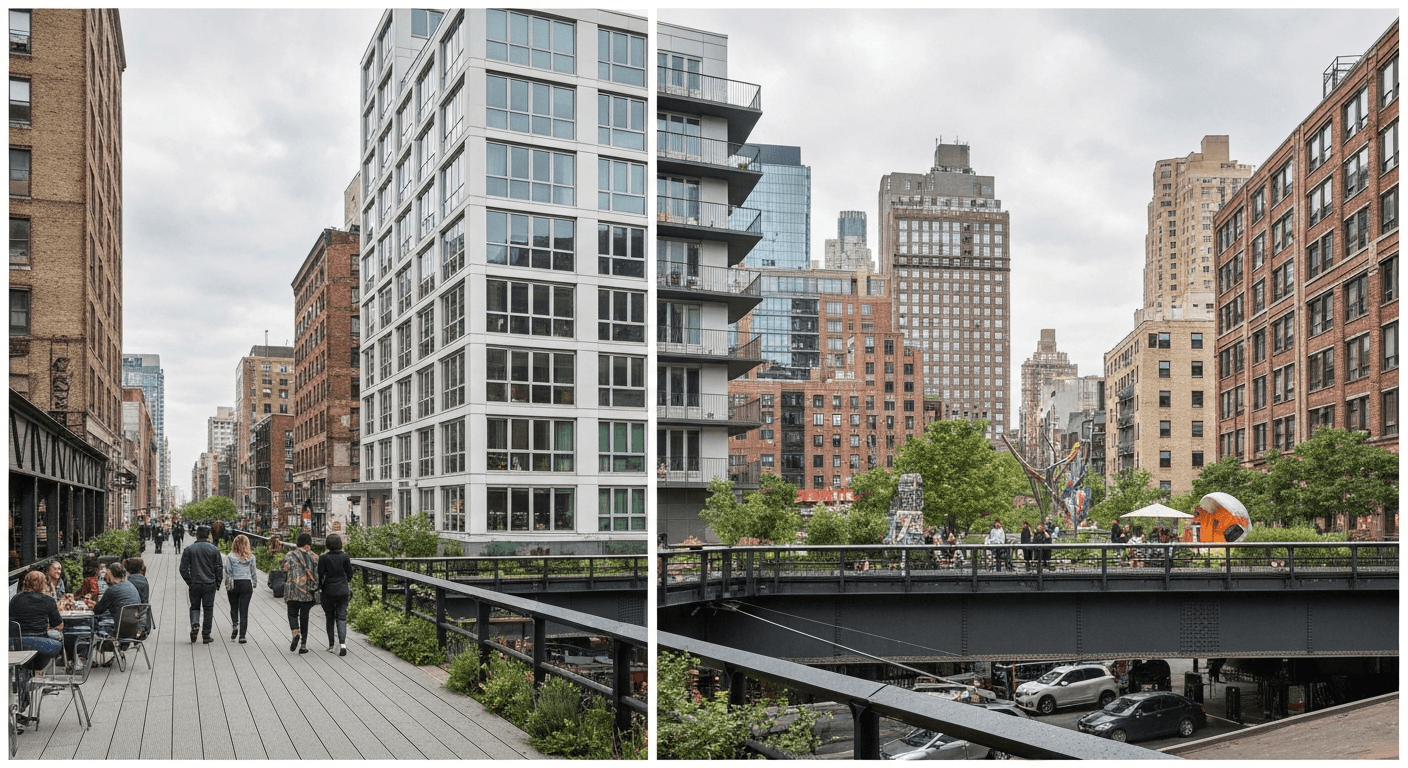
There are neighborhoods that define a city's creative soul, and in New York, Chelsea has long held that title. Bounded roughly by 14th Street to the south, 34th Street to the north, the Hudson River to the west, and Sixth Avenue to the east, Chelsea is a neighborhood of striking contrasts — Victorian brownstones tucked beside gleaming glass galleries, the elevated oasis of the High Line threading through blocks of converted industrial lofts, and one of the country's most concentrated art gallery districts humming quietly alongside food markets, rooftop bars, and some of the most coveted apartment buildings in the city. Chelsea has evolved from a gritty meatpacking and warehouse district to a global destination for art, culture, and sophisticated urban living, and through that transformation it has become one of the most desirable — and consistently appreciating — real estate markets in all of Manhattan. If you are a home buyer or investor looking for a neighborhood that blends creativity with luxury, community with cosmopolitan energy, and history with forward-looking design, Chelsea deserves your serious attention. This guide covers everything you need to know about living in, buying in, and investing in Chelsea, New York.
Chelsea's character is fundamentally shaped by its layers of history and its remarkable ability to reinvent itself. The neighborhood takes its name from the estate of retired British officer Thomas Clarke, who built his manor here in the 1750s; Clarke's grandson, Clement Clarke Moore — best known for writing "A Visit from St. Nicholas" — later developed much of the area into a planned residential district in the 1830s, platting the streets and selling lots for the Greek Revival and Italianate townhouses that still line West 20th, 21st, and 22nd Streets between Eighth and Tenth Avenues (now designated the Chelsea Historic District). By the late 19th century, Chelsea had become a bustling theatrical and entertainment hub — the first "Broadway" theater district actually flourished here before migrating uptown — and a working-class neighborhood of Irish and German immigrants employed in the Hudson River docks and rail yards. The 20th century brought waves of industrial use, including the famous General Theological Seminary (still operating on Ninth Avenue), the construction of the High Line freight rail viaduct in the 1930s, and the gradual transformation of warehouses and factories into artists' lofts beginning in the 1980s. The gallerists arrived in force in the 1990s when skyrocketing SoHo rents pushed the art world north and west: today, the blocks between Tenth and Eleventh Avenues from 20th to 26th Streets comprise the world's most important commercial art gallery district, home to Gagosian Gallery, David Zwirner, Pace Gallery, Hauser & Wirth, and over 300 additional exhibition spaces. Hudson Yards — the massive mixed-use development directly adjacent to Chelsea's northwestern edge — has added new layers of luxury retail, office space, and cultural institutions since its 2019 opening, and its presence continues to drive property values upward throughout the broader Chelsea market.
Chelsea's real estate market is one of the most varied and opportunity-rich in Manhattan, with a range of property types that appeals to virtually every buyer profile. The neighborhood's housing stock includes pre-war co-op buildings throughout the Chelsea Historic District and along Seventh and Eighth Avenues, newer condominium towers concentrated between Tenth and Twelfth Avenues near the High Line, converted warehouse lofts in the far west, and a small but charming inventory of single-family townhouses in the historic district. For buyers entering the market, one-bedroom apartments in Chelsea co-ops typically range from $750,000 to $1.2 million, while two-bedrooms span $1.3 million to $2.5 million in most mid-block pre-war buildings. Luxury condominium developments along the High Line corridor command significant premiums: buildings like 515 West 18th Street (designed by Jeanne Gang), 550 West 29th Street, and the Lantern House at 515 West 18th Street offer one-bedrooms starting around $1.5 million, with full-floor and penthouse units exceeding $15 million. Loft apartments — the raw or renovated industrial spaces for which Chelsea became famous — are increasingly rare in their truest form but still trade at $1,200 to $2,000 per square foot in the most coveted buildings. For investors, Chelsea's rental market is exceptionally strong: one-bedroom apartments rent for $4,200 to $6,500 per month, and well-located two-bedrooms command $6,000 to $10,000. The neighborhood's appeal to the creative and tech professional class — as well as its strong LGBTQ+ community, one of the largest and most established in the city — ensures that vacancy rates remain among the lowest in Manhattan. The continued expansion of Hudson Yards (Phase II is underway) and the ongoing High Line extension toward the rail yards will continue to exert upward pressure on Chelsea property values over the coming decade. Competition for well-priced listings is intense; properties priced correctly often go into multiple-bid situations within a week. Buyers who hesitate on Chelsea typically pay more six months later — or lose their window entirely.
Chelsea's lifestyle amenities are extraordinary in both breadth and quality. The High Line — the 1.45-mile elevated park built atop the former New York Central Railroad freight spur — is the defining feature of Chelsea's recent renaissance, offering art installations, native plantings, food vendors, and sweeping river views in a linear park that attracts millions of visitors annually and serves as a genuine neighborhood gathering space. Chelsea Market, the repurposed National Biscuit Company (Nabisco) factory at 75 Ninth Avenue, is a culinary destination unto itself: inside its brick-arched corridors you'll find the Lobster Place seafood hall, Amy's Bread, Fat Witch Bakery, Chelsea Thai, and dozens of additional food vendors alongside a Anthropologie, L'Occitane, and the Google New York offices. The Whitney Museum of American Art, though technically just over the neighborhood's southern border in the Meatpacking District, is a five-minute walk from most Chelsea apartments and programs world-class contemporary American art exhibitions. The neighborhood's park options include Chelsea Waterside Park on the Hudson River — with its skate park, dog run, and athletic fields — and the open lawns of the Hudson River Park that extend north from Gansevoort Street. Restaurants run the full gamut: Tía Pol on Tenth Avenue is a beloved Spanish tapas institution; Cull & Pistol at Chelsea Market serves extraordinary oysters; Cookshop on Tenth Avenue is a reliable neighborhood brunch anchor; and high-end spots like Morimoto, Buddakan (across the border in the Meatpacking District), and the rotating art-gallery restaurant concepts in Hudson Yards round out the dining scene. Nightlife is sophisticated without being overwhelming: Rebar, Qu, and a handful of longtime establishments serve Chelsea's LGBTQ+ community while Hotel Chelsea's bar and newer venues like The Flower Shop adjacent to the neighborhood attract a broader crowd.
Families considering Chelsea will find that public school options are solid, if not as storied as those in the Upper West Side or Park Slope. The zoned elementary school for much of Chelsea is P.S. 33 Chelsea Prep on West 29th Street, which has undergone significant improvement under recent principals and now offers a dual-language Spanish-English program alongside strong arts integration — a natural fit for the neighborhood's creative identity. P.S. 11 Clinton Hill on West 21st Street also serves the eastern portions of Chelsea and has a strong dual-language Mandarin program. For middle school, the neighborhood feeds primarily into I.S. 289 and I.S. 70, both accessible by subway. The LaGuardia High School of Music & Art and Performing Arts — the famed "Fame" school on West 65th Street — is audition-based and reachable from Chelsea in under 20 minutes; it draws many Chelsea students with artistic inclinations. Professional and private school options within reasonable distance include Friends Seminary in Gramercy, The Avenues World School on West 25th Street (one of the few world-class private schools actually within Chelsea), the Léman Manhattan Preparatory School, and numerous others. The New School university campus begins at 13th Street and Fifth Avenue, two stops away on the 1 train, while New York University's main campus in Greenwich Village is 20 minutes on foot.
Chelsea's transit infrastructure is excellent. The 1/2/3 subway lines run along Seventh Avenue through the heart of the neighborhood, with stops at 18th and 23rd Streets providing access to the entire West Side IRT network. The C/E trains on Eighth Avenue add another north-south option, stopping at 23rd Street with connections to Columbus Circle (59th Street) and the Port Authority Bus Terminal for New Jersey commuters. The PATH train station at 23rd Street connects Chelsea directly to Hoboken, Jersey City, and Newark Airport service — a key asset for residents with ties to New Jersey. The M11, M23, and M34 crosstown buses handle east-west movement, and the dedicated bus lane on 23rd Street speeds crosstown travel. For cyclists, Chelsea is exceptionally well-served: the Hudson River Greenway runs along the western waterfront providing a fully protected, car-free cycling path from the Battery to the George Washington Bridge; protected bike lanes on Eighth and Ninth Avenues connect Chelsea to Midtown and the Village; and Citi Bike docking stations are positioned every three to four blocks throughout the neighborhood. Walk Score in Chelsea consistently exceeds 95, with virtually all daily needs — groceries, pharmacies, restaurants, gyms, parks — accessible on foot within five minutes. Commutes to the Financial District take 20–25 minutes on the 1 train; trips to Midtown run 10–15 minutes.
Chelsea represents one of those rare cases where buying is clearly advantageous over renting for any buyer with a horizon of two or more years. The rental market's strength — consistently among the tightest in Manhattan — means monthly rents for desirable apartments are nearly as expensive as carrying costs for comparable owned units. A one-bedroom apartment that rents for $5,000 per month could often be purchased in the $900,000 to $1.2 million range, with monthly carrying costs (mortgage, maintenance or common charges, taxes) of $5,500 to $7,500 — only modestly above rent, but building equity rather than paying a landlord. Chelsea's appreciation track record is compelling: the neighborhood has consistently outperformed the broader Manhattan market over rolling five-year periods, driven by the High Line effect, gallery district prestige, and the continued buildout of Hudson Yards. Investors who purchased lofts in Chelsea in the early 2000s for $600,000 to $800,000 have seen those assets double or more in value. For renters who are financially stable, Chelsea is one of Manhattan's strongest arguments for entering the ownership market.
Chelsea attracts one of the most diverse, sophisticated, and creatively engaged buyer populations in New York City. Artists, architects, designers, and media professionals are drawn to the neighborhood's gallery culture, its architectural beauty, and its legacy of creative tolerance. Young technology professionals from Google's nearby Chelsea headquarters and the broader tech ecosystem in Hudson Yards and the Flatiron District find Chelsea's transit access and lifestyle amenities ideal. The LGBTQ+ community has deep historical roots in Chelsea, and while the neighborhood's character has evolved, it remains one of the most welcoming and well-resourced communities for LGBTQ+ buyers in the city. Empty-nesters relocating from suburban Westchester or Connecticut frequently target Chelsea for its walkability, restaurant density, and connection to the arts world. Investors seeking pied-à-terre apartments or income-generating rentals find Chelsea's strong fundamentals and limited new supply an attractive proposition. In short, Chelsea appeals to anyone who values beauty, creativity, connectivity, and the particular magic of a neighborhood that has become globally synonymous with what New York does best.
Navigating a Chelsea purchase requires a few key insights. First, understand the difference between the High Line premium and the rest of Chelsea: apartments with High Line views or direct access from their buildings command 15–25% premiums over comparable units without that amenity, so clarify whether that premium aligns with your priorities. Second, in the Chelsea Historic District, alteration work on landmarked buildings (including exterior window and facade changes) requires Landmarks Preservation Commission approval — verify any planned renovations early in your due diligence. Third, Chelsea's far west blocks near the Hudson River experience some of the highest wind exposure in Manhattan; if you're considering a high-floor apartment in that zone, visit in winter to gauge comfort. Fourth, the neighborhood is experiencing a gradual commercial-to-residential conversion wave as older office and studio buildings repurpose themselves — some of these conversions offer genuinely interesting spaces at price points below luxury towers, but require careful review of building financials and board governance structure. Fifth, parking in Chelsea is limited and expensive; if you own a car, factor in garage costs of $500 to $800 per month. Engage a buyer's broker with deep Chelsea expertise, get your financial documents in order early, and be prepared to move quickly — well-priced Chelsea listings do not last.
Chelsea is more than a neighborhood — it is a living expression of New York City's capacity to transform, inspire, and endure. From the ivy-draped rowhouses of the historic district to the steel-and-glass towers beside the High Line, from the whisper of gallery openings on a Thursday evening to the roar of Chelsea Market on a Saturday afternoon, this neighborhood offers a quality of life that is genuinely unmatched. Whether you're searching for your first Manhattan apartment, your forever home, or a smart investment in one of the city's strongest real estate corridors, Chelsea deserves serious consideration. Let Farva Scott, Associate Broker at The Real Brokerage, guide you through the Chelsea market with the expertise, integrity, and attention to detail your purchase deserves. Visit farvascott.com or call (914) 417-9215 today to schedule a consultation and start your Chelsea home search.