Chinatown Real Estate Guide: Living, Buying & Investing in Chinatown, NY
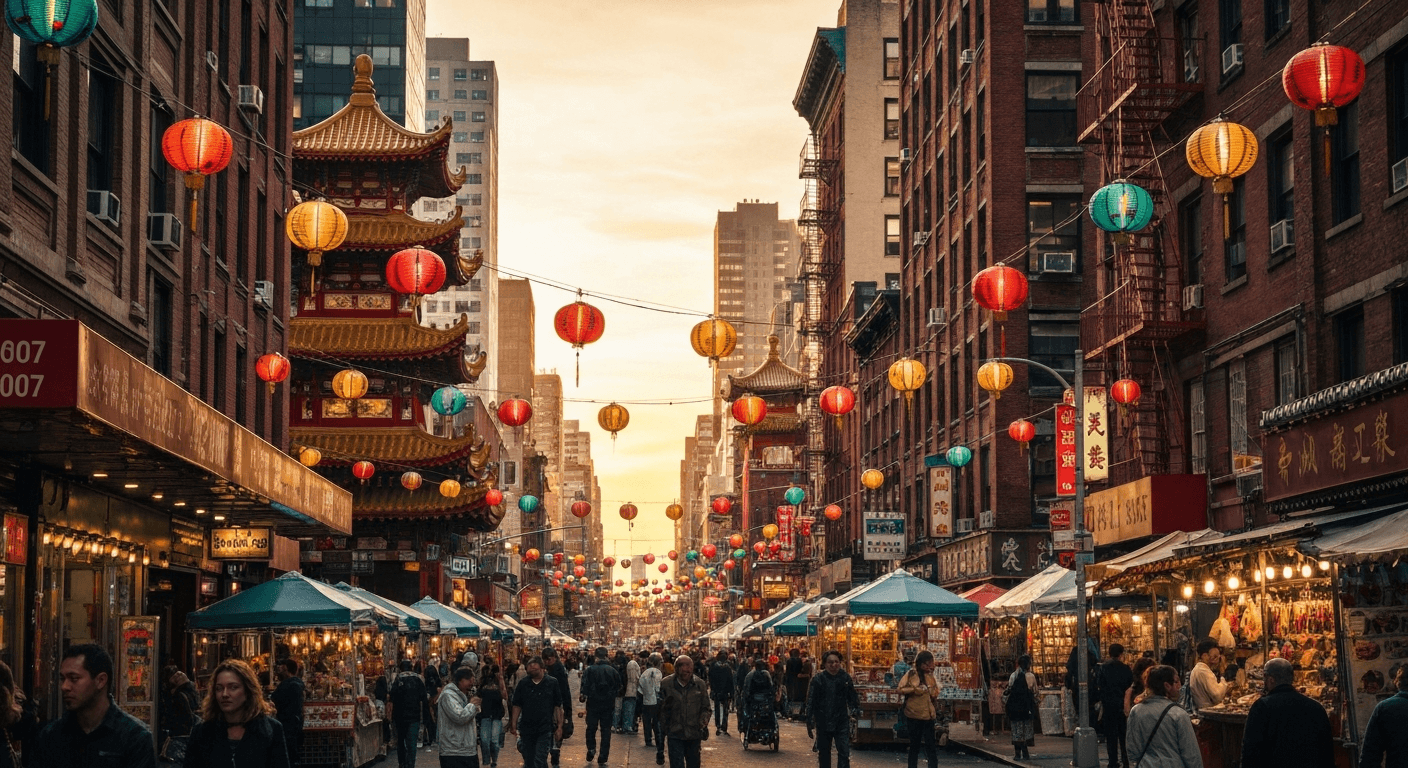
Manhattan's Chinatown is one of the most densely populated, culturally vibrant, and commercially dynamic neighborhoods in New York City — and one of its most underappreciated real estate markets. Centered on Canal Street and radiating outward along Mott, Bayard, Pell, Division, and East Broadway, Chinatown is home to the largest Chinese-American community in the Western Hemisphere. Walk through its streets on a Saturday morning and you'll hear Mandarin, Cantonese, and Fujianese competing with the clattering of produce markets, the sizzle of roast duck from open-window kitchens on Mott Street, and the percussion of delivery trucks navigating Canal Street's perpetual traffic. The sensory richness is total and entirely unlike anywhere else in Manhattan.
For real estate buyers and investors, Chinatown represents one of lower Manhattan's most compelling value propositions. Property prices here run significantly below the adjacent neighborhoods of Tribeca, SoHo, and Little Italy — often by 30 to 50 percent per square foot — while sharing their extraordinary subway access, proximity to the Financial District, and position in one of the world's most desirable cities. The neighborhood is in a period of gradual but real transformation: acclaimed chefs opening boundary-pushing restaurants, converted mixed-use buildings attracting creative tenants, and an influx of professionals from neighboring Lower East Side and NoLiTa are all gradually shifting the neighborhood's real estate dynamics upward.
The community has also demonstrated remarkable resilience. After the severe challenges of the pandemic years — which hit Chinatown particularly hard through a devastating combination of reduced foot traffic and anti-Asian sentiment — the neighborhood rebounded strongly, with retail corridors returning to full occupancy and restaurant traffic recovering to pre-2020 levels by mid-2024. The MOCA (Museum of Chinese in America) at 215 Centre Street has emerged as a cultural anchor, drawing visitors and new residents who might not have discovered the neighborhood's depth otherwise.
Chinatown's origins trace to the 1870s, when a small community of Chinese immigrants — many of whom had helped build the transcontinental railroad — established themselves in the blocks around Mott and Pell Streets in Lower Manhattan. Strict federal immigration laws, including the Chinese Exclusion Act of 1882, kept the community small and insular for decades, creating a neighborhood that was self-sufficient by necessity. By 1940, Chinatown covered only a few blocks and housed approximately 10,000 residents in conditions of extreme density.
The repeal of restrictive immigration quotas in 1965 fundamentally transformed the neighborhood. Over the following four decades, successive waves of immigration from Guangdong, Fujian, and later mainland China swelled Chinatown's population and geographic footprint dramatically. By the 1990s, the neighborhood had absorbed much of the original Little Italy to the north and spread east across the Bowery into what had been the Lower East Side. Today, Chinatown's effective territory extends from Broadway on the west to Essex Street on the east, and from Canal Street south to Fulton Street in places.
Today, the neighborhood's commercial heart runs along Canal Street, a six-lane artery that functions as both a major transit corridor and an outdoor bazaar of extraordinary variety — electronics, knockoff luxury goods, fresh seafood, produce, herbal medicines, and tourist souvenirs coexist in a chaotic, energetic mix. Mott Street is the historic soul, with family association buildings (tongs), Buddhist temples, and Nom Wah Tea Parlor at 13 Doyers Street — the oldest dim sum restaurant in New York, in continuous operation since 1920.
The Church of the Transfiguration at 29 Mott Street has served the Chinese Catholic community since 1901. Doyers Street — the narrow, sharply curved alley known historically as the "Bloody Angle" for its 19th-century gang conflicts — is today a food destination lined with Vietnamese banh mi shops and Sichuan restaurants. Joe's Shanghai at 9 Pell Street is credited with popularizing the soup dumpling (xiao long bao) in New York. Columbus Park at Mulberry and Bayard Streets is the neighborhood's primary gathering space, where residents play mahjong, practice tai chi, and perform traditional Chinese opera on weekend afternoons.
Chinatown's real estate market is one of lower Manhattan's best-kept secrets among value-oriented buyers and sophisticated investors. While the neighborhood sits minutes from Tribeca (where condominiums trade at $2,500 to $3,500 per square foot) and the Financial District ($1,500 to $2,000 per square foot), prices in Chinatown proper run between $800 and $1,400 per square foot for condominiums and co-ops — representing a genuine 30 to 50 percent discount to comparable lower Manhattan addresses within the same transit shed.
The housing stock is diverse in type but generally older. The neighborhood's traditional building fabric consists of late 19th and early 20th-century tenement buildings — five- to six-story walkups originally built for immigrant factory and garment workers. Many of these have been minimally renovated over the decades and remain in mixed-use configurations, with commercial or restaurant ground floors and residential upper floors. Renovation quality varies enormously: some units have been beautifully updated with modern kitchens and baths while preserving high ceilings and wood floors; others remain in original condition and represent genuine value-add opportunities for buyers with renovation budgets.
A newer condominium development wave along the neighborhood's periphery — particularly on the blocks bordering SoHo and the Financial District along Worth Street, Murray Street, and Park Place — has introduced modern full-service buildings with doormen, fitness centers, and rooftop terraces. These attract buyers who want newer amenity packages in close proximity to Chinatown's food and cultural offerings.
Within Chinatown proper, the co-op market is particularly active. Many buildings along East Broadway, Henry Street, Division Street, and Madison Street are co-operative ownership structures with relatively low monthly maintenance fees — often $800 to $1,400 per month for a one-bedroom — reflecting the older, lower-amenity nature of the buildings. Entry-level studios and one-bedroom co-ops can be found in the $350,000 to $650,000 range, making Chinatown one of the very few Manhattan neighborhoods where a first-time buyer can access ownership below $500,000. This represents an extraordinary market inefficiency that discerning buyers are beginning to recognize.
For two-bedroom units, prices range from $650,000 to $1.2 million in older co-ops and $1.1 million to $1.8 million in renovated condominiums. Three-bedroom family-sized units, while rare, can be found between $1.4 million and $2.5 million — a fraction of the $3.5 million to $6 million that equivalent space would cost in adjacent Tribeca or SoHo.
The investment case for Chinatown is compelling on multiple dimensions. The discount-to-adjacent-neighborhoods story alone is powerful: even a partial convergence with SoHo or Tribeca pricing would deliver exceptional returns. Rental demand is strong and growing: a one-bedroom apartment rents for $2,800 to $3,800 per month, and two-bedrooms command $3,500 to $5,200, supporting gross yields of 4.5 to 6 percent — meaningfully better than the 3.5 to 4 percent achievable in SoHo or Tribeca. Multiple structural catalysts also support appreciation: the Museum of Chinese in America's expanded cultural programming, the continued creative-class spillover from the Lower East Side, improvements to the Canal Street streetscape, and increasing media coverage of Chinatown's food scene as a global culinary destination.
For investors, the entry-level co-op market in the $400,000 to $700,000 range offers the most attractive risk-adjusted return: moderate price basis, strong rental demand, and limited downside given the already-significant discount to market. Buyers willing to accept older building stock and the ambient commercial energy of Canal Street's truck traffic will find deals unavailable anywhere else in lower Manhattan.
Life in Chinatown revolves around food, community, and an extraordinary density of daily convenience at prices unmatched anywhere else in Manhattan. The neighborhood's culinary offerings are legendary. Nom Wah Tea Parlor at 13 Doyers Street, in operation since 1920, serves traditional Cantonese dim sum in a space that has barely changed since mid-century. Big Wong at 67 Mott Street feeds neighborhood regulars roast duck and congee for under $10 at lunch. Xi'an Famous Foods at 67 Bayard Street serves hand-pulled noodles from the Shaanxi province in spicy lamb sauce — one of the most distinctive and beloved lunch experiences in New York. Joe's Shanghai at 9 Pell Street draws lines for its pork and crab soup dumplings.
For the freshest ingredients, Chinatown's open-air markets on Canal Street and Mulberry Street sell produce, live seafood, and Asian pantry staples at prices significantly below any Manhattan supermarket. The Hong Kong Supermarket at 157 Hester Street and Kam Man Foods at 200 Canal Street are comprehensive Asian grocery destinations that supply much of lower Manhattan's Chinese-American cooking community as well as professional restaurant kitchens throughout the city.
Beyond the traditional, Chinatown has attracted a wave of compelling new restaurants. Kimika at 130 Baxter Street has received significant critical attention for its Japanese-Italian fusion cooking. The Bowery Hotel corridor, just one block to the north, brings additional fine dining within easy walking distance. The New Museum of Contemporary Art at 235 Bowery is a world-class contemporary arts institution that serves as a cultural anchor for the entire lower east side and Chinatown community.
For outdoor space, Columbus Park provides green space, chess tables, and the lively social activity that animates the neighborhood daily. Sara D. Roosevelt Park along Chrystie Street adds basketball courts and playgrounds. The East River waterfront and Brooklyn Bridge Park are accessible by bike across the Manhattan or Brooklyn Bridges. Walk Score: 99. Bike Score: 87.
Chinatown falls within Manhattan Community School District 2. PS 124 Yung Wing School at 40 Division Street is the neighborhood's primary elementary school, nationally recognized for its Chinese-English bilingual program. The school's academic performance consistently exceeds citywide averages, particularly in mathematics. PS 130 Hernando De Soto at 143 Baxter Street (on the Little Italy border) offers an additional strong elementary option with its own Spanish-English and Mandarin-English dual language tracks.
For middle school, IS 131 Dr. Sun Yat Sen at 100 Hester Street serves the neighborhood and maintains a strong academic reputation. The district's gifted and talented pipeline connects ambitious students to stronger middle schools including IS 89 in Battery Park City. The specialized high school pipeline is a genuine draw for academically ambitious families: Stuyvesant High School at 345 Chambers Street — historically one of the nation's strongest public high schools — has drawn a substantial portion of its student body from the Chinatown, Lower East Side, and lower Manhattan communities for decades. The SHSAT preparation culture is embedded in the neighborhood, with numerous after-school programs along East Broadway and Canal Street offering intensive test preparation.
Pace University's lower Manhattan campus at 1 Pace Plaza is a seven-minute walk. NYU Law School and Fordham Law are accessible within 20 minutes by subway.
Chinatown's transit access is exceptional, with multiple subway lines converging within a few blocks of each other. The primary hub is the Canal Street station complex, served by the J and Z trains (Jamaica–Manhattan express, with direct service across the Manhattan Bridge to Williamsburg and Jamaica, Queens), the N, Q, R, and W trains (direct service to Atlantic Terminal/Brooklyn, and north to Midtown's Times Square in about 25 minutes), and the 6 train (Lexington Avenue local, reaching Grand Central in approximately 20 minutes). The Grand Street B and D station provides access to the Sixth Avenue express line, reaching Rockefeller Center in under 25 minutes.
The East Broadway F train station at East Broadway and Pike Street provides additional access to the Lower East Side, East Village, Second Avenue, and Midtown East at 63rd Street. The Manhattan Bridge bike path (accessible from Canal Street) and the Brooklyn Bridge bike path (accessible from the adjacent Civic Center) provide car-free bike access to DUMBO and Brooklyn Heights in about 12 to 15 minutes. Walk Score: 99. Bike Score: 87.
For buyers in the $400,000 to $700,000 range, Chinatown's entry-level co-op market represents one of the most compelling ownership opportunities in all of Manhattan. At these price points, monthly carrying costs (mortgage plus maintenance) can actually be comparable to or even slightly below market rents for equivalent space — a dynamic that almost never exists elsewhere in the borough. For buyers targeting one-bedroom co-ops at $500,000, a 20 percent down payment of $100,000 and a monthly mortgage of approximately $2,700 (at 6.75 percent), combined with maintenance of $1,100, totals roughly $3,800 per month — essentially equivalent to the prevailing rent for the same unit.
At higher price points ($1 million and above), the standard buying-versus-renting analysis applies, and the break-even point for buying versus renting shifts to approximately 4 to 5 years. Investors targeting yield should focus on the entry-level co-op and small condo market, where gross yields of 5 to 6 percent are achievable and the low price basis limits downside exposure.
Chinatown draws a remarkably diverse buyer population. The traditional community of multigenerational Chinese-American families — many of whom have owned their units for 20 to 40 years — remains the largest ownership cohort. This stability is part of what keeps inventory tight and the community's character intact. The newer wave of buyers includes creative professionals: artists, architects, food writers, restaurateurs, and designers attracted by the neighborhood's authenticity, extraordinary food access, and central Manhattan location. Young professionals priced out of SoHo and Tribeca regularly discover Chinatown as a logical next step, typically targeting condominiums and renovated co-ops in the $700,000 to $1.2 million range. International buyers — particularly Chinese-American buyers maintaining ties to community and heritage — represent a consistent and committed segment of the buyer pool, often purchasing as long-term holds rather than speculative flips.
The most critical due diligence step for Chinatown co-op buyers is a thorough review of building financials. Many buildings were converted from rental structures in the 1980s and 1990s under various New York conversion programs, and their financial position — reserve funds, deferred maintenance, commercial lease terms — can vary significantly. Request and review the last three years of audited financials, the most recent board meeting minutes, and any pending assessment notices. Buildings with significant commercial ground-floor tenants may have complex lease structures affecting shareholder finances; ensure any commercial leases are at market rates and have defined expiration terms.
On block selection within Chinatown, note that the blocks closest to Canal Street experience the highest commercial traffic and noise. Henry Street, Monroe Street, Madison Street, and East Broadway generally offer quieter residential environments while remaining fully within the neighborhood. The blocks east of the Bowery, toward the lower Lower East Side, are particularly quiet and residential in feel. An attorney experienced specifically in New York co-op transactions is essential — the proprietary lease review, recognition agreement, and UCC filing process differs meaningfully from standard condominium closings and requires specialized expertise.
Manhattan's Chinatown is a neighborhood of extraordinary depth, cultural permanence, and underappreciated real estate value. It is one of the last places in lower Manhattan where a buyer can acquire a piece of the city at a meaningful discount to surrounding neighborhoods while enjoying the same transit access, employment proximity, and world-class urban density. The neighborhood's resilience through decades of challenge and change, its irreplaceable cultural identity, and its emerging role as a global culinary and cultural destination make it one of New York's most interesting real estate bets for the coming decade.
Whether you're a first-time buyer looking for Manhattan's most accessible entry point, an investor seeking reliable yield in a rising market, or someone drawn to the authentic energy of one of New York's most storied communities, Chinatown deserves your serious consideration. Contact Farva Scott, Associate Broker at The Real Brokerage, at (914) 417-9215 or visit farvascott.com to begin your search today.