Crown Heights Real Estate Guide: Living, Buying & Investing in Crown Heights, NY
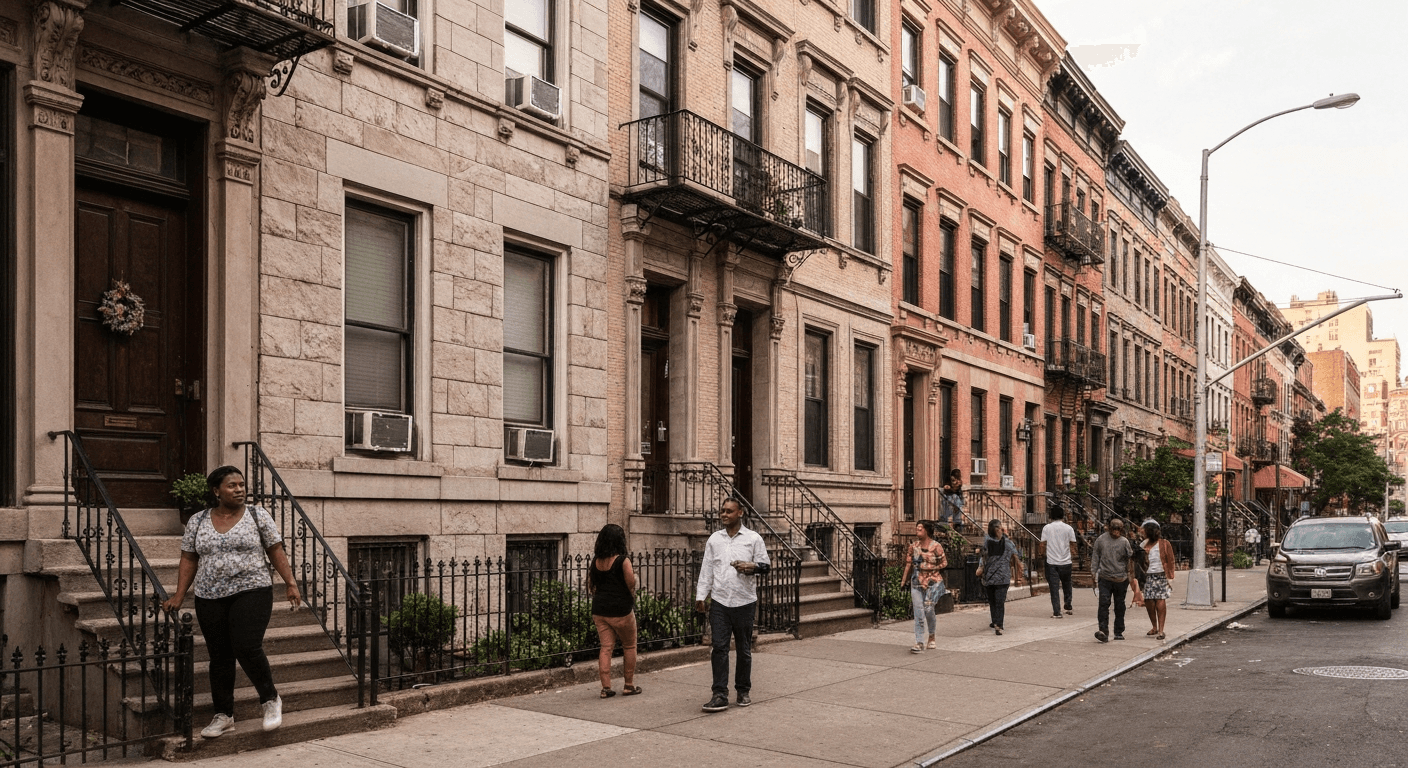
Crown Heights is Brooklyn's most culturally layered neighborhood — a place where Caribbean carnival traditions, Jewish community life, and a new wave of young professionals coexist on streets lined with some of the borough's grandest residential architecture. Stretching from Eastern Parkway and the edge of Prospect Park southward to Empire Boulevard, and bounded by Washington Avenue to the west and Ralph Avenue to the east, Crown Heights encompasses a vast swath of central Brooklyn that is simultaneously historic and rapidly evolving. For home buyers and investors who can look past the noise of transition to see the fundamentals — spectacular building stock, superb transit, proximity to Prospect Park, and accelerating neighborhood investment — Crown Heights represents one of New York City's most compelling real estate opportunities of the decade.
What makes Crown Heights genuinely exciting is not just the price-to-quality ratio that has attracted buyers from pricier adjacent neighborhoods like Prospect Heights and Park Slope, but the authentic vitality of the community itself. Eastern Parkway, the grand 19th-century boulevard that forms the neighborhood's northern spine, is alive with energy every day of the year — families strolling the central mall, elders on benches, children at play — and absolutely electric on Labor Day weekend when the West Indian American Day Parade draws a million or more revelers in the largest Caribbean carnival celebration in North America. This neighborhood has earned its reputation, and as investment continues to pour in, those who buy here today are positioning themselves on the right side of a significant appreciation curve.
Neighborhood Overview & History
Crown Heights has a history as rich and complex as any neighborhood in New York City. The land was originally farmland and estate territory in the colonial and early American periods, with development accelerating in the late 19th century as the Brooklyn real estate boom transformed central Brooklyn from agricultural land to some of the most elegant rowhouse districts in the nation. The neighborhood's western blocks — particularly the sections north of Eastern Parkway — were developed primarily between 1890 and 1920 with limestone-faced rowhouses, neo-Renaissance apartment buildings, and gracious single-family homes that still define the streetscape today.
The 20th century brought successive waves of migration that shaped Crown Heights' character. European Jewish immigrants, particularly from Eastern Europe, settled in large numbers between the 1910s and 1940s, establishing a dense cultural and religious infrastructure of synagogues, yeshivas, and community organizations. The neighborhood is home to the world headquarters of Chabad-Lubavitch, a global Hasidic Jewish movement, centered on Kingston Avenue and Eastern Parkway — a presence that remains central to the neighborhood's identity and draws thousands of pilgrims annually to the Ohel, the resting place of the Lubavitcher Rebbe, Rabbi Menachem Mendel Schneerson.
From the 1950s onward, Crown Heights saw significant in-migration from the Caribbean — Jamaica, Trinidad and Tobago, Barbados, Guyana, and Haiti — creating what is today one of the most vibrant Caribbean-American communities in the United States. Caribbean-owned businesses, restaurants, groceries, record shops, and cultural organizations give the neighborhood's main commercial corridors — Nostrand Avenue, Utica Avenue, and Flatbush Avenue — a distinctive and irreplaceable character.
The 1991 Crown Heights riots, which followed a tragic traffic accident involving a member of the Hasidic community and a young Guyanese child, brought national attention to the neighborhood's racial and ethnic tensions. The community's subsequent three decades of dialogue, investment, and reconciliation have yielded a neighborhood that, while still diverse and occasionally complicated, has made remarkable strides toward stability and mutual respect.
The Real Estate Market
Crown Heights offers some of the most compelling real estate value in Brooklyn, particularly for buyers who are willing to tolerate a slightly longer hold period compared to already-gentrified neighborhoods. As of mid-2026, the median sale price for a home in Crown Heights ranges from approximately $750,000 to $1.1 million, depending on location and property type — a significant discount to comparable properties in Prospect Heights or Park Slope just blocks away.
The dominant residential building type in Crown Heights is the limestone-faced or brick Romanesque rowhouse, typically built between 1895 and 1920 on 20-to-25-foot-wide lots. Many have been converted to two-family or three-family configurations over the decades, and two-family properties — an owner-occupied parlor floor and garden duplex above a rental unit — are available in the $900,000 to $1.5 million range depending on block and condition. Three-family properties with positive rental cash flow are priced from $1.2 million to $2 million and represent strong investment opportunities for buyers willing to manage rental units.
The eastern portions of Crown Heights, roughly east of Nostrand Avenue, offer lower entry points but require more due diligence on condition and rental market dynamics. The western blocks near Washington Avenue and Classon Avenue — sometimes called "North Crown Heights" or informally absorbed into the Prospect Heights designation — command higher prices and have seen the most significant appreciation in recent years. A two-bedroom condominium in a gut-renovated townhouse on these blocks can sell from $850,000 to $1.2 million.
New construction has come to Crown Heights more slowly than to some adjacent neighborhoods, which has helped preserve the historic building stock but also means less inventory overall. Several new condo projects have launched along Franklin Avenue and on former industrial or vacant lots, offering buyers modern finishes in a historic neighborhood context at prices ranging from $700,000 for one-bedrooms to $1.5 million for larger units. These projects tend to sell quickly, reflecting robust demand from buyers priced out of Prospect Heights.
The rental market in Crown Heights remains strong. One-bedroom apartments rent for $2,400 to $3,200 per month, and two-bedrooms for $3,000 to $4,200, with higher rents achievable in fully renovated brownstone units. For investors, the combination of lower purchase prices relative to adjacent neighborhoods and solid rental demand creates better yield potential here than in many other Brooklyn markets.
Lifestyle & Amenities
Crown Heights has experienced a remarkable restaurant and café renaissance over the past decade. Franklin Avenue — from Eastern Parkway south to Lefferts Avenue — has emerged as the neighborhood's premier dining corridor, with options ranging from Caribbean home cooking to farm-to-table American cuisine. Glady's is a beloved neighborhood staple offering exceptional jerk chicken and rum cocktails in a warm, year-round garden setting. Café Erzulie on Franklin Avenue blends Caribbean flavors with a Brooklyn sensibility, while Hart's on Lincoln Place serves sophisticated modern American food that draws diners from across Brooklyn.
For Caribbean food authenticity, Nostrand Avenue and Utica Avenue offer an abundance of Trinidadian roti shops, Jamaican patty establishments, and Guyanese bakeries that cannot be found at the same density anywhere else in New York City. The Crown Inn on Brooklyn Avenue is a neighborhood institution, and the Caribbean food markets along Nostrand Avenue stock produce, seasonings, and ingredients that cater to a community that cooks seriously.
Proximity to Prospect Park is one of Crown Heights' most underrated amenities. Lefferts Gardens, the historic district just south of the park's Willink entrance, gives Crown Heights residents direct access to the park's southern meadows, the Lefferts Historic House Museum, and the zoo. The Crown Heights community has invested significantly in local parks as well — St. John's Park and Brower Park both serve as active neighborhood gathering spaces.
The Brooklyn Museum and Brooklyn Botanic Garden, both on Eastern Parkway, are within walking distance of the neighborhood's northern blocks, giving residents access to world-class cultural programming. The Brooklyn Children's Museum at 145 Brooklyn Avenue — the world's first museum built specifically for children — is a beloved Crown Heights institution drawing families from across the borough.
Schools & Education
Crown Heights families have access to a mix of public school options across Community School Districts 13 and 17. P.S. 161 (The Crown) at 330 Crown Street has historically served as a neighborhood anchor school. P.S. 189 (The Bilingual Center) at 797 Marcy Avenue provides bilingual programming. P.S. 316 on Classon Avenue serves the neighborhood's western edge. For academically ambitious students, K-12 admissions processes open access to New York City's specialized high schools, including Brooklyn Technical High School in Fort Greene, which is accessible via Eastern Parkway subway service.
The Hasidic community operates an extensive network of private religious schools — yeshivas and Torah day schools — primarily serving the Lubavitcher community in the neighborhood's eastern sections around Kingston Avenue. These institutions include Central Lubavitch Yeshiva and Beth Rivkah Schools for girls, which together form the educational backbone of the Chabad community.
For families focused on public school quality, the NYC school choice process allows Crown Heights residents to apply to magnet programs, gifted and talented programs, and specialized middle and high schools throughout the city. Several charter schools have opened in and around Crown Heights in recent years, adding further options for families willing to navigate the admissions landscape.
Transportation & Commute
Crown Heights is superbly connected to the rest of New York City by subway and bus. The 2 and 3 express trains stop at Eastern Parkway–Brooklyn Museum at the neighborhood's northern edge, and at Nostrand Avenue one stop east — putting Midtown Manhattan approximately 25 to 30 minutes away. The 4 and 5 trains stop at Franklin Avenue, expanding options and providing redundancy for commuters who depend on a reliable subway. The A and C trains run along Nostrand Avenue via the Nostrand Avenue station, providing access to lower Manhattan and JFK Airport.
Bus service on Nostrand Avenue (the B44/B44 SBS), Flatbush Avenue, Utica Avenue (the B46/B46 SBS), and Eastern Parkway provides extensive crosstown and north-south coverage. The B44 Select Bus Service offers faster limited-stop service connecting Crown Heights to Williamsburg, Bedford-Stuyvesant, and eventually to Bay Ridge. The MTA's bus rapid transit expansion has meaningfully improved transit quality on these corridors in recent years.
For commuters headed to Long Island or Manhattan via commuter rail, the LIRR's Atlantic Terminal is accessible via the 2/3 train (three stops) or a roughly 20-minute walk, providing a 20-minute express connection to Penn Station. The neighborhood's overall transit score is among the highest in Brooklyn — nearly every daily destination is reachable without a car, making Crown Heights particularly attractive to car-free buyers.
Buying vs. Renting
Crown Heights currently offers a more favorable buy-versus-rent calculation than most Brooklyn neighborhoods, particularly for buyers purchasing multi-family properties. A well-maintained two-family townhouse purchased at $1.2 million, with a two-unit rental income supplementing the owner-occupant's mortgage, can generate a cash flow position that approaches neutrality even at current interest rates — something nearly impossible in Prospect Heights or Park Slope at comparable price points.
For single-family condo buyers, the calculus depends heavily on specific unit pricing and mortgage terms, but Crown Heights' below-average entry price and above-average appreciation trajectory over the past decade (properties have approximately doubled in many sections since 2012) make a strong case for ownership over long-term renting. Renters planning to remain in New York City for five or more years should seriously consider whether continuing to rent is the wisest financial path, particularly given the accelerating rental market that makes long-term rent stability difficult to count on.
Who Should Live Here
Crown Heights draws a wonderfully eclectic mix of residents. Young professionals, particularly those priced out of Prospect Heights or Park Slope, find Crown Heights offers comparable transit access and better walkability than many outer Brooklyn neighborhoods at a meaningful price discount. Creative professionals — musicians, artists, writers, educators — are attracted by the neighborhood's cultural richness and authentic community character.
Families who have done their school research and identified their preferred educational path find Crown Heights' large brownstone stock ideal for the space needs of a growing household. Investors looking for positive cash flow and long-term appreciation potential — particularly those comfortable with multi-family management — will find Crown Heights one of Brooklyn's most interesting markets. The Hasidic Jewish community continues to represent a stable and established homeownership base in the neighborhood's eastern portions, while the Caribbean community provides commercial and cultural vitality across the full width of the neighborhood.
Tips for Buying in Crown Heights
Due diligence is especially important in Crown Heights, where the quality of properties varies more dramatically than in some adjacent neighborhoods. When evaluating brownstone properties, commission a thorough structural inspection that specifically examines the condition of the façade pointing, roofing, parapet walls, and rear yard drainage — common deferred maintenance issues in buildings of this age and type. Basement and cellar conditions should be carefully assessed for moisture intrusion, which is endemic in many Brooklyn rowhouses.
Understand the block-by-block dynamics before making a final offer. Crown Heights encompasses enormous variation in street character, with some blocks offering pristine historic architecture and strong owner-occupancy rates, while others have more mixed condition and ownership patterns. Work with a buyer's broker who has active Crown Heights experience and can walk you through the nuances of specific blocks.
For multi-family buyers, verify the rent roll carefully before closing — understand whether existing tenants are rent-stabilized or market-rate, as this dramatically affects the economic model of the investment. New York rent stabilization rules are complex, and mistakes in due diligence can significantly impact projected returns. Consult a real estate attorney experienced in New York landlord-tenant law before finalizing any multi-family purchase.
Conclusion & CTA
Crown Heights is a neighborhood at an inflection point — one where the fundamentals of location, transit access, architectural quality, and cultural vitality converge with real estate pricing that still represents genuine value relative to adjacent Brooklyn neighborhoods. Buyers who act thoughtfully and work with an experienced broker stand to benefit enormously from the continued evolution of this extraordinary community.
I am Farva Scott, Associate Broker at The Real Brokerage, and I have guided buyers and investors through Brooklyn's most competitive markets. Whether you are looking for your first brownstone or your next multi-family investment, I am ready to help you find the right opportunity in Crown Heights. Call me at (914) 417-9215 or visit farvascott.com to schedule a consultation and take the first step toward owning a piece of Brooklyn's most compelling neighborhood story.