East Village Real Estate Guide: Living, Buying & Investing in the East Village, NY
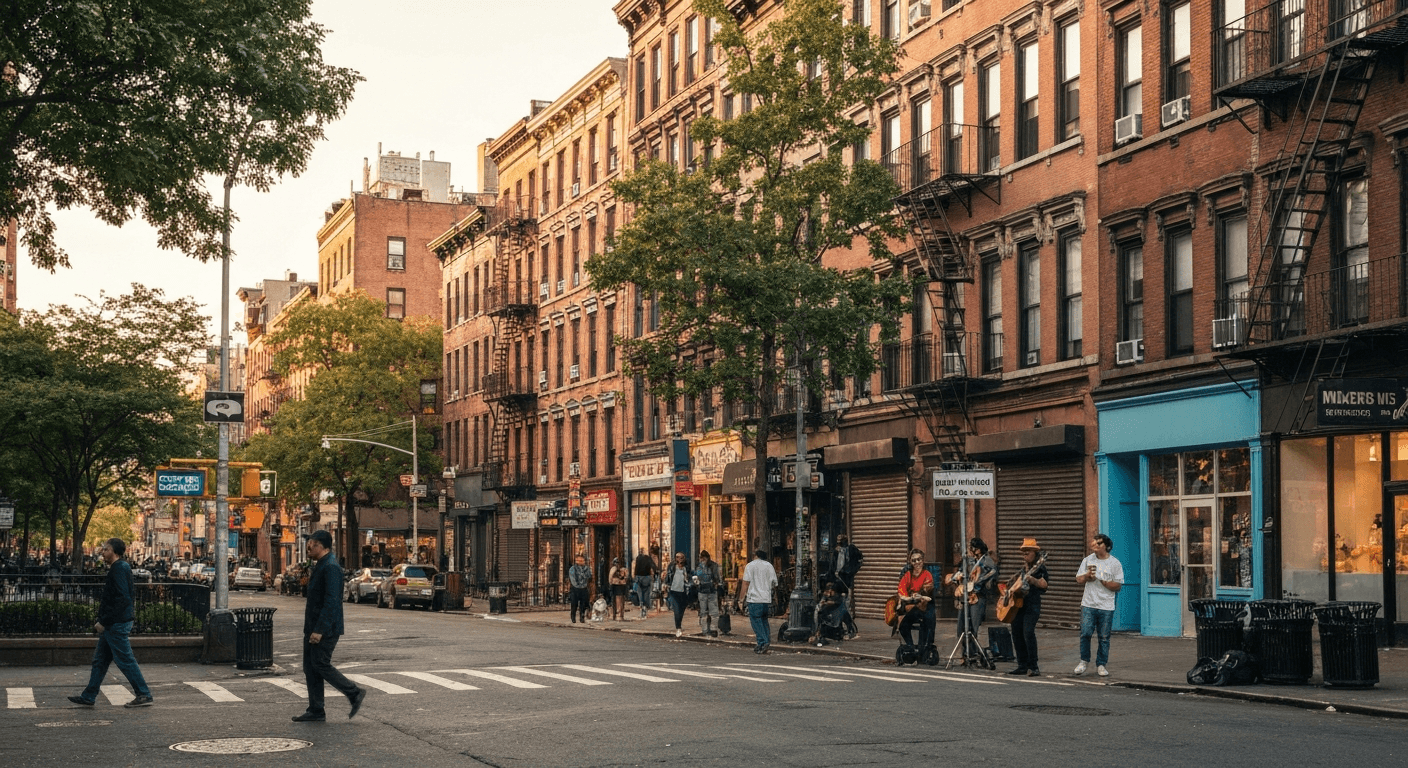
The East Village is New York City's perpetual act of creative defiance — a neighborhood that has absorbed wave after wave of immigrants, artists, activists, and reinventors without ever losing its fundamental character as a place where people come to become who they actually want to be. Bounded by 14th Street to the north, Houston Street to the south, the East River to the east, and Fourth Avenue/the Bowery to the west, the East Village packs more history, more restaurants, more creative energy, and more genuine urban texture into its roughly one square mile than most entire cities can claim. It is the neighborhood where punk rock was born at CBGB, where the Off-Broadway scene found its voice at La MaMa Experimental Theatre Club, where generations of young New Yorkers have figured out what they believed and who they were going to be.
For real estate buyers and investors, the East Village tells a compelling story about the long arc of gentrification, value creation, and neighborhood evolution in New York City. The neighborhood that was genuinely dangerous in the 1970s and 1980s — a combat zone of abandoned buildings, open-air drug markets, and squatter encampments — has become one of the most sought-after residential addresses in all of Manhattan, a destination neighborhood for young professionals, creative entrepreneurs, and design-conscious buyers who want the energy of downtown New York without the social performance of the West Village or SoHo. Yet despite this transformation, the East Village retains a grit, diversity, and authenticity that more polished neighborhoods have lost, and that authenticity is increasingly rare and valuable in a city that trends relentlessly toward the generic.
Whether you are a first-time buyer attracted by the neighborhood's cultural richness and still-competitive pricing relative to adjacent neighborhoods, an investor seeking a market with strong fundamentals and rental demand from New York University students and young professionals, or a long-term Manhattan resident looking to upgrade from a rental to ownership in a neighborhood you actually love, this guide gives you everything you need to know about the East Village real estate market.
The East Village's history is a layered story of successive immigrant communities, each leaving cultural marks that are still visible on the neighborhood's streets today. The neighborhood was originally part of the Lenape land called Lenapehoking before Dutch colonization. In the 18th century, it was home to elegant farms and country estates belonging to families like the Stuyvesants, whose family chapel still stands as the oldest church in Manhattan — St. Mark's Church-in-the-Bowery at 131 East 10th Street, built in 1799 on the site of Peter Stuyvesant's original burial chapel.
The 19th century brought waves of German, Irish, and Eastern European Jewish immigrants who transformed the neighborhood into one of the most densely populated areas in the world. Tompkins Square Park, established in 1834, became the neighborhood's commons — a site for labor organizing, political rallies, and community life. The period also saw the construction of the tenement buildings that still define much of the neighborhood's streetscape, narrow five- and six-story buildings that housed immigrant families in conditions of stunning density. By the turn of the 20th century, the area had evolved into Little Ukraine and Little Italy, communities that established churches, restaurants, and cultural organizations that persist to this day — St. George Ukrainian Catholic Church on East 7th Street and the Surma Ukrainian shop on East 7th Street are living remnants of this heritage.
The mid-20th century brought Puerto Rican and Dominican migration, creating the neighborhood known as Loisaida (a Spanish phonetic rendering of "Lower East Side") and establishing the vibrant Latino community whose bodegas, community gardens, and cultural organizations remain central to the East Village identity. The 1960s and 1970s brought the counterculture, with Tompkins Square Park hosting rock concerts, Vietnam War protests, and the kind of freewheeling communal life that defined that era. The punk explosion at CBGB at 315 Bowery in the mid-1970s — with Television, the Ramones, Blondie, Talking Heads, and Patti Smith all performing on that legendary stage — made the East Village a global touchstone for transgressive creativity.
The crack epidemic devastated the neighborhood in the 1980s, and the so-called Tompkins Square Park Riot of 1988 — in which police clashed with homeless residents and activists who were protesting a park curfew — crystallized the neighborhood's tensions between gentrification and displacement. But the 1990s and 2000s brought stabilization, driven by investment, the strengthening of community land trusts, and the sheer desirability of the neighborhood's bones: beautiful brownstones, community gardens planted on formerly vacant lots, and a restaurant and bar scene that was becoming one of the most exciting in the city.
Today, the East Village is a neighborhood in equilibrium — expensive enough to signal genuine desirability, edgy enough to maintain creative energy, and diverse enough to feel authentically New York in a way that increasingly sanitized neighborhoods cannot.
The East Village real estate market offers a mix of housing types that reflects the neighborhood's layered history and variable lot sizes. The predominant housing stock consists of low-rise pre-war tenement buildings, typically five to six stories, built between 1880 and 1920. These buildings have been converted over the years into rental apartments and, increasingly, into condominium units. The conversion quality ranges widely — from meticulously renovated buildings with original details lovingly preserved to more utilitarian gut-renovations that prioritize current-use efficiency over historic character.
Small to mid-size elevator condominiums built in the post-2000 development wave offer modern floor plans, in-unit washer/dryers (a significant amenity in the East Village context), roof access, and the building amenities that younger buyers increasingly expect. Buildings like The Saint at 50 East 8th Street and various boutique developments along 2nd Avenue and Avenue B represent this newer layer of the market.
Co-operatives are common in the East Village, particularly in the blocks around St. Mark's Place, Stuyvesant Street, and the western portion of the neighborhood near Third Avenue. Many East Village co-ops are in pre-war buildings that have strong bones but older mechanical systems, and board policies range from highly restrictive to relatively investor-friendly. Understanding the co-op's financial health, subletting policy, and board culture is essential before committing to a purchase.
Townhouses — true single-family or two-family row houses — do exist in the East Village, concentrated around Stuyvesant Street (which runs diagonally and creates some of the most charming residential blocks in Manhattan) and the East 4th through 10th Street blocks between Second and Third Avenues. These properties are rare, highly coveted, and command premium prices when they come to market.
As of mid-2026, pricing in the East Village reflects its position as an established prime neighborhood. Studios typically range from $550,000 to $800,000. One-bedrooms run from $825,000 to $1.3 million, with renovated units in strong buildings achieving the top end. Two-bedrooms list from $1.3 million to $2.2 million, and three-bedrooms reach $2.5 million to $3.5 million in well-located, well-maintained buildings. The price-per-square-foot average runs approximately $1,200 to $1,500, making the East Village more affordable than the West Village (where PSF regularly exceeds $1,800 to $2,500) while still reflecting its desirability as a prime downtown Manhattan address.
Investment fundamentals in the East Village are supported by strong and consistent rental demand from New York University and The New School students and faculty, young professionals in media, technology, and creative industries, and long-term residents who rent by choice. Rental rates for one-bedrooms run $3,200 to $4,500 per month, with renovated units in quality buildings capturing premiums. The neighborhood's perpetual desirability among young New Yorkers entering the rental market ensures low vacancy rates and sustained rental income for investor-owners.
Buyer competition in the East Village has moderated somewhat from the peak years of 2020-2022 but remains active for well-priced units. Renovated one-bedrooms priced accurately will typically attract multiple offers within two to three weeks of listing. Unrenovated units and those in buildings with structural or financial issues can linger significantly longer, creating opportunities for buyers willing to take on renovation projects.
Living in the East Village means living at the center of one of the world's great restaurant neighborhoods. The density and range of dining options in the East Village is staggering even by New York standards. Momofuku Noodle Bar at 171 First Avenue — where celebrity chef David Chang built an empire that launched a thousand imitators — remains one of the city's essential dining experiences. Veselka at 144 Second Avenue, the 24-hour Ukrainian diner that has been serving borscht and pierogies since 1954, is as much a community institution as a restaurant. The vegetarian Japanese haven of Cha-An Teahouse (230 East 9th Street), the carnivore's paradise of Takahachi (85 Avenue A), and the transcendent Sri Lankan cooking at Spice & Honey represent the neighborhood's extraordinary global range.
East 6th Street — famously known as "Little India" or "Curry Row" — has evolved from a strip of almost identical Indian restaurants into a more varied block of South Asian and fusion dining. St. Mark's Place (East 8th Street between Second and Third Avenues) remains the neighborhood's main drag, lined with Japanese and Korean restaurants, vintage clothing stores, tattoo parlors, and the kind of eclectic retail that defines the East Village brand. The Essex Market at 88 Essex Street on the Lower East Side border provides a community market with food stalls, specialty food vendors, and prepared food options.
Drinking culture is a cornerstone of East Village life, and the neighborhood's bars range from the divey dive bars of Second Avenue to sophisticated cocktail destinations. Death & Co at 433 East 6th Street is one of the finest cocktail bars in the United States, a small reservation-only room where the cocktails are works of art. Rolf's German Bar at 281 Third Avenue, the legendary PDT (Please Don't Tell) speakeasy accessible through a phone booth inside Crif Dogs at 113 St. Mark's Place, and the sprawling McSorley's Old Ale House at 15 East 7th Street (established 1854, the city's oldest continuously operating bar) represent the neighborhood's drinking variety.
Cultural life in the East Village remains vital. La MaMa Experimental Theatre Club (74A East 4th Street) continues to present avant-garde theater as it has since 1961. The Public Theater, though technically in NoHo, is closely associated with the neighborhood's creative community. Anthology Film Archives at 32 Second Avenue is a world-class institution for experimental and avant-garde cinema. The neighborhood's remaining live music venues — Nublu at 62 Avenue C, Niagara at Avenue A and 7th Street — carry on the tradition of the clubs and performance spaces that defined the neighborhood's cultural identity for decades.
Tompkins Square Park (9.6 acres, bounded by Avenues A and B and 7th and 10th Streets) remains the East Village's commons — a place where dog walkers, skateboarders, chess players, families, and loafers share space in the kind of spontaneous democratic mixing that Jane Jacobs considered the essential quality of city life. The Halloween Dog Parade held there each October is one of the most charming free events in New York City.
Public school options in the East Village reflect the neighborhood's diverse community. PS 64 at 600 East 6th Street is the neighborhood's primary elementary school, serving a student body that reflects the area's cultural diversity. PS/IS 364 Academy of Excellence (AoE) serves elementary and middle school students and has received strong ratings for academic performance. District 1, which covers the East Village and Lower East Side, has been subject to ongoing conversations about integration and school choice, and the range of options available to families includes both zoned schools and District 2 schools accessible through the transfer process.
New York University's main campus is centered around Washington Square Park, directly adjacent to the East Village's western boundary, and its presence is felt throughout the neighborhood in ways that range from the cosmopolitan (access to university lectures, performances, and events) to the commercial (the density of cafes, bookshops, and casual dining that serve the NYU community). The New School's scattered campuses on West 13th Street and surrounding blocks are also walkable, and Cooper Union's distinguished free art and engineering school at 41 Cooper Square is located at the neighborhood's western edge.
Private school options within reasonable distance include The Dalton School (uptown), Friends Seminary (222 East 16th Street, effectively in Gramercy but close), and St. Brigid School (at 185 Avenue B) for families seeking Catholic education.
East Village residents enjoy exceptional transit access. The L train at 14th Street and First Avenue, 14th Street and Second Avenue, and 14th Street and Third Avenue (the latter being the 4/5/6/N/Q/R/W hub at Union Square) provides the broadest set of options. The L connects directly to Williamsburg and Bushwick in Brooklyn, making the East Village particularly attractive for residents with professional or social ties to both the Manhattan and Brooklyn creative economies.
The 6 train at Astor Place and at Bleecker Street provides direct access to Midtown's Lexington Avenue corridor. The F/M trains at Second Avenue provide service to the crosstown network connecting Brooklyn via the Queens-Midtown Tunnel corridor. The J/Z trains at Essex Street on the neighborhood's eastern boundary connect to Brooklyn and Queens via the Williamsburg Bridge.
For commuters to Midtown, the 4/5/6 express trains from Union Square reach Grand Central Terminal in approximately 8 minutes — among the fastest commutes of any Manhattan neighborhood. The 14th Street Union Square hub also connects to the 4, 5, 6, N, Q, R, and W lines, providing access to virtually every corner of the subway system within a single transfer.
Citi Bike docking stations are plentiful throughout the neighborhood, and the Second Avenue bike lane and crosstown bike infrastructure on 9th Street and other side streets provide cycling connections to the rest of the city. The neighborhood's Walk Score consistently exceeds 99, reflecting a built environment in which virtually every daily need can be met on foot.
The buy-versus-rent equation in the East Village currently presents a genuine argument for ownership, particularly for buyers who intend to stay three years or more. With quality one-bedroom rentals commanding $3,500 to $4,200 monthly and comparable owned units available at $875,000 to $1.1 million (at 20% down, generating monthly carrying costs of roughly $4,500 to $5,500), the cost gap is real but closing when equity accumulation and appreciation potential are factored in. The East Village's proven track record of price appreciation — values have risen substantially over the past two decades even accounting for cyclical corrections — supports the long-term ownership case.
For buyers who want to capture renovation upside, the East Village market rewards renovation projects more than most Manhattan neighborhoods because of the volume of older tenement stock that has not yet been updated to current standards. A unit purchased at a discount due to dated finishes and outdated kitchen and baths can generate meaningful equity through targeted renovation, particularly in buildings with strong fundamentals and desirable locations.
The East Village attracts a remarkably diverse buyer pool that reflects the neighborhood's character as a place that refuses to be defined by a single demographic. Young professionals in their late 20s and 30s — particularly those in creative, media, technology, and educational fields — represent the core buyer cohort, drawn by the neighborhood's energy, social infrastructure, and the sense that they are participating in something genuine rather than purchased. Long-term renters who have fallen in love with the neighborhood over years of renting and are now ready to commit to ownership make up another significant segment, often with deep knowledge of specific blocks and buildings that more recent arrivals lack.
Investors seeking student and young professional rental income find the East Village's proximity to NYU, The New School, and Cooper Union a reliable driver of demand. Families are less common as buyers in the East Village than in neighborhoods like the Upper West Side or Park Slope, but the families who do buy here tend to be deeply committed to the neighborhood and to its school community, which has been working hard to build quality and community pride.
Pre-war building due diligence in the East Village requires careful attention to mechanical systems. Buildings constructed in the late 19th and early 20th century may have aging boilers, plumbing stacks, and electrical panels that have been piecemeal-updated over decades without comprehensive replacement. Request detailed building financials and, for co-ops, review the board minutes from the past two to three years for any indication of deferred capital projects or assessment discussions.
For co-op purchases, understand the board's subletting policy from the outset. Many East Village co-ops have restrictive subletting rules that limit the ability to rent out your unit — a critical consideration for buyers who are not certain about their long-term plans or who are considering the unit as part of an investment strategy. Buildings with more flexible subletting policies will typically command modest premiums over comparable restricted buildings.
Flood risk is a consideration primarily for units on the east side of the neighborhood near the FDR Drive and the East River waterfront. The low-lying blocks between Avenue C and the river sit within or near FEMA flood zones, and buyers should verify current flood zone designation, required insurance, and any building-specific resilience measures for units in this zone. The city's ongoing East Side Coastal Resiliency project is working to provide improved flood protection for this area, which may affect both risk profiles and future development patterns.
Finally, pay careful attention to rent stabilization status in any building you are considering. Many East Village buildings still contain rent-stabilized units alongside market-rate apartments, and the legal and practical implications of purchasing in a mixed-stabilized building (or one with a history of stabilization) require careful legal review. New York's Housing Stability and Tenant Protection Act of 2019 significantly strengthened rent stabilization protections, and any building with remaining stabilized units requires specific legal guidance before committing to a purchase.
The East Village is one of New York City's irreplaceable neighborhoods — a place with genuine character, genuine history, and genuine community that cannot be manufactured or replicated. Its real estate market rewards buyers who approach it with knowledge, patience, and a genuine appreciation for what the neighborhood offers, and it has consistently delivered long-term value to owners who have made the commitment to put down roots in one of New York's most dynamic communities.
Farva Scott, Associate Broker at The Real Brokerage, brings extensive experience in downtown Manhattan residential real estate to every East Village transaction. Whether you are navigating the co-op approval process, evaluating renovation projects, or identifying the buildings with the strongest fundamentals in a complex and varied market, Farva's expertise is your advantage. Visit farvascott.com or call (914) 417-9215 to begin your East Village real estate journey today.