Flatiron Real Estate Guide: Living, Buying & Investing in Flatiron, NY
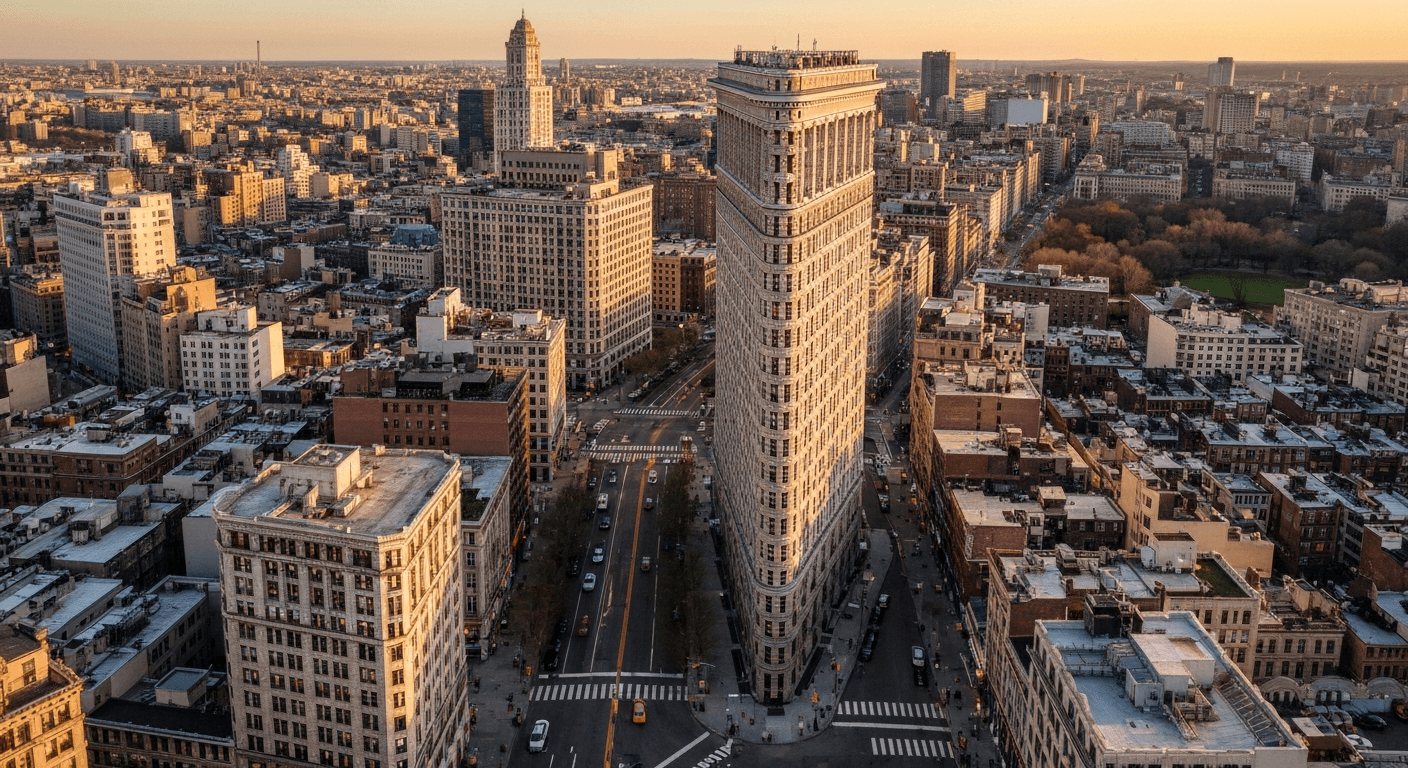
There are neighborhoods in New York City that announce themselves loudly — Times Square blazes with neon, the Financial District pulses with the energy of global capital, and the West Village charms with cobblestones and carriage houses. Then there is the Flatiron District, a neighborhood that commands attention not through spectacle but through sheer architectural confidence. Standing at the intersection of Broadway, Fifth Avenue, and 23rd Street, the Flatiron Building has been stopping New Yorkers in their tracks since 1902. It is a building so unusual, so improbably triangular, so perfectly placed, that it became the symbol of an entire neighborhood — and eventually, an emblem of New York itself.
But the Flatiron District is far more than its famous building. It is one of Manhattan's most livable neighborhoods, a place where the hustle of Midtown gives way to the creative energy of Chelsea and the Village, where tech startups share block space with century-old restaurants, and where Madison Square Park provides an unexpected green oasis right in the middle of it all. Residents here enjoy a neighborhood that is genuinely walkable in all directions — 20 minutes by foot gets you to the West Village, SoHo, Murray Hill, or the Penn Station transit hub. For home buyers and investors searching for a Manhattan address that combines prestige, livability, and long-term upside, the Flatiron District deserves serious consideration.
Whether you are a tech professional drawn to Silicon Alley, a finance executive who wants proximity to Midtown without living there, or an investor looking for a neighborhood with consistent appreciation, the Flatiron District offers a compelling case. This guide covers everything you need to know about living, buying, and investing in one of Manhattan's most dynamic neighborhoods.
The Flatiron District takes its name from the Fuller Building, commissioned by the George A. Fuller Company and designed by Chicago architect Daniel Burnham. When it was completed in 1902, the building rose 22 stories from a triangular lot — a shape created by the intersection of Broadway (which runs diagonally across Manhattan's grid) and Fifth Avenue. New Yorkers immediately dubbed it the Flatiron Building for its resemblance to a clothes iron, and the unofficial name stuck far longer than Fuller ever intended.
The neighborhood itself has deeper roots. In the late 19th century, the stretch of Broadway from 14th Street up to 23rd Street was known as the Ladies' Mile — a premier shopping corridor lined with grand department stores including Siegel-Cooper at 616-632 Sixth Avenue, B. Altman at 615-621 Sixth Avenue, and Lord & Taylor at 901 Broadway. These cast-iron commercial buildings, many still standing today, gave the neighborhood its architectural vocabulary: wide facades, large display windows, ornate cornices. When retail shifted uptown in the early 20th century, these buildings transitioned to manufacturing and wholesale uses before eventually finding new life as offices, lofts, and eventually residential conversions.
The neighborhood gained a new identity in the 1990s when it became the epicenter of Silicon Alley — New York's answer to San Francisco's tech boom. Internet startups clustered on the blocks around 23rd Street, drawn by large floor plates in converted loft buildings and rents far lower than Midtown. That identity has persisted even as rents have risen dramatically. Today, technology companies, advertising agencies, design firms, and media organizations maintain a strong presence in Flatiron, giving the neighborhood a creative, entrepreneurial energy. Beyond the Flatiron Building itself, the neighborhood's architectural landmarks include the Appellate Division Courthouse at 27 Madison Avenue, a Beaux-Arts masterpiece completed in 1900, and the Metropolitan Life Insurance Tower at 1 Madison Avenue, which was the world's tallest building when completed in 1909.
The Flatiron District's real estate market reflects both its prestige and its unique position between several of Manhattan's most desirable neighborhoods. The housing stock here is predominantly composed of two categories: converted loft buildings from the late 19th and early 20th centuries, and modern condominium towers that have risen on the neighborhood's larger parcels. Prewar co-op buildings are less common here than on the Upper East or West Sides, which gives buyers more flexibility — co-op board approvals in Manhattan can be notoriously stringent, and the relative prevalence of condominiums in Flatiron is a genuine advantage.
Prices reflect the neighborhood's desirability without quite reaching the ultra-luxury levels of Tribeca or NoHo. Studios in Flatiron typically list between $700,000 and $1.2 million, depending on building quality, floor height, and finishes. One-bedroom apartments run from approximately $1.2 million to $2 million — with larger, more distinctive units at the higher end. Two-bedroom homes trade between $2 million and $3.5 million, while three-bedroom apartments — a relatively rare product in this neighborhood — can reach $6 million and above, particularly in full-service buildings with amenity packages.
Notable buildings in the Flatiron District include One Madison, the striking 50-story tower at 23 East 22nd Street, where two- and three-bedroom residences command some of the highest prices in the neighborhood. The tower's height provides extraordinary views of both Madison Square Park directly below and the broader Manhattan skyline, and its address directly across from the park makes it one of New York's more coveted residential addresses. Also significant are the converted loft buildings on West 20th, 21st, and 22nd Streets between Fifth and Seventh Avenues — these buildings offer the high ceilings, large windows, and character that buyers seeking classic Manhattan loft living will appreciate.
For investors, the Flatiron District has historically offered strong performance. The neighborhood's stable tenant base of tech and creative professionals, combined with limited residential inventory relative to demand, has kept vacancy rates low and rental appreciation steady. A one-bedroom apartment that rents for $4,000 to $5,500 per month provides meaningful cash flow for buyers who can manage the entry price. The NoMad corridor just north of 25th Street — technically its own neighborhood but closely affiliated with Flatiron — offers slightly lower purchase prices with the same walkability and access, worth considering for buyers who want value relative to the premium Flatiron addresses.
Few Manhattan neighborhoods can match Flatiron's lifestyle offering. The anchor of it all is Madison Square Park, the 6.2-acre park that runs along Madison Avenue from 23rd to 26th Streets. The park is home to the original Shake Shack — yes, the exact concrete shack where Danny Meyer's burger empire was born in 2004 — and has been serving long lines of devotees every day since. Beyond the burgers, Madison Square Park hosts an exceptional public art program (the Oval Lawn has hosted works by major contemporary artists), a farmers market on Fridays, and seasonal programming that makes it a genuine community gathering place.
Food in the Flatiron District is exceptional across every category. Eleven Madison Park at 11 Madison Avenue is widely regarded as one of the finest restaurants in the world, a Michelin three-star experience that happens to be a short walk from the residential blocks. Eataly at 200 Fifth Avenue brings the Italian food marketplace concept to Manhattan at a sprawling 50,000-square-foot scale — you can buy groceries, eat at any of several restaurants, or simply browse imported ingredients with the same enthusiasm as a weekend in Bologna. ABC Kitchen and its sibling ABC Cocina at 35 East 18th Street define the refined farm-to-table aesthetic, while Cosme at 35 East 21st Street brings acclaimed modern Mexican cooking to the neighborhood.
For daily needs, the retail along Fifth Avenue and Broadway is comprehensive — everything from grocery stores to pharmacy chains to specialty food shops is within walking distance. Fitness options are abundant: Equinox at 15 East 26th Street, multiple boutique studios for cycling, yoga, and strength training accessible through ClassPass, and Chelsea Piers about ten blocks west offering one of New York's most comprehensive athletic facilities on the Hudson River waterfront. The dog-friendly culture here is notable — Madison Square Park's off-leash hours and the neighborhood's general pedestrian friendliness make it particularly appealing to pet owners.
Families considering the Flatiron District will find solid public school options anchored by strong District 2 schools. PS 33 Chelsea, located at 281 Ninth Avenue, serves much of the Flatiron area and has a well-regarded program. PS 11 William T. Harris at 320 West 21st Street is another District 2 elementary school with strong community involvement. Both schools benefit from the relatively high income and educational attainment of families in the area, which tends to translate to active parent organizations and supplemental programming.
Private school families have rich options nearby. The Little Red School House and Elisabeth Irwin High School at 272 Sixth Avenue is a progressive institution with a long history in Greenwich Village that draws students from across Manhattan. Friends Seminary at 222 East 16th Street, a Quaker school founded in 1786, is among Manhattan's most distinguished independent schools. For middle and high school, The High School of Fashion Industries at 225 West 24th Street is a specialized public school with strong creative programs.
Higher education institutions enrich the neighborhood's intellectual culture considerably. The New School at 66 West 12th Street, one of the most progressive universities in the country, brings a constant stream of students, faculty, and cultural events to the area. Baruch College (CUNY) at 55 Lexington Avenue draws thousands of students daily to the neighborhood. And NYU's campus, centered on Washington Square Park about ten blocks south, is close enough to feel like part of the same urban ecosystem.
The Flatiron District is one of Manhattan's best-connected neighborhoods for commuters. At 23rd Street, three separate subway lines converge: the N, Q, R, and W trains at Broadway and 23rd Street; the 1 train at Seventh Avenue and 23rd Street; and the F and M trains at Sixth Avenue and 23rd Street. This redundancy means that a power outage or service disruption on one line rarely strands residents — alternative routes are always available within a short walk.
From Flatiron, the commute to Midtown (42nd Street area) takes approximately 10 to 15 minutes by subway. Getting downtown to the Financial District takes 15 to 20 minutes. The neighborhood's central position means that virtually anywhere in Manhattan is accessible in under 30 minutes by subway. Bus service is extensive — the M1, M2, M3, and M23 all run through or near the neighborhood, providing surface alternatives on Fifth Avenue, Broadway, and crosstown on 23rd Street.
Walkability in the Flatiron District ranks among the highest in New York City, which itself ranks among the world's most walkable urban environments. The neighborhood's central Manhattan location means that residents can walk to jobs in Chelsea, the West Village, Gramercy, Murray Hill, and large parts of Midtown. Citibike stations are positioned throughout the neighborhood for cycling trips. For those occasionally needing to leave the city, the PATH train — accessible from the 23rd Street/Sixth Avenue area — connects directly to Hoboken and Newark in New Jersey.
The current rental market in Flatiron underscores just how attractive the neighborhood is. One-bedroom apartments rent for approximately $4,000 to $5,500 per month, with two-bedrooms running $6,000 to $9,000 depending on size, floor, and amenities. At those rent levels, the financial case for buying becomes compelling for anyone planning to stay in the neighborhood for five or more years. A buyer who purchases a one-bedroom for $1.5 million with a 20 percent down payment ($300,000) and a 6.5 percent 30-year mortgage faces a monthly payment of approximately $7,600 — higher than renting, but building equity in an asset with strong appreciation history rather than paying a landlord.
Flatiron prices have appreciated consistently over the past two decades, with relatively shallow dips even during the 2008 financial crisis and the 2020 pandemic. The neighborhood's fundamentals — limited residential inventory, strong tenant and buyer demand, exceptional lifestyle infrastructure, and central location — provide a durable floor under prices. Interest rates in 2025 and 2026 have stabilized after the volatility of 2022-2023, bringing qualified buyers back to the market after a period of hesitation. Inventory remains tight, which means buyers face competition, but also that owners enjoy pricing power.
The Flatiron District is ideally suited to a specific kind of New York City resident: someone who wants to be thoroughly in the city without being overwhelmed by it. Tech and finance professionals who work in Midtown or downtown appreciate the short commute and the neighborhood's relatively calm character compared to the blocks immediately around Grand Central or Times Square. Creative professionals — designers, architects, advertising and media executives — are drawn by the neighborhood's Silicon Alley heritage and the concentration of creative firms.
Young couples and dual-income households who can afford Flatiron's entry prices find it particularly appealing: the neighborhood offers excellent dining, parks, and cultural programming without the party-district noise of the Lower East Side or Murray Hill. Empty nesters who have sold larger suburban homes and want to downsize into Manhattan living discover that Flatiron's walkability, park access, and transit connections make it an exceptional choice for urban living. Investors, meanwhile, appreciate that the neighborhood's fundamentals are unlikely to deteriorate — there is simply no scenario in which proximity to Madison Square Park and multiple subway lines becomes less desirable.
Buying in the Flatiron District requires preparation and strategic thinking. Start by getting pre-approved for a mortgage before you begin touring apartments — in a competitive market, sellers and their brokers want to see proof of financing capability before accepting offers. Work with a broker who has specific experience in Manhattan's co-op and condo market, particularly the loft building conversions that make up a significant portion of Flatiron's housing stock.
If you are considering a co-op building, request at least two years of board meeting minutes and financial statements before making an offer. Co-op boards in Manhattan can reject buyers for financial reasons that seem arbitrary, and understanding a building's culture and fiscal health before bidding protects you from wasted time. Condominiums have a significantly lighter approval process but may carry higher common charges, so compare the full cost of ownership across both building types.
When evaluating specific blocks, West 21st through West 26th Streets between Fifth and Seventh Avenues often offer somewhat better value relative to premium addresses on the park. Also worth exploring are the blocks just north of 25th Street into the NoMad corridor — this area has gentrified substantially and now offers Flatiron-quality lifestyle at prices that have not fully caught up to the Flatiron premium. Finally, always commission a thorough home inspection even in luxury buildings — older cast-iron and converted commercial buildings can have outdated plumbing, electrical systems, or HVAC configurations that require expensive updates.
The Flatiron District represents one of Manhattan's most mature and consistent real estate propositions. It is not a neighborhood on the rise — it has already risen, and it maintains its position through the sheer quality of what it offers: an iconic address, extraordinary food and culture, world-class transit connectivity, and some of the most distinctive architecture in New York City. If you have been considering a move to the Flatiron District, the time to act is now, before rising demand pushes prices even further.
Farva Scott is an Associate Broker at The Real Brokerage with deep expertise in Manhattan's most competitive neighborhoods. Whether you are buying your first New York City apartment, upgrading to a larger family home, or building a real estate investment portfolio, Farva brings the market knowledge and negotiating skills that Flatiron buyers need. Visit farvascott.com to learn more or call (914) 417-9215 to schedule a consultation. Your Flatiron journey starts with one conversation.