Gramercy Real Estate Guide: Living, Buying & Investing in Gramercy, NY
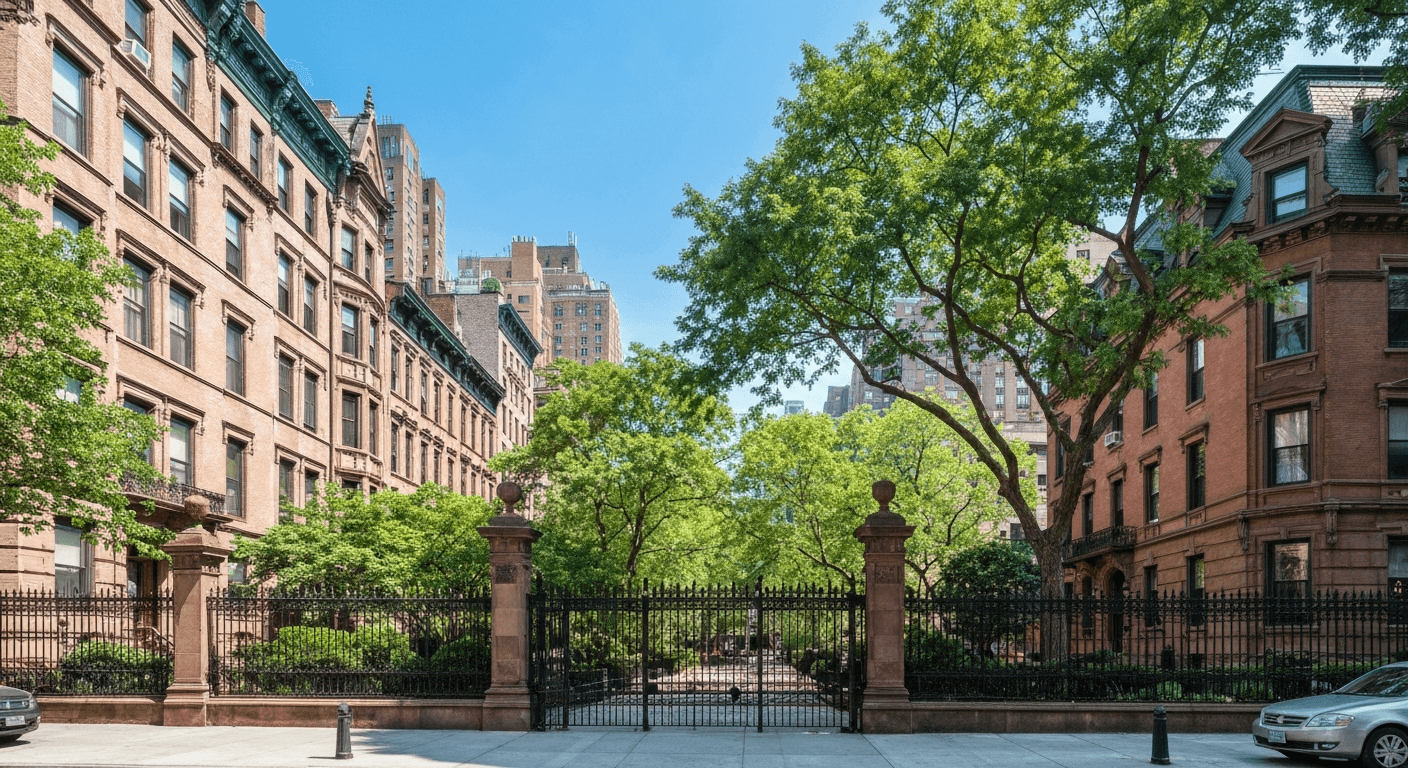
There is exactly one private park in Manhattan, and it belongs to Gramercy. The iconic iron-gated Gramercy Park, accessible only to residents of the surrounding buildings who hold one of the neighborhood's coveted brass keys, is the defining symbol of a neighborhood that has always prized quiet elegance, cultural depth, and a certain dignified remove from the frenetic pace that governs much of the city. Gramercy Park real estate is among the most consistently sought-after in all of Manhattan — not because it is flashy or trendy, but precisely because it is the opposite. This is a neighborhood of beautiful historic brownstones, landmarked pre-war apartment buildings, and some of the most gracious residential streets that New York City has to offer. Bounded roughly by 18th Street to the south, 23rd Street to the north, Park Avenue South to the west, and 3rd Avenue to the east, Gramercy occupies a central but remarkably serene corner of Manhattan that manages to feel removed from urban chaos while remaining extraordinarily well-connected to every part of the city. For buyers who have spent time in SoHo, Tribeca, or the West Village and found those neighborhoods too loud, too crowded, or too scene-driven, Gramercy often presents as a revelation — a place where people actually know their neighbors, where the architecture tells a coherent story, and where the investment case for residential real estate is supported by decades of demonstrated appreciation and scarcity.
\n\n
The story of Gramercy Park begins in 1831, when Samuel Ruggles, a New York lawyer and real estate developer with an eye for long-term value, purchased a marshy, irregular parcel of land called Krom Moerasje — "little crooked swamp" in Dutch — and set about transforming it into one of Manhattan's first planned residential neighborhoods. Ruggles drained the swamp, laid out 66 building lots around a central two-acre park, and established the covenant that still governs the neighborhood today: only residents of the surrounding buildings would have access to the park itself. The idea was borrowed from the great garden squares of London, and it worked. By the mid-19th century, Gramercy Park had become home to some of Manhattan's most distinguished residents — writers, artists, lawyers, and financiers who valued both the beauty of the park and the social cachet of an address that required a literal key to access. The Players Club, founded by actor Edwin Booth in 1888 at 16 Gramercy Park South, became a gathering place for the luminaries of the American arts — Mark Twain was a founding member, and the building's ornate Stanford White facade remains one of the neighborhood's finest architectural achievements. The National Arts Club, housed in the former Tilden Mansion at 15 Gramercy Park South, has championed the visual arts since 1898. Irving Place, the quiet, tree-shaded street running south from the park, is named for Washington Irving and carries a literary atmosphere that feels entirely appropriate to a neighborhood with this kind of cultural pedigree. The Gramercy Park Historic District, designated by the New York City Landmarks Preservation Commission, protects the neighborhood's architectural character and ensures that the brownstones, townhouses, and apartment buildings that define its streets will remain largely unchanged for generations to come.
\n\n
Gramercy Park real estate is defined by a combination of scarcity, quality, and the kind of irreplaceable location premium that only comes from being adjacent to Manhattan's only private park. The housing stock here is exceptional by any measure. Historic brownstones and townhouses on 19th, 20th, 21st, and 22nd Streets between Park Avenue South and 3rd Avenue represent some of the finest residential architecture in the city — four- and five-story row houses with original stoops, ornamental ironwork, and interior volumes that have been updated for modern living while preserving their historic character. These townhouses, when they come to market, typically trade in the range of $4 million to $10 million or more, depending on size, condition, and proximity to the park. Pre-war co-operative apartment buildings — many of them white-glove buildings with full-time doormen, live-in superintendents, and active resident communities — line the blocks surrounding the park and along Lexington Avenue and 3rd Avenue. Studios in these buildings start around $550,000 to $750,000; one-bedrooms typically trade from $850,000 to $1.4 million; and two-bedrooms range from $1.5 million to $3 million and above for the most sought-after layouts and views. Buildings that directly overlook Gramercy Park command a significant premium — apartments with park-facing exposure can carry price premiums of 20 to 30 percent over comparable units in the same building without park views. Condominium options, while less plentiful than co-ops, can be found on the neighborhood's perimeter, particularly along Park Avenue South and on select cross streets. The rental market in Gramercy is strong and relatively consistent: one-bedroom apartments rent for $3,200 to $4,500 per month in pre-war buildings, with high-floor or park-adjacent units commanding $5,000 or more. Vacancy rates are historically low, reflecting the neighborhood's appeal to established professionals who tend to stay for extended periods once they arrive.
\n\n
The Gramercy lifestyle is quieter and more considered than in many Manhattan neighborhoods, and that restraint is very much by design. The dining scene along Lexington Avenue, 3rd Avenue, and Park Avenue South offers exceptional options without the overwhelming density of the Meatpacking District or the West Village. Gramercy Tavern on East 20th Street near Park Avenue South is one of the great American restaurants — Danny Meyer's flagship has been setting the standard for hospitality-driven fine dining since 1994, and a dinner there remains one of the genuinely transcendent New York experiences. Pete's Tavern on Irving Place has been operating continuously since 1864, making it one of the oldest bars in New York City and a neighborhood gathering place with genuine historic atmosphere. Casa Mono on the corner of Irving Place and 17th Street brings the flavors of Spain with an intimate room and a wine list that ranks among the city's finest. Union Square Greenmarket, one of the premier farmers markets in the country, is a brief walk to the southwest and operates four days per week year-round, providing Gramercy residents with extraordinary access to seasonal produce, artisanal products, and an open-air community experience. Eleven Madison Park, one of the world's most celebrated fine dining restaurants, is within easy walking distance on Madison Avenue. The Flatiron Building — one of New York City's most beloved architectural landmarks — is visible from much of the neighborhood and anchors the western edge of the Gramercy district with its distinctive triangular silhouette. For day-to-day shopping, Park Avenue South and 3rd Avenue offer a well-curated mix of independent retailers, specialty grocery options, and the practical services that make urban life functional.
\n\n
Families exploring Gramercy Park real estate will find the public school landscape to be a genuine strength of the neighborhood. PS 40 Augustus Saint-Gaudens, located on East 19th Street, is the neighborhood's primary public elementary school and has developed a strong academic reputation within Community School District 2 — one of the highest-performing school districts in the New York City public school system. For families seeking additional options, District 2's school choice program allows residents to explore a variety of specialized and themed elementary programs throughout the district, which spans from Tribeca through the Upper West Side. Middle school options include Baruch College Campus High School, a respected public high school that doubles as a middle school option for some families, as well as the full range of District 2 middle school programming. Stuyvesant High School in TriBeCa, one of New York City's nine specialized high schools and consistently ranked among the finest public high schools in the nation, is accessible from Gramercy by subway in under 15 minutes. The School of Visual Arts, a highly regarded art and design college, operates multiple facilities within easy reach of the neighborhood and reflects Gramercy's longstanding connection to the visual arts. Baruch College, part of the CUNY system, sits just blocks from the neighborhood on Lexington Avenue. NYU's main campus in Greenwich Village is reachable in minutes by subway. For private school options, families in Gramercy have access to an extensive range of independent schools in the Village, on the East Side, and throughout the broader Manhattan school corridor.
\n\n
If Gramercy Park has a secret weapon among Manhattan real estate buyers, it is transportation — specifically, the neighborhood's exceptional centrality. The 4, 5, and 6 trains at 23rd Street and at 14th Street–Union Square provide local and express service along the East Side of Manhattan; the express stop at Union Square, reachable in minutes, reduces travel time to the Financial District to under 15 minutes and to Midtown to under 10. The L train at 14th Street–Union Square connects Gramercy residents directly to the Brooklyn neighborhoods of Williamsburg, Bushwick, and Bedford-Stuyvesant — an increasingly important connection for buyers with professional or social ties to north Brooklyn. The N, Q, R, and W trains at Union Square further expand connectivity, providing access to Queens and to the full length of Broadway from Battery Park to 96th Street. Bus service in the neighborhood is comprehensive: the M1, M2, and M3 run north-south on Madison and 5th Avenues; the M15 SBS provides rapid service along 1st and 2nd Avenues; and the M23 provides crosstown service along 23rd Street. What makes Gramercy's transportation profile uniquely valuable, however, is its walkability. The neighborhood's central position — roughly equidistant between the Financial District and the Upper East Side, midway between the East River and the Hudson — means that many Gramercy residents can walk to a significant number of Manhattan destinations without any transit at all. Few neighborhoods in Manhattan offer this combination of subway access and pedestrian centrality.
\n\n
For buyers deciding between renting and buying in Gramercy, the calculation is clear: the long-term investment case for ownership here is among the most compelling in Manhattan. Rental prices in Gramercy have risen to levels that make the monthly cost of renting nearly equivalent to ownership for many income levels — and unlike ownership, renting builds nothing. The neighborhood's landmark protection status means supply is constrained, new development is limited, and the inventory of available properties is perpetually small relative to demand. This structural supply constraint is one of the most reliable drivers of long-term appreciation in any real estate market, and Gramercy has benefited from it consistently for decades. For buyers who can meet co-op board requirements — typically 20 to 25 percent down payment, post-closing liquidity of one to two years of carrying costs, and a debt-to-income ratio of 28 percent or below — a pre-war co-op in Gramercy represents one of the most defensible stores of wealth in New York City real estate.
\n\n
Understanding the full range of buyers who seek Gramercy Park real estate reveals the neighborhood's broad and enduring appeal. Established professionals in law, finance, and medicine — people who have moved past their desire for the trendy neighborhoods of their 20s and are seeking substantive, quiet quality of life — represent the neighborhood's core buyer cohort. Empty nesters trading out of larger apartments uptown or suburban homes frequently select Gramercy for its combination of convenience, beauty, and community. International buyers, particularly Europeans accustomed to the aesthetic and cultural density of great city neighborhoods, respond powerfully to Gramercy's architectural coherence and its resemblance to the finest residential quarters of London or Paris. Collectors, patrons of the arts, and anyone with a deep connection to New York City's cultural life will find Gramercy's proximity to the Players Club, the National Arts Club, and the broader cultural institutions of lower Manhattan to be a meaningful quality-of-life factor. This is not a neighborhood for people chasing the newest thing. It is a neighborhood for people who have found what they are looking for.
\n\n
Buying in Gramercy requires preparation, patience, and an understanding of several neighborhood-specific factors. The most distinctive consideration is Gramercy Park key access: only residents of buildings that directly surround the park — including addresses on Gramercy Park East, West, North, and South — receive keys to the private park. Buildings one or two blocks away, while within the neighborhood, do not confer this benefit. If park key access is important to you, be explicit with your broker about targeting buildings that actually surround the park. Co-op board approval processes in Gramercy's established buildings are thorough and sometimes protracted; expect to prepare detailed financial packages, supply multiple years of tax returns, and participate in in-person board interviews. The neighborhood's landmark district status means that exterior renovations to brownstones and townhouses require Landmarks Preservation Commission approval — a process that can add time and complexity to major renovation projects, though the protections this provides to your investment are substantial. When evaluating individual units, pay close attention to the building's reserve fund, any pending assessments, and the underlying mortgage situation for co-ops — these factors significantly affect the true cost of ownership. Finally, when you find the right property in Gramercy, be prepared to act with confidence. This neighborhood has very low inventory turnover, and the best apartments frequently receive multiple offers within days of listing.
\n\n
Gramercy Park is one of Manhattan's enduring gifts — a neighborhood that has maintained its character, its beauty, and its investment value through decades of cycles, trends, and upheavals that have dramatically transformed the city around it. Buying here is not merely a financial decision; it is a statement about the kind of life you want to build in New York City. If you're ready to explore what Gramercy real estate can offer you — whether you're searching for a primary residence, a pied-à-terre, or a long-term investment — Farva Scott is ready to be your guide. As an Associate Broker at The Real Brokerage with deep expertise in Manhattan's most distinguished residential neighborhoods, Farva brings the market knowledge, professional relationships, and client-first approach to help you find exactly the right property. Visit farvascott.com or call (914) 417-9215 to begin your Gramercy search today.