Greenwich Village Real Estate Guide: Living, Buying & Investing in Greenwich Village, NY
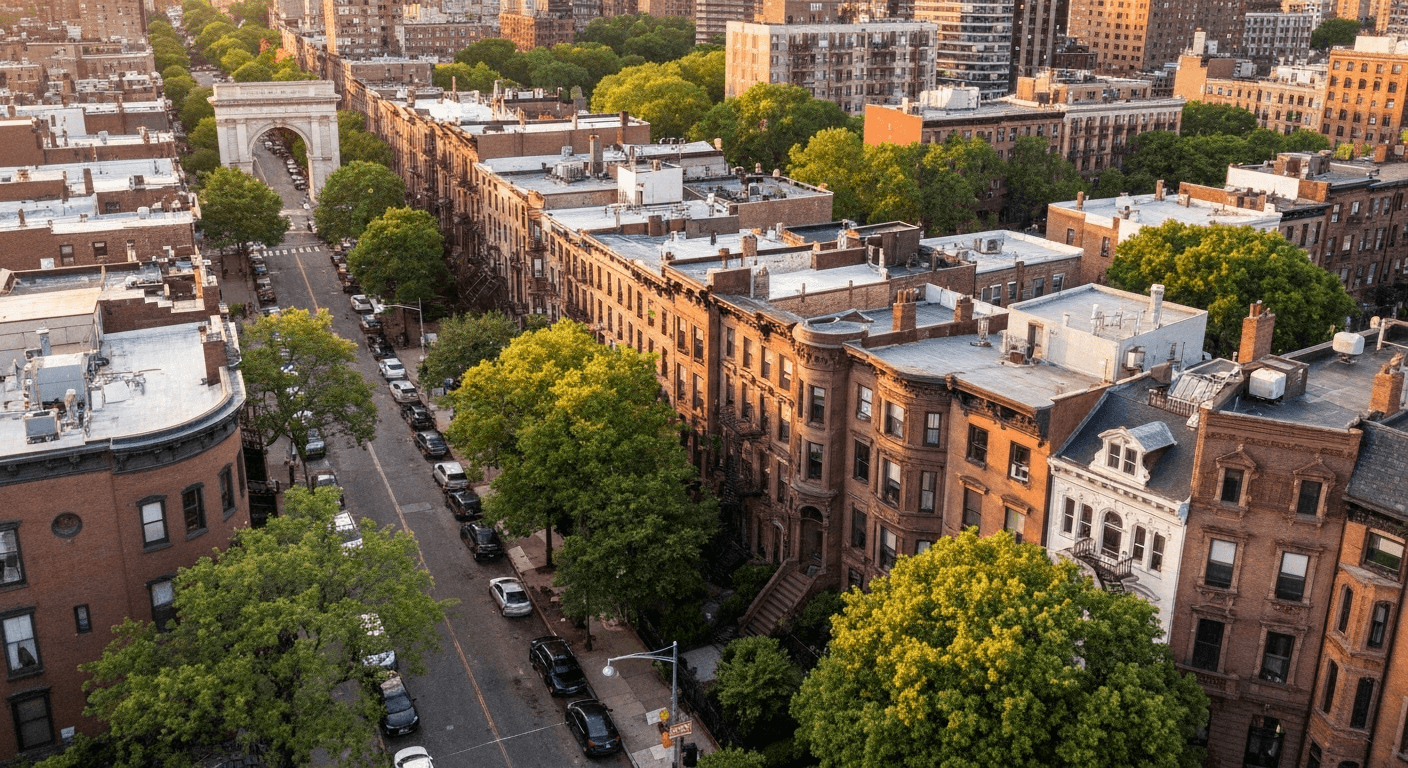
There is a certain magic that wraps itself around the cobblestone streets of Greenwich Village, a magic that has drawn poets, painters, musicians, and dreamers to these blocks for well over a century. Tucked into the southwestern corner of Manhattan below 14th Street, between the Hudson River and Broadway, Greenwich Village—affectionately called "the Village" by New Yorkers—is the city's most storied bohemian enclave. Walking down Bleecker Street at golden hour, past century-old brownstones draped in climbing ivy and coffee shops humming with conversation, it is easy to understand why so many people fall in love with this neighborhood and never want to leave.
The Village is a place of contradictions that somehow work: it is densely urban yet surprisingly intimate, historically significant yet vibrantly alive in the present, extraordinarily expensive yet stubbornly unpretentious in spirit. Washington Square Park, the beating heart of the neighborhood, draws chess players, street musicians, dog walkers, NYU students, and curious tourists together in a daily democratic gathering that feels uniquely, essentially New York. Families stroll past the iconic arch on weekend mornings while old-timers reminisce about decades past and newcomers take their first photographs in the city.
For home buyers and investors, Greenwich Village represents one of Manhattan's most sought-after addresses—and for good reason. The neighborhood offers an unmatched combination of architectural charm, cultural prestige, walkability, and access to some of the city's finest dining and entertainment. Whether you are a young professional drawn to the creative energy, a family seeking tree-lined streets and community-oriented blocks, or an investor targeting one of Manhattan's most consistently appreciated real estate markets, the Village delivers. This guide covers everything you need to know about buying and living in Greenwich Village, New York.
Greenwich Village's identity as an artistic and intellectual haven is rooted deep in its history. Originally settled by the Dutch and later developed by wealthy New Yorkers as a suburban escape from the crowded downtown streets in the early 19th century, the Village's irregular street grid—a product of old farm roads and colonial-era pathways—stands in defiant contrast to Manhattan's rigid Commissioners' Plan grid above 14th Street. This quirky layout, full of diagonal streets and unexpected corners, gives the neighborhood its distinctive, labyrinthine character.
By the mid-19th century, the Village had transformed into a fashionable residential district centered on Washington Square Park, which began life as a potter's field before being converted into a military parade ground and eventually one of Manhattan's most beloved public spaces. The Greek Revival townhouses along Washington Square North, known as "the Row," built in the 1830s, still stand today as pristine examples of antebellum Manhattan elegance and contribute to the neighborhood's landmarked character.
The Village's bohemian reputation solidified in the late 19th and early 20th centuries as affordable rents attracted writers, artists, and political radicals. The area became the epicenter of Greenwich Village's Bohemia—the American Left Bank. Eugene O'Neill wrote his early plays here; Edgar Allan Poe lived on West 3rd Street; Henry James set Washington Square in the neighborhood of his childhood. The 1960s brought a new wave of cultural revolution: Bob Dylan played his first New York gigs on Bleecker Street, the folk revival bloomed at clubs like the Bitter End and Café Wha?, and the Stonewall Inn on Christopher Street became the birthplace of the modern LGBTQ+ rights movement after the historic 1969 uprising.
Today, Greenwich Village is anchored by New York University, whose sprawling urban campus weaves through the neighborhood's streets and plazas. The cultural institutions, galleries, and performance spaces that define the Village—the Cherry Lane Theatre, the Blue Note jazz club, the IFC Center art house cinema, the LGBTQ+ History Museum—are direct descendants of this extraordinary creative legacy. The neighborhood is now a Historic District protected by the NYC Landmarks Preservation Commission, ensuring that its architectural character will be preserved for generations to come.
Greenwich Village's real estate market is among the most competitive and desirable in all of New York City. Unlike many Manhattan neighborhoods that are dominated by high-rise condominiums, the Village is defined by its low-scale, human-sized architecture: Federal-style rowhouses, Greek Revival brownstones, Italianate townhouses, and pre-war walk-up apartment buildings cluster along streets that rarely see buildings taller than six stories. This scarcity of supply relative to extraordinary demand is the defining feature of the Village real estate market.
The primary property types in Greenwich Village are co-ops, condominiums, and townhouses. Pre-war co-ops are the most abundant housing type, typically occupying the upper floors of five- and six-story buildings along streets like Bank Street, Perry Street, and West 11th Street. These co-ops often feature original details—herringbone hardwood floors, decorative fireplaces, plaster crown moldings—that buyers find irresistible. Entry-level studios and one-bedrooms in co-op buildings typically start around $600,000 to $850,000, while two-bedroom co-op apartments range from $1.2 million to $2.5 million depending on floor, light, and building quality. Three-bedroom pre-war co-ops command $2.5 million to $4 million or more.
Condominium apartments, most of which occupy newer or converted buildings, carry a price premium over co-ops because of their greater flexibility (easier financing, sublet policies, international buyer eligibility). A one-bedroom condo in the Village typically starts around $900,000, with two-bedrooms beginning at $1.5 million and climbing well above $3 million for larger or view units. Full-floor loft conversions and penthouse condos in boutique buildings regularly trade above $5 million.
The Village's townhouses are the ultimate trophy properties. Intact single-family Greek Revival and Federal-style townhouses on the most coveted blocks—West 11th Street between Fifth and Sixth Avenues, Charles Street, West 10th Street—frequently sell for $8 million to $20 million or more. Even multi-family townhouses converted into rental income properties command premiums of $5 million to $10 million based on the underlying real estate value of the land and structure.
Investment fundamentals in Greenwich Village are exceptionally strong. The neighborhood's landmark protections limit new supply, while demand from NYU faculty, finance professionals, tech executives, and international buyers remains consistently elevated. Annual appreciation has historically tracked 4–7% over the long term, with the market proving more resilient than other Manhattan neighborhoods during downturns. Vacancy rates for rental units are extremely low, making income-producing properties in the Village reliable long-term holds. The cap rates are thin (typically 2–3.5%), but the value appreciation and liquidity make the Village one of Manhattan's premier investment destinations.
Greenwich Village's lifestyle offerings are extraordinary and varied. Washington Square Park is the neighborhood's social hub, hosting outdoor concerts, chess tournaments, dog runs, and impromptu performances year-round. The park's central fountain is one of the most photographed spots in New York City and serves as a genuine community gathering point for Village residents of all ages.
The dining scene in the Village is celebrated across New York. Bleecker Street is lined with iconic food destinations: the original John's of Bleecker Street pizza, Murray's Cheese, and Amy's Bread are institutions. Via Carota on Grove Street has become one of New York's most beloved Italian restaurants, consistently packed despite no reservations. Minetta Tavern on Cornelia Street is a classic French brasserie that draws the city's power crowd. The Spotted Pig, when it was open, defined the gastropub movement in New York. L'Artusi on West 10th Street offers refined Italian-American cuisine in a sophisticated setting. For cocktails, Employees Only on Hudson Street is a perennial favorite, with bartenders who take their craft as seriously as the Village takes its art.
Shopping along Bleecker Street's western stretch—once lined with high-fashion boutiques—has settled into a charming mix of independent shops, bookstores, and vintage clothing. The Strand Bookstore's nearby location on Broadway and several independent galleries around the neighborhood cater to the intellectually curious. The Jefferson Market Garden, a community garden tucked behind the Victorian Gothic Jefferson Market Library on Sixth Avenue, is one of the Village's most beloved hidden gems.
For fitness and wellness, residents have access to multiple Equinox locations, independent yoga studios like Yoga Works, and direct access to the Hudson River Greenway for running and cycling. Chelsea Piers is a short bike ride away for more comprehensive athletic facilities.
Nightlife centers on Bleecker Street and Hudson Street, with legendary venues including the Blue Note (one of the world's premier jazz clubs), Smalls Jazz Club for late-night sets, and the Comedy Cellar on MacDougal Street, which has launched the careers of numerous major comedians including Louis C.K., Jerry Seinfeld, and Dave Chappelle.
Families considering Greenwich Village will find a neighborhood with a strong commitment to public education and a supportive community atmosphere. The anchor public school is PS 41 (Greenwich Village School) on West 11th Street, which consistently earns high ratings and serves the neighborhood's elementary-aged children with a rigorous academic program that embraces the Village's creative heritage. PS 3 (Charrette School) on Hudson Street is another well-regarded public elementary option, known for its progressive educational approach.
For middle school, District 2 students have access to several competitive screened programs including IS 70 (O'Henry Middle School) and the highly sought-after MS 51 (William Alexander) in Park Slope through the citywide middle school selection process. For high school, Village students can apply to the specialized high schools including Stuyvesant High School (located just across Chambers Street in Tribeca), Bronx Science, and Brooklyn Tech through the SHSAT, as well as to LaGuardia High School of Music & Art and Performing Arts, which perfectly mirrors the Village's creative spirit.
Private school options in and near the Village are numerous and prestigious. The Little Red School House and Elisabeth Irwin High School on Bleecker Street embody the Village's progressive educational values and have educated generations of New Yorkers in a student-centered environment. Trevor Day School, Corlears School, and Bank Street School for Children are other private options favored by Village families. New York University, whose main campus surrounds Washington Square Park, provides a university environment that infuses the neighborhood with intellectual energy and world-class cultural programming accessible to the broader community.
Transportation access from Greenwich Village is outstanding. The neighborhood is served by multiple subway lines converging near Washington Square Park and Sheridan Square. The A, C, E, B, D, F, and M trains stop at West 4th Street–Washington Square, providing direct access to Midtown (approximately 15–20 minutes to Times Square-42nd Street on the A/C/E) and to all the way to JFK Airport via the A train connection at Howard Beach. The 1 train stops at Christopher Street–Sheridan Square and at 14th Street–Seventh Avenue, providing a direct line to the Upper West Side, Penn Station, and downtown to the 1's southern terminus at South Ferry. The PATH train at 14th Street–Sixth Avenue connects Village residents to Hoboken and Jersey City in New Jersey, making it a popular choice for commuters who work in either direction.
For cyclists, Greenwich Village sits directly adjacent to the Hudson River Greenway, Manhattan's premier off-street cycling path, and is served by the Citi Bike bike-share network with numerous stations throughout the neighborhood. Walk Score rates most of the Village in the high 90s, making nearly all daily errands achievable on foot. Midtown Manhattan is approximately 25–30 minutes by subway, 40–45 minutes by foot, or 15 minutes by Citi Bike. Downtown financial district destinations are accessible in 20 minutes via subway or a pleasant 20-minute walk through Soho and Tribeca.
In the current Greenwich Village market, buyers face a fundamental question: buy or rent? The case for buying is strong despite the premium price points. The neighborhood's consistently low vacancy rate (typically under 2%) means quality rental inventory is scarce, and asking rents for desirable Village apartments are high—a one-bedroom apartment typically rents for $3,500 to $5,500 per month, while two-bedrooms command $5,000 to $8,000 monthly. When you factor in the historical appreciation rate and the tax benefits of ownership, buying in the Village makes strong financial sense for anyone planning to stay five or more years.
That said, buyers need sufficient capital—most Village co-op buildings require 20–25% down payments, and many have income and asset requirements that screen for financial stability. Cash purchases are not uncommon in this market. Renters who are not yet ready to buy should be aware that Village landlords are selective and that desirable apartments move quickly, often within days of listing.
Greenwich Village attracts an exceptionally diverse set of residents. Young creative professionals in finance, media, publishing, and the arts are drawn by the neighborhood's cultural cachet and nightlife. NYU faculty and administrators frequently choose the Village for its proximity to the university and its intellectual atmosphere. Empty nesters and retirees who have spent careers in the city often gravitate toward the Village's manageable scale and walkability. Families—particularly those with progressive educational values who prize the Little Red School House or PS 41—are a consistent presence on the tree-lined residential streets.
Investors are drawn by the stability of the asset class: Village properties rarely sit on the market long and tend to hold value exceptionally well during broader market corrections. International buyers—particularly from Europe and Asia—view the Village as a safe haven for capital investment with lifestyle benefits. The neighborhood's global name recognition and its association with American cultural history make it a perennial favorite among buyers from London, Paris, Hong Kong, and São Paulo.
Buying in Greenwich Village requires preparation, patience, and the right professional guidance. Here are the most important things to know before you make an offer:
First, understand the co-op approval process. The majority of Village buildings are co-ops, and board approval is required for every purchase. Boards evaluate buyers' financial profiles, employment, references, and sometimes conduct in-person interviews. Work with a buyer's broker experienced in the Village co-op market who can help you prepare a board package that presents your strongest case.
Second, act quickly when you find the right property. Desirable Village apartments routinely receive multiple offers within the first week of listing. Having your financing pre-approved (or proof of funds if paying cash) and your attorney on standby is essential. Delaying to "think it over" in this market often means losing the apartment.
Third, understand building specifics before making an offer. Co-op buildings have individual bylaws governing subletting, renovations, pets, and financing. Some Village co-ops are among the most restrictive in the city. Before falling in love with an apartment, have your broker confirm that the building's rules are compatible with your lifestyle and financial plans.
Fourth, invest in a thorough home inspection and review the building's financials. Pre-war buildings can have aging mechanical systems, roof issues, and other deferred maintenance. A professional inspection and a careful review of the building's board minutes, reserve fund, and underlying mortgage (for co-ops) will protect you from unexpected assessments or capital improvements after closing.
Fifth, budget for closing costs and monthly carrying costs. NYC buyer closing costs typically run 2–4% of purchase price for co-ops and 3–5% for condos (which carry Mansion Tax on purchases above $1M). Monthly carrying costs in the Village include maintenance fees (for co-ops, which cover building expenses and the underlying mortgage share) and real estate taxes. Budget these carefully with your broker and attorney.
Greenwich Village is not just a neighborhood—it is one of New York City's most enduring cultural statements. It says that creativity matters, that history is worth preserving, and that a great city block can change your life. Whether you are buying your first Manhattan apartment, trading up to a brownstone townhouse, or searching for a real estate investment that will hold its value for decades, Greenwich Village deserves serious consideration.
If you are ready to explore what the Village has to offer, Farva Scott, Associate Broker at The Real Brokerage, is here to guide you every step of the way. Farva brings deep expertise in Manhattan's most competitive neighborhoods and a commitment to finding the right property for every client. Contact her at (914) 417-9215 or visit farvascott.com to start your Village home search today. The perfect apartment—on a cobblestone street, under a canopy of ginkgo trees, steps from Washington Square Park—might be waiting for you right now.