Inwood Real Estate Guide: Living, Buying & Investing in Inwood, NY
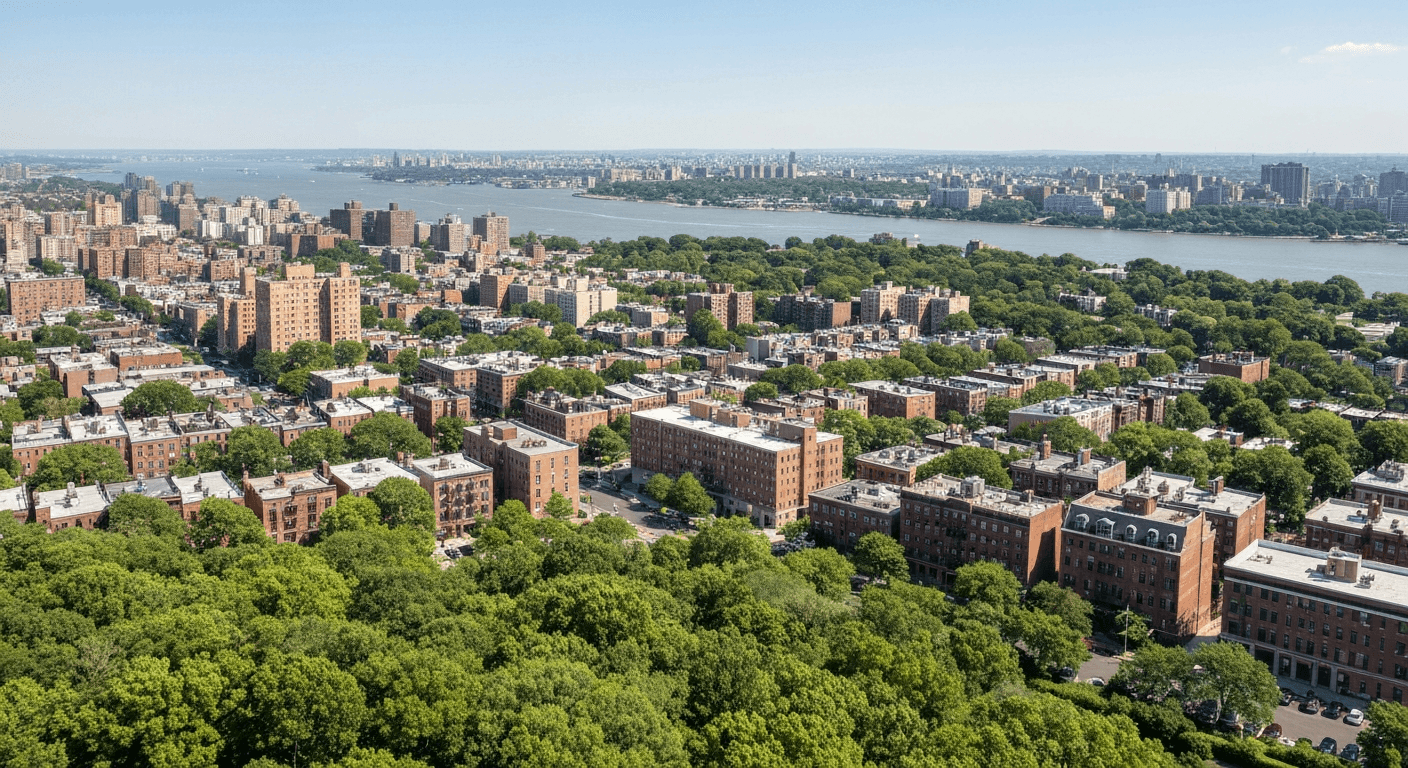
Imagine waking up on a Saturday morning in the northernmost neighborhood of Manhattan and heading out for a walk through a primeval forest — not a park with manicured lawns and paved paths, but an actual ancient forest with 200-year-old tulip trees and caves used by the Lenape people centuries ago. That's Inwood, and it's unlike any other place in New York City. Tucked above Dyckman Street between the Hudson and Harlem Rivers, Inwood has long been the city's best-kept secret — a neighborhood where Manhattan feels less like a concrete jungle and more like a place where real life happens. Families stroll along Seaman Avenue on Sunday afternoons. Neighbors greet each other by name at Inwood Hill Park. Kids play on jungle gyms within earshot of birdsong rather than traffic. And all of this sits just a 35-minute ride from Midtown Manhattan on the A or C train.
Inwood's real estate market has evolved significantly over the past decade. Once overlooked in favor of trendier enclaves downtown, Inwood is now attracting a new generation of buyers who recognize what longtime residents have known for years: this neighborhood offers extraordinary value, genuine community, and a quality of life that's increasingly rare in New York City. Whether you're a first-time buyer looking to plant roots in Manhattan, an investor seeking below-market opportunities in a neighborhood on the rise, or a family craving green space without leaving the city, Inwood deserves your serious attention.
The neighborhood is bookended by two of New York City's most remarkable green spaces: Inwood Hill Park to the northwest and Fort Tryon Park to the south. It is a neighborhood of pre-war apartment buildings, Dominican culture, farmers markets, kayak launches, and extraordinary value. This guide breaks down everything you need to know about living, buying, and investing in Inwood, NY.
Neighborhood Overview & History
Inwood's story begins long before Europeans arrived in the New World. The Lenape people — the original inhabitants of Manhattan — maintained a significant settlement in what is now Inwood Hill Park, where they fished the Hudson River and lived among the ancient forest that still stands today. In 1626, a famous transaction took place in this very neighborhood: according to historical accounts, Peter Minuit purchased the island of Manhattan from the Lenape near the Indian Cave at the northern tip of Inwood Hill Park. A plaque inside the park commemorates this moment, making Inwood arguably the birthplace of New York City itself.
European settlement came slowly to Inwood, which remained largely rural farmland until the late 19th century. The Dyckman Farmhouse, built around 1784 and located at 4881 Broadway, is the last surviving Dutch colonial farmhouse in Manhattan and serves as a living museum open to the public year-round. It anchors the neighborhood's sense of history and serves as a gathering space for community events, school trips, and cultural programming.
Urbanization accelerated dramatically in the early 20th century with the arrival of the IRT subway in 1906 and the IND line in the 1930s. Grand apartment buildings rose along Dyckman Street, Broadway, Seaman Avenue, Payson Avenue, and Riverside Drive, many featuring elaborate pre-war architecture with ornate lobbies, hardwood floors, and the generous room proportions that modern construction simply cannot replicate. The neighborhood attracted waves of Jewish, Irish, and German immigrants, followed by a large Dominican community beginning in the 1960s and 1970s that defines much of Inwood's cultural character today.
Today, Inwood is a vibrant, multicultural neighborhood with a palpable sense of community identity. Broadway and Dyckman Street form the commercial backbone, lined with Dominican restaurants, bodegas, barbershops, and an increasing number of newer cafes and boutiques. Inwood Hill Park to the north and west spans 196 acres of forest and river views, and Fort Tryon Park to the south — home to The Cloisters museum — provides sweeping Hudson River panoramas and one of the most spectacular cultural institutions in New York City.
Inwood's character is defined by paradox: it is simultaneously the most historically significant neighborhood in Manhattan (likely the site of the island's original purchase) and among its most affordable. It is the most densely forested and the most overlooked by mainstream real estate discourse. For buyers who do their homework, that paradox is an opportunity.
The Real Estate Market
Inwood's real estate market offers something increasingly rare in Manhattan: genuine affordability combined with real long-term appreciation potential. While the neighborhood doesn't have the name recognition of the West Village or the cachet of Tribeca, it offers solid value with significant upside potential as gentrification continues to move northward along the island.
The vast majority of Inwood's housing stock consists of pre-war elevator buildings — large, beautifully constructed apartment buildings erected between the 1910s and 1940s along streets like Seaman Avenue, Payson Avenue, Park Terrace West, Riverside Drive, and Cumming Street. These buildings typically feature thick plaster walls, hardwood parquet floors, generous room sizes, and architectural details — crown moldings, arched doorways, decorative cornices — that simply aren't replicated in modern construction. Many buildings retain original Art Deco lobbies with terrazzo floors and ornamental ironwork. Most are co-operative apartment buildings (co-ops), though condominiums have been introduced through new development along the waterfront and in converted buildings.
Studio apartments in Inwood co-ops typically start around $180,000 to $250,000, while one-bedrooms range from $300,000 to $450,000 and two-bedrooms from $450,000 to $650,000. Three-bedroom units — increasingly rare in Manhattan — can be found between $650,000 and $900,000. Monthly maintenance fees for co-ops range from $800 to $1,400 depending on building amenities, unit size, and underlying mortgage. Many buildings include heat and hot water in the maintenance fee, which reduces the effective cost of ownership.
For condominium buyers, newer developments near the Harlem River or along Dyckman Street can command higher prices. New construction condos have sold in the $500,000 to $900,000 range for one- and two-bedrooms, with some waterfront units pushing $1.2 million for larger layouts. These condos attract buyers who need flexibility — pied-à-terre buyers, investors interested in rental income, or purchasers who can't navigate co-op board approval processes.
From an investment perspective, Inwood presents a compelling case. The neighborhood saw significant appreciation from 2010 to 2019, with some properties doubling in value as buyers priced out of more southerly Manhattan neighborhoods discovered Inwood's value proposition. Rental demand is robust: a one-bedroom apartment in Inwood typically rents for $2,200 to $2,800 per month, while two-bedrooms fetch $2,800 to $3,500. Cap rates for multi-family properties remain more attractive here than virtually anywhere else in Manhattan.
The buyer pool in Inwood has diversified considerably. Historically, the neighborhood attracted primarily first-time buyers priced out of more expensive Manhattan zip codes. Today, it's drawing professional couples relocating from Brooklyn who want the simplicity of Manhattan transit, families who prioritize green space, and international buyers seeking below-average-for-Manhattan price points. Competition can be real: well-priced properties in desirable buildings on Payson Avenue or Seaman Avenue routinely generate multiple offers within days of listing. Properties with private outdoor space — a rarity in Inwood — command significant premiums of 15% to 25% over comparable interior units.
For investors specifically, Inwood remains one of Manhattan's last accessible multi-family markets. Three- and four-family walk-up buildings on residential side streets can still be acquired in the $1.2 million to $2 million range, producing rental yields that simply don't exist in neighborhoods south of 125th Street. The long-term investment thesis is straightforward: Inwood's quality-of-life fundamentals are strong, its transit access is excellent, and its prices remain well below comparable neighborhoods — a gap that history suggests will continue to narrow.
Lifestyle & Amenities
Living in Inwood means inhabiting one of New York City's greenest urban landscapes. Inwood Hill Park, at the neighborhood's northern edge, spans 196 acres along the Hudson River and contains the last remaining old-growth forest in Manhattan. Hiking trails wind through tulip trees, oaks, and hickories; kayak launches allow residents to paddle the Hudson; and the stone cave where legend places Peter Minuit's famous transaction creates a tangible link to the city's founding history. In warmer months, the park fills with weekend picnickers, youth soccer leagues on the meadow fields, and nature walkers escaping the city's relentless pace. The park's salt marsh at the northern tip is a critical habitat for migratory birds and a peaceful destination year-round.
Fort Tryon Park, designed by Frederick Law Olmsted Jr. and located just south of Inwood at the neighborhood's border with Washington Heights, provides sweeping views of the Palisades across the Hudson and contains The Cloisters — a Metropolitan Museum of Art branch dedicated to medieval European art and architecture, housed in a building that incorporates actual sections of European monasteries. The Unicorn Tapestries hang here. Admission is included with a standard Met ticket, and visits feel like a genuinely different world.
Dyckman Street is the neighborhood's main commercial artery and pulses with energy day and night. La Cabaña Restaurant serves traditional Dominican food to devoted regulars. Mamajuana Café blends Latin music with inventive cocktails and Dominican dishes that draw diners from across the city. Café Buunni on Vermilyea Avenue offers specialty coffee and a neighborly atmosphere that has become a hub for the neighborhood's newer residents. The Inwood Farmhouse on Vermilyea Avenue provides craft beer and inventive bar food in a relaxed, neighborhood-first setting.
The Inwood Local community garden and the Isham Park farmers market (seasonal, Saturdays) bring organic produce, local honey, and artisan goods to residents who want farm-fresh quality without leaving the neighborhood. Garden of Eden grocery along with Key Food and C-Town supermarkets provide everyday shopping. For fitness, Inwood Hill Park's trails are a year-round destination for trail runners, and the park offers free outdoor fitness equipment. Blink Fitness on Broadway provides affordable gym access, and several yoga studios and martial arts schools operate throughout the neighborhood. The Dyckman Houses Community Center provides programming for families and seniors year-round.
Nightlife in Inwood is low-key and genuine — this is not a neighborhood of trendy rooftop bars, but of local watering holes where regulars have been coming for years. The neighborhood's social life centers on its parks, its restaurants, and its community organizations, which host events throughout the year including the annual Inwood Arts Festival and neighborhood block parties that bring the community together in ways that few Manhattan neighborhoods still manage.
Schools & Education
Inwood falls within Community School District 6 (CSD 6), which covers the northernmost section of Manhattan. Public school options include P.S. 98 (The Shorac Kappock School) on Bogardus Place, which serves elementary grades and has earned recognition for strong community involvement and dual-language programming in English and Spanish. P.S./I.S. 218 (The Salomé Ureña School) is a K-8 school serving the neighborhood with particular strength in its middle school programming and active parent community.
For high school, students are zoned for George Washington High School on Audubon Avenue in Washington Heights — a large school with a storied alumni list that includes former Secretary of State Henry Kissinger. Students can also apply through the NYC specialized high school and screened school processes to attend schools citywide, including the highly regarded Beacon High School on West 61st Street and the Bard High School Early College programs.
Private school options near Inwood include Catholic schools including St. Jude School on Nagle Avenue and Good Shepherd School on Vermilyea Avenue. Families seeking non-sectarian private education typically look to schools on the Upper West Side or in Washington Heights, which are easily accessible by subway.
Higher education is readily accessible: Columbia University's main campus is a 15-minute subway ride south on the 1 train, and City College of New York (CCNY) on Convent Avenue in Hamilton Heights is even closer. Yeshiva University maintains its main campus in Washington Heights. Columbia University Irving Medical Center at 168th Street draws graduate students and faculty who live throughout the northern Manhattan corridor, adding to the neighborhood's educated professional population.
Transportation & Commute
Inwood is served by three subway lines that provide excellent connectivity throughout Manhattan and beyond. The A and C trains stop at Dyckman Street (200th Street) and at 207th Street — placing riders on the A Express, which runs without stops from 207th Street all the way to 59th Street-Columbus Circle in approximately 28 minutes and reaches Midtown's 42nd Street-Port Authority in about 33 minutes. From 207th Street, the A train reaches Fulton Street in Lower Manhattan in approximately 45 minutes.
The 1 train serves the neighborhood's eastern edge at Dyckman Street (207th Street station) and continues south through the Upper West Side to Midtown in approximately 40 minutes. During rush hour, combined frequency across the A, C, and 1 lines means wait times of 3-5 minutes during peak periods.
The MTA's M100 and M101 bus lines provide crosstown and north-south coverage for trips within the neighborhood and to destinations not served directly by subway. For commuters to New Jersey, the George Washington Bridge Bus Terminal at 179th Street (two stops south on the A train) provides direct bus connections across the GWB to dozens of New Jersey communities. The George Washington Bridge itself is bikeable, and Inwood has become a popular starting point for cyclists who ride down the Hudson River Greenway — one of the longest continuous urban bike paths in the United States — all the way to Lower Manhattan and beyond. Citi Bike has expanded its network into Inwood, with docking stations along major commercial corridors.
Inwood's walk score is approximately 95, reflecting the dense mix of services, grocery stores, restaurants, and transit within easy walking distance of virtually any residential address in the neighborhood.
Buying vs. Renting
In Inwood's current market, buying makes strong financial sense for anyone planning to stay three or more years. The combination of below-Manhattan-average purchase prices, stable rental demand, and ongoing neighborhood development creates favorable conditions for building equity. A buyer who purchases a one-bedroom co-op at $380,000 with a 20% down payment ($76,000) would carry a monthly mortgage around $1,700 plus maintenance of roughly $900-1,000, totaling approximately $2,600-2,700 per month — competitive with renting the same unit at $2,400-2,800 per month, with the added benefit of equity accumulation.
Renters benefit from relatively affordable rates compared to other Manhattan neighborhoods, particularly on two- and three-bedroom units that are scarce elsewhere. However, with Manhattan rents broadly rising and Inwood's rental vacancy rate tight, renters face annual renewal increases that erode the short-term cost advantage of renting versus buying. For anyone with the financial capacity and the intention to remain in the neighborhood for several years, the ownership case is compelling. The break-even point — after which the total cost of ownership falls below the cumulative cost of renting — is typically reached within three to four years at current price and rent levels.
Who Should Live Here
Inwood appeals to a distinct set of New Yorkers who prioritize community, green space, and value over cachet and status-signaling. Families with young children are perhaps the ideal Inwood residents: large pre-war apartments, Inwood Hill Park's playgrounds and sports fields, and a genuinely safe, walkable environment make raising kids here an authentically good experience. The neighborhood is significantly more affordable than the Upper West Side or Riverdale for comparable family-sized apartments, and the outdoor space available to children is unmatched anywhere in Manhattan.
Young professional couples who work in Midtown or Lower Manhattan appreciate the commute times (30-40 minutes on express trains) and the opportunity to own rather than rent at a Manhattan address. First-time buyers represent a significant portion of purchasers in Inwood: it is one of the few Manhattan neighborhoods where a first-time buyer with moderate savings can realistically enter the ownership market. Retirees who have lived in the neighborhood for decades continue to age in place, contributing to the multi-generational character that gives Inwood its warmth and stability.
Investors — particularly those interested in multi-family residential buildings — find Inwood one of Manhattan's last affordable entry points, with rental yields that outperform neighborhoods to the south and a clear long-term appreciation thesis driven by the neighborhood's quality-of-life fundamentals and improving name recognition.
Tips for Buying in Inwood
Co-op purchases dominate Inwood's market, so preparation is essential before you begin your search. Co-op boards typically require buyers to demonstrate post-closing liquidity of one to two years' worth of maintenance and mortgage payments. Getting pre-approved — and understanding the distinction between co-op financing pre-approval and standard mortgage pre-approval — before beginning your search will save significant time and prevent disappointment.
Research the specific building before making an offer. Request the co-op's most recent financial statements, the building's reserve fund balance, and any upcoming special assessments. Buildings with strong reserves and low underlying debt are significantly more financially stable and easier to resell. Avoid buildings with structural issues, facade violations (Local Law 11 filings are public record), or a high proportion of investor-owned units, which can create friction in the board approval process.
Move quickly on desirable listings. Properties in sought-after buildings on Payson Avenue, Seaman Avenue, or with park views frequently go into best-and-final offer rounds within the first week of listing. Having a real estate attorney lined up in advance and your financial documents organized can make the difference between winning and losing a competitive offer situation. Finally, engage a broker with specific Inwood experience — the neighborhood has its own rhythms, buildings, and board requirements that neighborhood specialists navigate most effectively.
Conclusion
Inwood is one of New York City's most underappreciated stories in real estate — a neighborhood that offers Manhattan's finest green spaces, genuine community character, pre-war housing stock that can't be replicated, and price points that remain accessible to a broad range of buyers and investors. Whether you're drawn by the ancient forest in Inwood Hill Park, the Dominican culinary culture on Dyckman Street, the 30-minute express ride to Midtown, or simply the opportunity to own in Manhattan at a price that doesn't require a trust fund, Inwood has something real to offer. The neighborhood rewards buyers who look past conventional wisdom and make decisions based on fundamentals — and those fundamentals have never been stronger.
If you're ready to explore what Inwood has to offer — or if you want expert guidance on buying or investing in this neighborhood — reach out to Farva Scott, Associate Broker at The Real Brokerage. Call (914) 417-9215 or visit farvascott.com to schedule a consultation and start your Inwood real estate journey today.