Little Italy Real Estate Guide: Living, Buying & Investing in Little Italy, NY
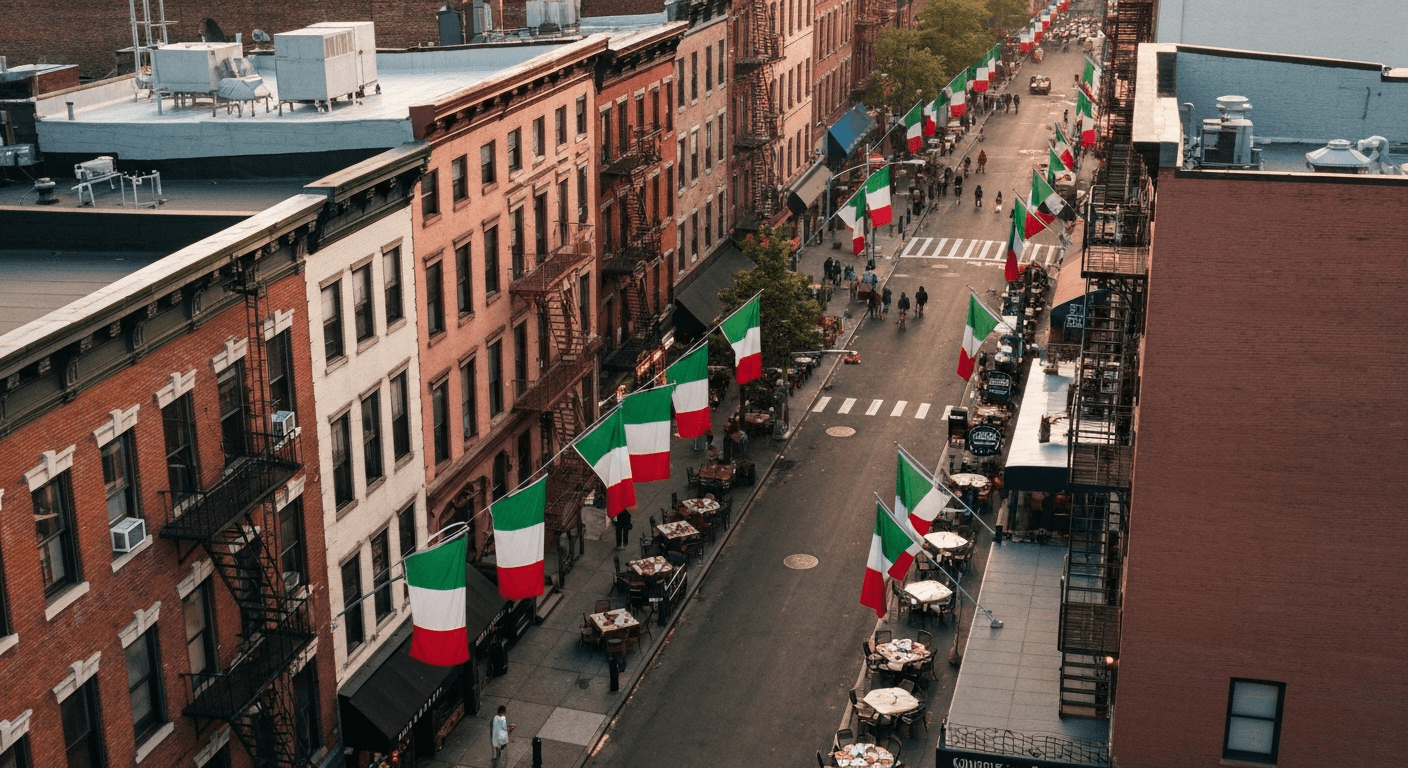
Few neighborhoods in New York City carry the weight of history as lightly — or as joyfully — as Little Italy. Wedged between SoHo to the north, Chinatown to the south and east, and NoLiTa to the northwest, Little Italy stretches primarily along a magnificent stretch of Mulberry Street between Canal Street and Kenmare Street. The smell of fresh cannoli from Ferrara Bakery, the red-checkered tablecloths at Umberto's Clam House, the annual Feast of San Gennaro filling Mulberry Street with lights and laughter every September — these are the touchstones of a neighborhood that, even as it has shrunk to just a few precious blocks, retains enormous cultural gravity in the city's imagination and its real estate market.
For home buyers and investors, Little Italy occupies a fascinating position. Its tiny footprint means inventory is extremely limited, which translates directly into premium prices and fierce competition when units do come to market. Co-ops and condominiums in the area blend pre-war elegance with modern renovations, drawing buyers who want proximity to SoHo's designer boutiques, the Lower East Side's vibrant restaurant scene, and Tribeca's waterfront, all while living in one of Manhattan's most photographed streetscapes. The neighborhood's Walk Score of 99 means virtually every daily errand — groceries, coffee, transit, dining — is accomplished on foot.
Living in Little Italy means waking up surrounded by the physical evidence of New York's remarkable immigrant story. You're steps from Lombardi's at 32 Spring Street, widely recognized as America's first pizzeria (in operation since 1905). You're minutes from the Brooklyn Bridge, City Hall, and the Financial District. This is a neighborhood where Old World character and cosmopolitan sophistication coexist on a single block — where a 19th-century cast-iron building houses a rooftop terrace apartment overlooking a street that hasn't changed much since the 1920s.
Little Italy's origins trace to the mass immigration waves that swept through Ellis Island from the 1880s through the 1920s. Southern Italian immigrants — primarily from Naples, Sicily, and Calabria — settled densely in the blocks surrounding Mulberry, Mott, and Elizabeth Streets. At its peak in the early 20th century, the neighborhood housed over 10,000 Italian-Americans and was a self-contained world of tenement life, pushcart markets, social clubs, and Catholic churches. Old St. Patrick's Cathedral, completed in 1815 at 263 Mulberry Street, served as the spiritual anchor of the community and remains a national historic landmark today, drawing Catholic pilgrims and architectural tourists from around the world.
The neighborhood's character began to shift dramatically after World War II, as second and third-generation Italian-Americans moved to the outer boroughs and New Jersey suburbs. Simultaneously, neighboring Chinatown expanded northward, absorbing many of the original blocks that had once been part of the Italian district. By the 1980s, the neighborhood's "official" boundaries had contracted to roughly a five-block corridor along Mulberry Street.
Despite its diminished footprint, Little Italy's cultural identity endures with remarkable stubbornness. The Feast of San Gennaro, held every September since 1926, remains one of New York's most beloved street festivals, drawing over one million visitors annually to Mulberry Street for sausage sandwiches, cannoli-eating competitions, and carnival games. The neighborhood's streetscape — cast-iron buildings, painted murals, vintage storefronts — feels like a stage set for a Scorsese film, which is not coincidental: Martin Scorsese filmed Mean Streets here in 1973.
Notable landmarks include the magnificent Puck Building at 295 Lafayette Street, a Romanesque Revival masterpiece now converted to luxury loft residences and event space, and the former New York City Police Headquarters building at 240 Centre Street — a stunning Beaux-Arts building that was converted to luxury condominiums in the 1980s and remains one of lower Manhattan's most distinguished residential addresses. The San Gennaro murals along Mulberry Street and Ferrara Bakery at 195 Grand Street (in operation since 1892) maintain the neighborhood's living connection to its heritage.
Little Italy's real estate market is defined by one overriding characteristic: scarcity. The neighborhood's shrinking footprint — barely a handful of blocks in its most authentic expression — means available listings are rare and competition is intense. When properties do come to market, they typically move within days and frequently above asking price, particularly for renovated loft-style units in former commercial or cast-iron buildings that line the core blocks.
The dominant property type is the condominium, with a mix of pre-war co-ops and converted loft buildings. Many of the most desirable units occupy the neighborhood's surviving cast-iron buildings dating to the 1870s through the 1890s, offering ceiling heights of 11 to 14 feet, oversized south-facing windows, and architectural detail — exposed brick, wide-plank hardwood floors, decorative cornices — that simply cannot be replicated in new construction. The Puck Building at 295 Lafayette Street houses some of the most sought-after loft conversions in all of Manhattan, with individual units regularly trading above $3 million.
As of mid-2026, median condominium prices in the Little Italy and NoLiTa corridor hover between $1.8 million and $3.5 million for one- and two-bedroom units, with larger loft spaces frequently exceeding $5 million. Price per square foot typically ranges from $1,500 to $2,500 for finished units in established buildings, with the most premium properties commanding over $3,000 per square foot. Studio and smaller one-bedroom apartments occasionally surface in the $900,000 to $1.3 million range, though these are uncommon given the neighborhood's limited supply.
Co-op apartments, which exist in smaller numbers along the side streets, tend to run somewhat more affordable than condominiums — often 10 to 15 percent lower on a per-square-foot basis — but carry the standard co-op transaction complexity: board approval, financial scrutiny, and restrictions on subletting. For international buyers or investors seeking maximum flexibility, condominiums are almost always the preferable vehicle.
Investment dynamics in Little Italy are driven by the neighborhood's proximity to three of Manhattan's highest-value real estate zones: SoHo, Tribeca, and NoLiTa. Buyers who acquire here gain access not just to Little Italy itself but to the entire cultural, retail, and dining corridor of lower Manhattan. Short-term rental demand is enormous given the neighborhood's tourist foot traffic from domestic and international visitors drawn to Mulberry Street and the Feast of San Gennaro, though New York City's strict short-term rental regulations restrict most hosts to registered platforms only.
Long-term rental demand remains exceptionally robust. A one-bedroom apartment rents for $3,500 to $5,000 per month, and two-bedrooms command $5,500 to $8,500. These figures support gross rental yields of 3.5 to 4.5 percent — modest by outer-borough standards, but reflective of the significant capital appreciation potential in a market with severely constrained supply. New developments in the immediate area are rare given landmark protections and the preservation of historic facades across much of the district, which functions as the most important bullish factor for existing property owners.
Living in Little Italy means choosing between two very different lifestyles within the space of a few blocks. The Mulberry Street corridor itself is tourist-facing — lively, loud during festivals, and remarkably colorful at all hours. The side streets on Mott, Elizabeth, and Baxter offer a quieter residential quality that belies the tourist activity just a block away. Buyers who value peace and privacy should focus on upper floors in buildings set back from Mulberry; buyers who want to be at the center of the neighborhood's cultural energy should embrace street-facing apartments with views of the festival preparations and the distinctive cast-iron streetscape.
The neighborhood's culinary offerings are a primary quality-of-life driver. The culinary identity — built on generations of Italian-American tradition — remains vivid. Umberto's Clam House at 107 Mulberry Street has been a neighborhood institution since 1972. Ferrara Bakery & Café at 195 Grand Street has been in continuous operation since 1892. Di Palo Fine Foods at 200 Grand Street is a third-generation Italian deli and cheese shop that draws food lovers from across all five boroughs. For contemporary dining, the NoLiTa spillover delivers Cafe Gitane at 242 Mott Street, Rubirosa at 235 Mulberry Street (widely praised for thin-crust pizza), and Pasquale Jones at 187 Mulberry Street for wood-fired pizza and pasta.
For outdoor space, Columbus Park at Mulberry and Bayard Streets offers open plazas, chess tables, and impromptu music on warm days. Sara D. Roosevelt Park extends along Chrystie Street with basketball courts and playgrounds. The High Line is a 20-minute walk to the northwest, and the Hudson River Greenway is accessible within 25 minutes on foot or 10 minutes by bike.
Families considering Little Italy should be aware that the neighborhood falls within Manhattan Community School District 2. PS 130 Hernando De Soto at 143 Baxter Street is the primary zoned elementary school, well-regarded for its Chinese-English and Spanish-English dual language programs. PS 1 Alfred E. Smith at 8 Henry Street in the adjacent Financial District provides another option school. For middle school, IS 89 at 201 Warren Street in Battery Park City is consistently rated among the city's top performers and is accessible via the 1 or R trains. The specialized high school pipeline leads to Stuyvesant High School at 345 Chambers Street, one of the nation's best public high schools, reachable by a 5-minute subway ride on the 1 train from Canal Street.
Private school options within reasonable distance include the Trevor Day School, Caedmon School, and Village Community School on the West Side. NYU's main campus at Washington Square Park is a 10-minute walk northwest, and Pace University's lower Manhattan campus is equally close — making the neighborhood popular with graduate students, professors, and academic professionals.
Transit access in Little Italy is exceptional. The Canal Street station complex serves the A, C, E, J, Z, 6, N, Q, R, and W trains within a two-block radius, making it one of the most multi-modal transit hubs in all of Manhattan. The 6 train runs north along Lexington Avenue, reaching Grand Central in approximately 18 minutes. The J and Z trains cross the Manhattan Bridge to Brooklyn, reaching Williamsburg in about 8 minutes. The N, Q, R, and W trains provide direct service to Times Square in approximately 25 minutes and to Atlantic Terminal in Brooklyn in about 30 minutes. The Broadway-Lafayette Street station at Houston Street (B, D, F, M trains) is a 7-minute walk north. Walk Score: 99. Bike Score: 82.
For most buyers contemplating Little Italy, the math favors purchasing over renting — particularly those with a multi-year time horizon. The neighborhood's severely constrained supply makes meaningful appreciation likely over the medium to long term. Renting remains reasonable for buyers uncertain about their three-to-five-year trajectory: a one-bedroom at $3,800 per month is financially prudent compared to the carrying costs of a $2 million purchase. Buyers who do purchase should factor the New York City mansion tax — 1 percent at $1 million, 1.25 percent at $2 million — as part of their closing cost calculation alongside attorney fees, title insurance, and mortgage recording tax.
Little Italy draws a distinctive cross-section of buyers. The most common profile is the urban professional or couple — typically in their 30s to 50s — drawn by the neighborhood's walkability, cultural cachet, and proximity to downtown employment. Many buyers come from backgrounds in finance, media, the arts, and the law. Empty nesters seeking a Manhattan pied-à-terre frequently look here, attracted by the limited-maintenance condominium lifestyle in a neighborhood where cultural, culinary, and retail options are inexhaustible. International buyers — particularly from Italy, France, and other European countries with an appreciation for the neighborhood's heritage — represent a consistent and substantial segment of the buyer pool.
Understanding Little Italy's micro-market requires working with a broker who specializes in lower Manhattan and has active transaction experience in the Little Italy, NoLiTa, and SoHo corridor specifically. Given the small number of annual transactions, off-market deals are common, and a well-connected broker may surface opportunities before they appear on public listing platforms. For pre-war co-op buyers, conduct thorough due diligence on building financials — obtain the last three years of audited statements, review the reserve fund balance, check for pending assessments, and read recent board meeting minutes. Know the building's landmark status: many structures along Mulberry and Mott Streets sit within the SoHo-Cast Iron Historic District or adjacent protected areas, which restricts exterior modifications but also permanently protects the streetscape value you're investing in. Flip taxes — often 1 to 2 percent of sale price payable to the co-op at resale — can materially affect your exit economics and should be evaluated before any purchase.
Little Italy is one of New York City's most historically resonant and irreplaceable neighborhoods — a pocket of the city where Old World character, world-class dining, and premium Manhattan real estate converge. Its tiny footprint and landmarked streetscape mean supply will always be tight, making it one of the city's most durable bets for long-term value preservation and appreciation. Whether you're a buyer seeking a culturally rich Manhattan home, an investor targeting stable appreciation in a supply-constrained market, or simply someone who wants to live steps from some of New York's finest food and history, Little Italy warrants your closest attention.
Farva Scott is an Associate Broker at The Real Brokerage with deep expertise in lower Manhattan's competitive real estate market. Contact her at (914) 417-9215 or visit farvascott.com to schedule your consultation. Your Little Italy chapter starts here.