Morningside Heights Real Estate Guide: Living, Buying & Investing in Morningside Heights, NY
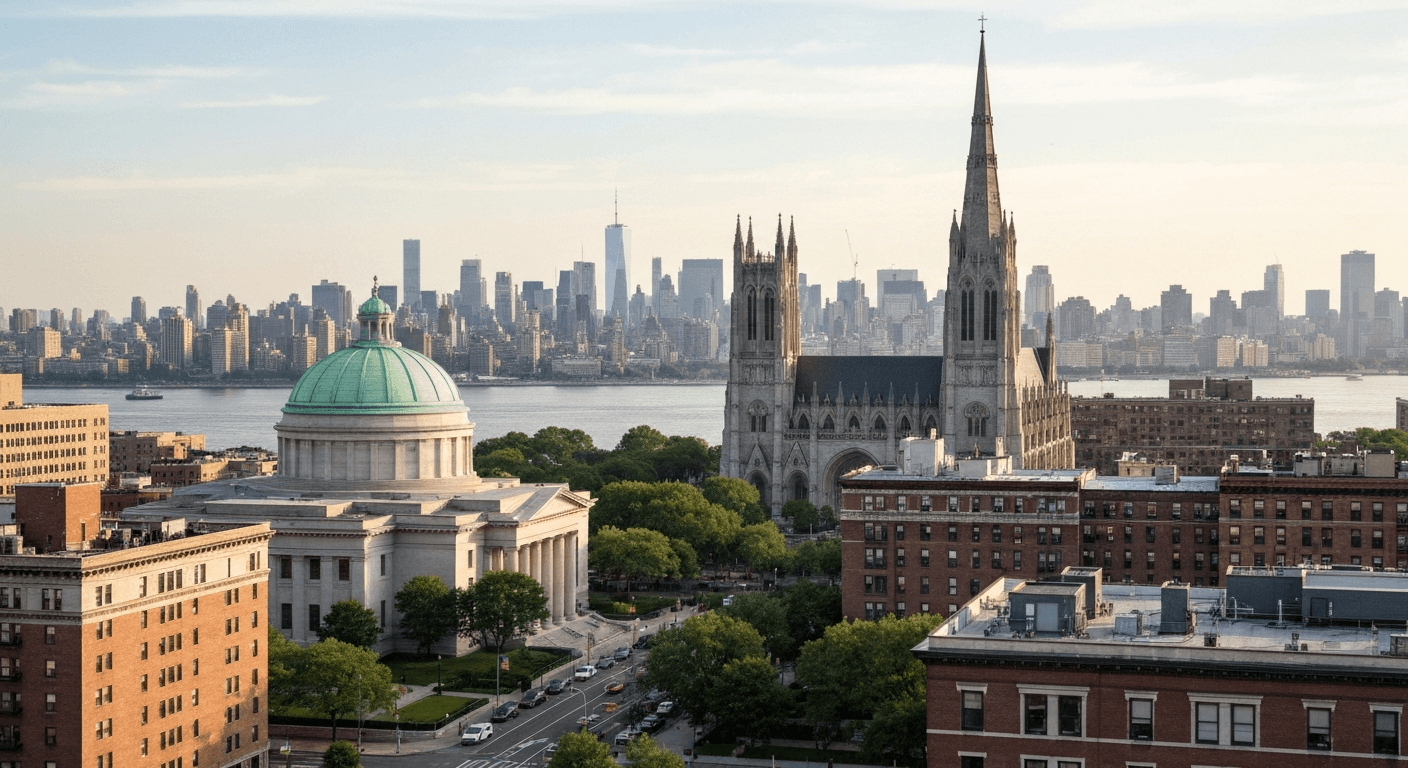
Morningside Heights has one of the most distinctive identities in all of Manhattan—it's a neighborhood that has been shaped more by institutions than by any other single force, and those institutions happen to be extraordinary. Located between 110th Street and 125th Street, roughly from Riverside Drive to Morningside Drive, the neighborhood is home to Columbia University, Barnard College, the Cathedral of St. John the Divine, Riverside Church, and the Jewish Theological Seminary, among others. This concentration of academic, spiritual, and intellectual life gives Morningside Heights an atmosphere that is unlike anything else in New York City: spirited, bookish, international, and surprisingly affordable by Manhattan standards. People love Morningside Heights for its energy—the streets hum with students, professors, researchers, and the kind of engaged urban citizens that great universities attract. But the neighborhood is also genuinely livable for non-academics: a growing restaurant and retail scene along Broadway and Amsterdam Avenue, access to two extraordinary parks (Riverside Park along the Hudson River and Morningside Park at the neighborhood's eastern edge), and a housing stock that spans pre-war co-ops, rental buildings, and a growing number of condos make this neighborhood one of Manhattan's best values. Families who want a rooted, intellectually vibrant community are increasingly choosing Morningside Heights, as are first-time Manhattan buyers who recognize that this neighborhood's time as one of the city's best undiscovered values may be running out as the market catches up to what residents already know.
Morningside Heights developed as a planned neighborhood in the late 19th century, shaped by the simultaneous arrival of major institutions that chose this plateau above Harlem—at the time considered far uptown—for its clean air, commanding views, and relatively affordable land. Columbia University relocated here from Midtown in 1897, and its neo-Gothic and Beaux-Arts campus, designed primarily by the renowned firm McKim, Mead and White, set the architectural and intellectual tone for everything that followed. The campus, centered on College Walk—the formal promenade along 116th Street between Broadway and Amsterdam Avenue—is one of the most beautiful urban university campuses in the Ivy League and one of the great public spaces in New York City. Low Memorial Library, the domed centerpiece of the campus, anchors a quadrangle ringed by Butler Library, Avery Hall (home to Columbia's architecture school, one of the finest in the world), and dozens of other academic buildings.
The Cathedral of St. John the Divine at Amsterdam Avenue and 112th Street is one of the neighborhood's most dramatic presences—an Episcopal cathedral that has been under continuous construction since 1892 and, when complete, will be the largest Gothic cathedral in the world by volume. Its nave is already longer than two football fields, and its scale gives the surrounding streets a medieval gravity uniquely stirring in an urban context. The cathedral hosts concerts of astonishing ambition (its acoustics are remarkable), major art installations, literary readings, community events, and its annual Blessing of the Animals each October, which draws neighborhood families with pets from dogs to horses in a joyfully chaotic procession through the nave.
Riverside Church at Riverside Drive and 120th Street was built with Rockefeller philanthropy and dedicated in 1930. Its 22-story neo-Gothic tower—visible from much of the Upper West Side and across the Hudson—houses the world's largest carillon, a 74-bell instrument played by a resident carillonist for concerts throughout the year. The church has historically been a center for progressive politics and social justice, hosting speeches by Martin Luther King Jr., Fidel Castro, and Nelson Mandela from its pulpit.
The neighborhood's residential blocks, particularly along Riverside Drive and Claremont Avenue, feature some of Manhattan's most gracious pre-war apartment buildings—wide-fronted limestone and brick structures with generous layouts and classical architectural detailing that would command significantly higher prices in other Manhattan neighborhoods. The mix of long-term institutional residents, Columbia faculty and staff, graduate students in every field of human inquiry, and an increasingly diverse population of families and professionals who have discovered the neighborhood's quality creates a social texture that is genuinely unlike anywhere else in the city.
Morningside Heights occupies a fascinating position in Manhattan's real estate market: it's a neighborhood where genuine value still exists, where buyers can find pre-war apartment space at prices per square foot that are meaningfully below comparable product on the Upper West Side or Upper East Side, while still offering excellent access to Midtown and a quality of life that is genuinely compelling. For buyers who have been priced out of other Manhattan neighborhoods, Morningside Heights deserves serious attention.
The housing stock in Morningside Heights is more diverse than in many Manhattan neighborhoods. Pre-war co-ops are prominent along Riverside Drive and on the large block-front buildings along Broadway and West End Avenue, with prices for two- and three-bedroom units ranging from $800,000 to $2.5 million—considerably more affordable than comparable square footage in the 70s or 80s on the Upper West Side. Buildings like 535 Riverside Drive and 620 Riverside Drive offer classic pre-war layouts with Hudson River views at prices that represent some of the best value in Manhattan. Many of these buildings were converted from rental to co-op status in the 1980s and 1990s, and the history of insider purchase prices means that some current shareholders acquired their apartments at very low basis, creating motivated sellers who can offer competitive pricing on resale.
The rental market has historically been a defining feature of Morningside Heights, with a large stock of regulated apartments and Columbia University-affiliated housing creating a somewhat unusual market structure. Columbia controls significant residential inventory around its campus, which it rents to faculty and affiliates at subsidized rates—beneficial for university employees but a factor that somewhat constrains the standard resale market in certain buildings. Buyers should work with a broker who understands which buildings are fully market-rate versus those with university affiliation complications.
New development condos have entered the Morningside Heights market over the past decade, particularly along the edges of the neighborhood toward Broadway and along 110th Street near Central Park. These projects—targeting the growing number of non-university buyers who want new construction amenities in an established neighborhood—have priced between $1,100 and $1,800 per square foot, significantly below equivalent new development in Chelsea, Tribeca, or even the adjacent Upper West Side. For buyers who want new construction without the premium pricing of trendier neighborhoods, these properties represent excellent value and offer the condo ownership advantages of easier board approval, freely sublettable units, and modern mechanical systems.
Single-family townhouses in Morningside Heights are rare but highly coveted when they come to market. A four- or five-story townhouse on a block like Claremont Avenue or Tiemann Place can range from $3.5 million to $8 million—well below comparable single-family product in the West 80s or 90s, and a compelling opportunity for buyers who want to customize a home on one of Manhattan's most architecturally coherent residential blocks.
Investment fundamentals in Morningside Heights are strong and improving. The presence of Columbia University creates a perpetual demand floor for rental housing—graduate students, postdoctoral researchers, visiting faculty, and university staff ensure that vacancy rates in the neighborhood remain extremely low year-round. A two-bedroom apartment might rent for $3,500 to $5,500 per month, providing reasonable returns given the lower purchase prices compared to neighboring areas. Columbia's own continued expansion—including the development of its Manhattanville campus along Broadway between 129th and 133rd Streets, which has already brought new academic buildings, public plazas, and retail—is driving improvements in neighborhood infrastructure and foot traffic that typically support property values.
Life in Morningside Heights revolves around its institutional anchors and a neighborhood commercial strip that has grown considerably more sophisticated in recent years. Broadway and Amsterdam Avenue are the primary retail corridors, and while the neighborhood is not yet at West Village or Upper West Side density levels for dining, it has enough quality to sustain a satisfying local food and social scene.
For dining, the standouts are diverse and genuine. Dinosaur Bar-B-Que on West 125th Street is one of New York City's great barbecue restaurants—a lively, generous establishment drawing enthusiastic lines on weekends for its ribs, brisket, and housemade sides. Pisticci on Broadway near 110th Street is a reliable neighborhood Italian that has been a Morningside Heights anchor for years, beloved for its pasta and its unpretentious warmth. The Hungarian Pastry Shop on Amsterdam Avenue at 111th Street is a neighborhood institution of a different kind: a cash-only, no-Wi-Fi coffee house where Columbia students and professors have been arguing about philosophy, literature, and politics for decades over cups of coffee and pastries. It's precisely the kind of place that defines a neighborhood's soul. Absolute Bagels on Broadway at 108th Street is widely considered one of the finest bagel shops in New York City—hand-rolled, water-boiled, baked with precision—and draws dedicated pilgrims from across Manhattan on weekend mornings. Community Food & Juice on Broadway is a neighborhood favorite for farm-to-table eating and one of the better brunches in the area.
Riverside Park is one of Morningside Heights' greatest assets—a Frederick Law Olmsted-designed masterpiece that runs along the Hudson River from 72nd Street to 158th Street. In the Morningside Heights section, the park offers expansive lawns, playgrounds, athletic courts, a dog run, a beautiful community garden, and the extraordinary Soldiers' and Sailors' Monument (accessible from 89th Street on the neighborhood's southern end). Watching the Hudson River traffic, cycling along the waterfront path, or simply reading on a bench with a view of the Palisades across the river is one of the defining pleasures of living in this neighborhood. Sunset over the river from Riverside Park is legitimately spectacular.
Morningside Park at the neighborhood's eastern edge—running between 110th and 123rd Streets along Morningside Drive—offers a more rugged landscape: rocky outcroppings, wooded paths, a pond, a community garden tended by dedicated neighborhood volunteers, and a natural amphitheater. The park separates Morningside Heights from Harlem and is a pleasant setting for morning runs, afternoon dog walks, and weekend afternoons. Cultural programming from Columbia, Barnard, and the Miller Theatre at Columbia—one of New York City's premier venues for contemporary classical music, jazz, and world music—keeps the neighborhood's intellectual and artistic life vivid throughout the academic year. Lectures, readings, film screenings, and concerts are regularly open to the public, making Morningside Heights feel genuinely culturally rich in a way that more expensive neighborhoods often don't match.
Morningside Heights falls within Community School District 3, which governs the Upper West Side and has a strong overall reputation for school quality. PS 125 Ralph Bunche School on West 125th Street and PS 145 the Bloomingdale School on West 105th Street serve the neighborhood's elementary school population with solid academic programming and genuinely diverse student bodies that reflect the neighborhood's international character.
For families seeking specialized or accelerated public options, District 3 offers dual language programs, gifted and talented tracks, and project-based learning schools that require applications. NEST+m (New Explorations into Science, Technology and Math) is a K-12 citywide gifted program accessible by subway and consistently ranked among the top public schools in New York. Manhattan School for Children (MS 333) is a well-regarded progressive school serving K-8 with strong arts and social-emotional learning programming. Specialized high schools including Stuyvesant, Bronx Science, and LaGuardia Arts are accessible by subway and regularly enroll students from Morningside Heights through competitive admissions.
Columbia University's presence makes the neighborhood feel perpetually academic in the best possible sense. Barnard College, a top-ranked liberal arts college for women affiliated with Columbia, sits directly in Morningside Heights, and the combined community of approximately 20,000 students, faculty, and staff gives the neighborhood an intellectual atmosphere invaluable for children growing up here. Programs, lectures, and cultural events from both institutions are regularly free and open to the public.
Private school options within Morningside Heights are limited, but the Upper West Side's extensive private school landscape—including Trinity School on West 91st Street, Columbia Grammar and Prep at 93rd Street, Riverside School, and the Abraham Joshua Heschel School—is accessible by subway or short taxi ride, giving families the flexibility to pursue independent school education without dramatically lengthening their daily commute. For families committed to a particular independent school, Morningside Heights offers a reasonable base from which to navigate the school day.
Morningside Heights is exceptionally well-connected to the rest of Manhattan, a fact that consistently surprises buyers who assume neighborhoods above 110th Street are somehow remote. The 1 train runs along Broadway through the heart of the neighborhood, with stops at 110th Street (Cathedral Parkway), 116th Street (Columbia University), and 125th Street. From the 116th Street station, a direct ride on the 1 train reaches Times Square in approximately 15 minutes and the Financial District in under 30 minutes. The station at 116th Street is clean, well-lit, and serves a straightforward local connection to the rest of the 1 train's route from the Bronx to South Ferry.
The A and D trains run along St. Nicholas Avenue on the east side of the neighborhood, accessible from the 125th Street station, providing express service that gets riders to 59th Street/Columbus Circle in approximately 10 minutes and reaches downtown Brooklyn, JFK Airport via the A train, and the Far Rockaway beaches. The B and C trains run along Central Park West, accessible from the western edge of the neighborhood with stops at 110th, 116th, and 125th Streets, providing another pleasant route to Midtown and the Upper West Side.
Bus service is plentiful: the M11 runs along Amsterdam Avenue, the M4 and M104 run along Broadway, and the M100 and M101 provide service along Amsterdam Avenue toward Harlem and the Bronx. Most usefully for travelers, the M60 Select Bus Service connects Morningside Heights directly to LaGuardia Airport in approximately 35 to 40 minutes—a surprisingly direct airport connection that residents learn to rely on. The M104 bus runs along Broadway to Midtown and is a useful backup during subway disruptions.
Citibike is well-deployed along Broadway and Amsterdam Avenue, and many Morningside Heights residents cycle regularly along Riverside Park's waterfront path and south along the Hudson River Greenway all the way to downtown Manhattan, a distance of about six miles manageable in under 30 minutes. The proximity to the Greenway makes biking to Lower Manhattan a legitimate and pleasant commute option during warmer months.
Morningside Heights makes an unusually compelling case for buying right now, precisely because of the gap between current prices and the trajectory of neighborhood appreciation. The neighborhood remains one of the more accessible entry points into Manhattan's residential market, but that affordability reflects perception more than fundamentals—the schools, transit, parks, and cultural life here are objectively excellent.
Currently, buying a two-bedroom co-op in Morningside Heights for $1.1 million to $1.8 million offers compelling value compared to renting a similar apartment for $3,200 to $4,500 per month—meaning that buyers who can manage the down payment often find their monthly ownership costs competitive with renting when mortgage deductions and equity accumulation are considered. The investment case is also strong: rental demand from the Columbia community creates a reliable occupancy floor, and buildings that allow subletting offer owners flexibility that many tighter co-ops don't.
For renters in Morningside Heights, the value proposition is real: prices are lower than comparable Upper West Side apartments, and the quality of life is genuinely excellent. However, given the neighborhood's trajectory—Columbia's Manhattanville campus expansion, improving retail, and the broader gentrification of upper Manhattan pushing values upward—buyers who can make the move from renting to owning in Morningside Heights are likely to look back on the decision favorably within a five-year horizon.
Morningside Heights has a wider range of ideal residents than perhaps any other Manhattan neighborhood, which is part of what makes it so energetic and interesting. Graduate students and postdoctoral researchers at Columbia, Barnard, the Jewish Theological Seminary, and the Union Theological Seminary form a significant residential constituency—these are not just transient students but serious academics who often stay in the neighborhood for five to ten years, becoming embedded members of the community and eventually transitioning from renters to buyers.
Faculty and staff at the neighborhood's universities and at Columbia University Medical Center—located at 168th Street in Washington Heights, accessible by a 15-minute subway or shuttle bus ride—represent another major buyer group. These buyers appreciate proximity to their workplace, the quality of the housing stock, and the ability to walk to campus or commute efficiently. Families who have been priced out of the Upper West Side but still want a Manhattan family experience—good schools, parks, a walkable neighborhood, cultural richness—increasingly choose Morningside Heights as the smart compromise. First-time buyers who want Manhattan homeownership at a realistic price point are strongly represented, drawn by relative affordability and the neighborhood's obvious quality.
Musicians, writers, artists, and creative professionals have long been part of the Morningside Heights fabric, attracted by the creative energy generated by the academic community and the somewhat lower cost of living compared to trendier neighborhoods like the West Village, SoHo, or Williamsburg. The neighborhood's mix of rigorous intellectualism, artistic ambition, and genuine diversity makes it unusually stimulating as a place to live and work.
Buyers entering the Morningside Heights market should start by understanding the difference between the neighborhood's rental-dominant buildings—many of which are Columbia-affiliated or have regulatory status that limits purchase options—and the co-op and condo buildings where ownership is straightforward. A broker with deep local knowledge can navigate this distinction efficiently and save buyers from falling in love with buildings that don't accommodate non-affiliated purchases.
For co-ops, Morningside Heights boards tend to be somewhat less restrictive than the famously stringent boards of the Upper East Side or prime Upper West Side, making the approval process more accessible for buyers with solid but not extraordinary financial profiles. That said, prepare your financial documents thoroughly: two years of tax returns, three to six months of bank statements, an employer reference letter, and personal references from non-family members are standard requirements. A thoughtful cover letter that describes your connection to the neighborhood and your plans for the apartment goes a long way in less formal board cultures.
Research maintenance fees carefully—some Morningside Heights co-ops carry higher-than-average maintenance due to deferred capital work in older buildings. Ask your broker to review the building's financials, including the reserve fund balance and any planned capital assessments, before making an offer. A building with a thin reserve fund is at risk of a special assessment in the near term, and that cost should factor into your purchase price analysis.
For new condos, negotiate closing cost contributions—developers in a competitive market often have flexibility to cover transfer taxes, offer rate buydowns, or provide seller concessions that reduce your out-of-pocket costs at closing. Pay attention to the Columbia University Manhattanville campus expansion plans and the new retail and public space programming planned along Broadway in the 129th to 133rd Street corridor—proximity to this expansion is likely to support values in properties on the northern edge of Morningside Heights as the campus opens additional facilities over the coming years.
Morningside Heights offers something increasingly rare in Manhattan: genuine value backed by genuine quality. The combination of Ivy League energy, extraordinary parks, excellent transit, and a housing market that still provides accessible entry points for serious buyers makes this one of the most compelling neighborhoods in New York City for buyers willing to look north of the traditional Upper West Side boundaries. The window for getting in at today's prices may not remain open forever—Columbia's continued investment and the broader gentrification of upper Manhattan are pushing values steadily upward.
If you're ready to explore Morningside Heights, Farva Scott is the right guide. As an Associate Broker with The Real Brokerage, Farva has worked with buyers across all of Manhattan's neighborhoods and can help you find the property that fits your goals, your timeline, and your budget. Visit farvascott.com or call (914) 417-9215 to start the conversation. The perfect Morningside Heights home is out there—let's find it together.