NoLiTa Real Estate Guide: Living, Buying & Investing in NoLiTa, NY
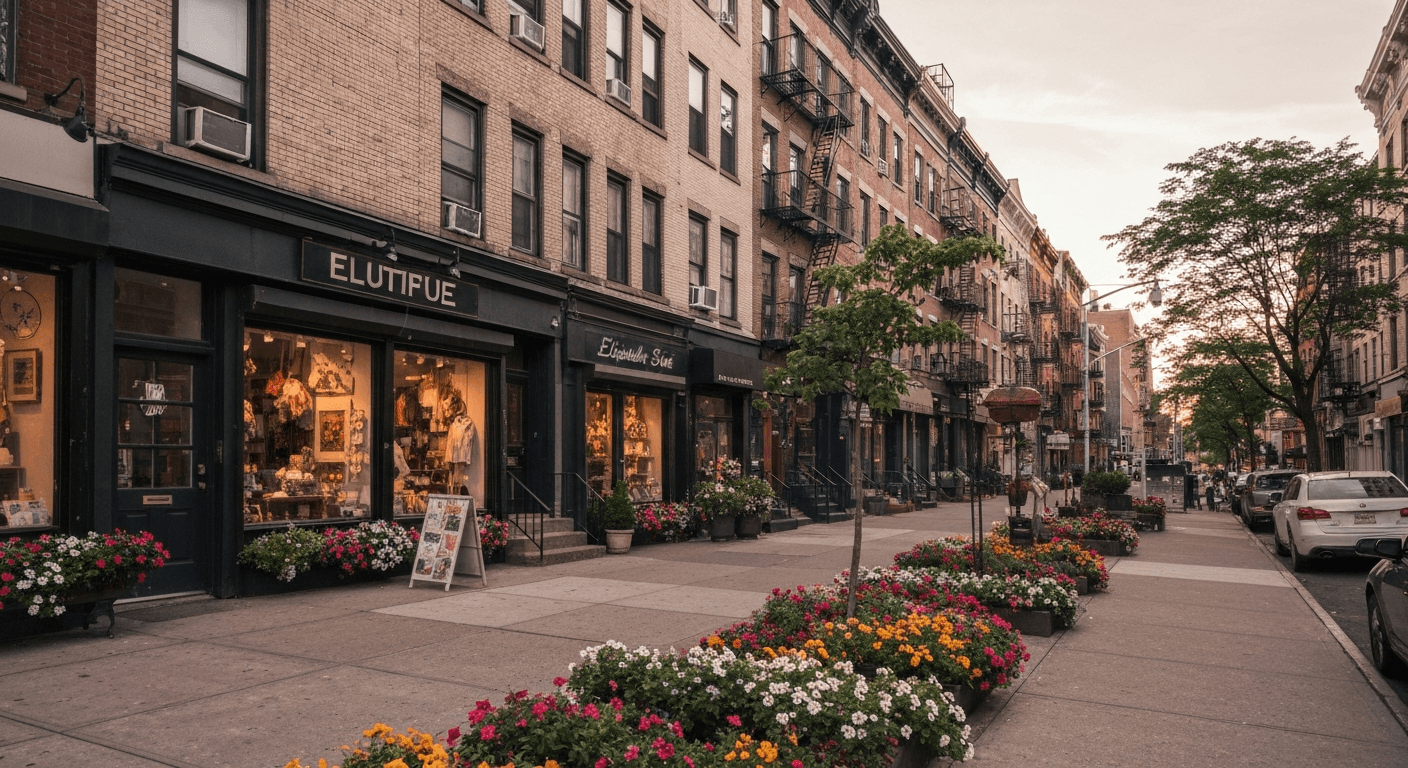
If there is one neighborhood in Manhattan that consistently makes visitors stop mid-stride, pull out their phone, and try to capture what they are looking at, it is NoLiTa. The neighborhood is not flashy. It does not have skyscrapers or famous parks or landmarks that appear on the covers of travel magazines. What it has is something far more elusive: an authentic, unhurried, deeply textured street life that feels closer to Rome's Trastevere or Paris's Marais than to the rest of New York City. Narrow streets. Low-rise tenement buildings draped in greenery. Independent boutiques spilling their inventory onto the sidewalk. The smell of coffee from Café Gitane drifting through an open window at 242 Mott Street. NoLiTa is what Manhattan would feel like if someone designed it at human scale.
NoLiTa — North of Little Italy — occupies a compact grid roughly bounded by Houston Street to the north, Broome Street to the south, Bowery and Lafayette Street to the east, and Mulberry Street to the west. It emerged as a distinct neighborhood in the mid-1990s, when real estate brokers and local business owners sought to differentiate the area from the tourist-heavy blocks of Little Italy to the south. The rebranding stuck because the neighborhood truly had earned its own identity: boutique fashion, artisan food, gallery spaces, and a residential community that was younger, more international, and less tourist-oriented than the red sauce restaurants and souvenir shops two blocks south on Mulberry.
Today, NoLiTa is one of the most sought-after residential addresses in Manhattan for a specific kind of buyer — someone who wants urban sophistication without urban anonymity, who prefers a neighborhood where the owners of the boutiques and restaurants know their neighbors, and who is willing to pay a significant premium for the experience of living on one of Manhattan's most genuinely charming blocks. For those buyers, this guide provides everything they need to understand the market, the lifestyle, and the opportunity.
NoLiTa's history runs deeper than its relatively recent rebranding suggests. The streets of Mott, Mulberry, Elizabeth, and Prince were built up in the late 19th and early 20th centuries to house waves of Italian immigrants arriving from Southern Italy and Sicily. The tenement buildings that line these streets — typically five or six stories, with narrow facades and deep lots — were constructed to house large working-class families in small apartments, with ground floors occupied by small businesses serving the community. St. Patrick's Old Cathedral at 263 Mulberry Street, completed in 1815, was the first St. Patrick's Cathedral in New York City and served as the spiritual center of the Italian immigrant community for well over a century before the current cathedral at 51st Street and Fifth Avenue took over that role.
The neighborhood maintained its Italian-American character through much of the 20th century. By the 1970s and 1980s, however, the population was shifting — younger Italian-Americans had moved to Brooklyn, Queens, and the suburbs, while new immigrants and young creative professionals discovered the area's affordable rents and extraordinary charm. Artists, photographers, and fashion designers began occupying the storefronts and upper-floor apartments, setting the stage for the boutique transformation that would accelerate in the 1990s. By 2000, Elizabeth Street had become one of the most photographed shopping blocks in New York, a mix of emerging designers, vintage dealers, and international fashion labels that drew buyers from across the city and around the world.
Elizabeth Street Garden, a beloved community green space between Spring Street and Prince Street, became one of the neighborhood's most cherished assets — a garden carved out of a former parking lot that now features sculptures, mature trees, and seasonal events that anchor the neighborhood's community life. The question of its permanent preservation has been a live political issue in recent years, with the community mobilizing to ensure that this rare Lower Manhattan green space is protected for future generations.
The anchor institution of NoLiTa is unquestionably St. Patrick's Old Cathedral, whose walled churchyard occupies an entire block of Mulberry Street and provides both a visual anchor and a genuine historic presence. The cathedral has been designated a New York City landmark and appears regularly in films and television productions set in old New York. Its presence on the neighborhood's western edge gives NoLiTa a sense of grounded history that counterbalances its fashion-forward commercial identity.
NoLiTa's housing market operates under constraints that are simultaneously a challenge for buyers and a long-term advantage for owners. The neighborhood's low-rise character — most buildings are five to six stories, with very few reaching above seven — means that the total residential inventory is small. New development is tightly constrained by both the city's zoning in this area and the general resistance of the neighborhood to large-scale construction. The result is a housing supply that cannot grow significantly, which exerts sustained upward pressure on prices even as demand from buyers increases.
The dominant housing stock consists of prewar tenement buildings converted to residential condominiums and co-operatives. These buildings typically have two to four units per floor, with apartments ranging from studios to two-bedrooms — three-bedroom units are unusual in the original tenement fabric, as the floor plates were simply not built to accommodate them. Boutique new development buildings, built on former commercial or parking sites, provide a small number of larger and more contemporary units. Notable buildings include 250 Elizabeth Street, a boutique condominium with a beautiful garden courtyard, 263 Bowery, and several converted buildings on Spring Street and Kenmare Street that have maintained their historic facade character while providing modern interiors.
Prices in NoLiTa have risen substantially over the past decade and currently reflect the neighborhood's status as one of Lower Manhattan's most desirable addresses. Studio apartments typically sell between $700,000 and $1.1 million. One-bedroom apartments range from approximately $1.1 million to $2 million, with larger and brighter units at the higher end of that range. Two-bedroom apartments — the most common family-size unit type — trade between $2 million and $3.5 million. Three-bedroom apartments, rare in the neighborhood's tenement fabric but present in some boutique buildings, can reach $4 million to $5.5 million and above.
For investors, NoLiTa's rental market is robust. One-bedroom apartments command $3,800 to $5,500 per month, and two-bedrooms rent for $5,500 to $8,000 per month depending on size, renovation quality, and floor. The tenant profile here — young professionals, fashion and media industry workers, international residents, and the occasional celebrity — tends to be stable and high-quality. Vacancy rates in well-managed buildings are typically very low, and landlords rarely need to offer concessions to attract tenants.
The investment thesis rests on the same structural argument as NoHo one neighborhood to the north: limited supply, growing demand, and a neighborhood character that is both irreplaceable and legally protected to a significant degree. NoLiTa does not have the formal landmark district designation of NoHo, but the combination of low-rise zoning, community activism, and the physical character of the existing buildings makes significant redevelopment unlikely. Buyers who acquire property here today are positioning themselves for continued appreciation in a market where supply fundamentally cannot keep up with demand.
The lifestyle that NoLiTa offers is worth describing in detail, because it is central to understanding why buyers pay the prices they do. The commercial blocks of Elizabeth Street, Prince Street, and Mott Street form one of Manhattan's most rewarding walking environments. Boutiques here are genuinely independent — this is not a neighborhood of chain stores. Creatures of Comfort on Elizabeth Street defines understated downtown fashion; weekend foot traffic brings a rotating cast of fashion insiders, off-duty creatives, and downtown regulars who treat the block as a social as well as commercial destination.
Café Gitane at 242 Mott Street is one of those New York institutions that defies easy categorization — a French-Moroccan café that has been the neighborhood's social heart since 1994, its sidewalk tables perpetually occupied by people who look simultaneously effortless and deeply considered in their personal style. The food is excellent, the coffee is strong, and the window seat looking out onto Mott Street is one of the best seats in New York on a clear afternoon. Rubirosa at 235 Mulberry Street serves what many consider the definitive version of the thin, crispy New York pizzas that are the neighborhood's culinary heritage. Estela at 47 East Houston Street, barely on the neighborhood's northern edge, has earned a national reputation for its inventive wine-forward cooking.
Butcher's Daughter at 19 Kenmare Street is the neighborhood's premier plant-based destination, a juice bar and café that has grown from a local favorite to a brand with multiple New York locations. Jajaja Plantas Mexicana at 162 Elizabeth Street is NoLiTa's reliably packed casual Mexican spot. The Prince Street Sunday greenmarket, combined with the nearby spring flower market that emerges each May along Prince Street, gives the neighborhood a seasonal rhythm that connects urban density to something more pastoral. Spring Street Park provides a small but well-designed public green space.
The proximity to the New Museum at 235 Bowery — one of New York's most adventurous contemporary art institutions — adds a significant cultural dimension to the neighborhood. The museum's distinctive stacked-box building designed by SANAA is itself an architectural landmark, and its programming draws an international audience that enriches the neighborhood's foot traffic. The Hole gallery and other smaller exhibition spaces in the immediate area maintain the neighborhood's connection to the visual arts community that helped define it a generation ago.
Families considering NoLiTa's public schools are served primarily by District 2, one of New York City's highest-performing school districts. PS 130 Hernando de Soto at 143 Baxter Street is the elementary school most directly associated with the NoLiTa area, serving the Chinatown and Lower Manhattan neighborhood cluster. The school reflects the extraordinary diversity of its surrounding neighborhoods — a strength both culturally and in terms of preparing children for a genuinely global urban environment. MS 131 Dr. Sun Yat Sen at 100 Hester Street serves middle school students in the area.
Private school options in the surrounding neighborhood cluster are numerous. The Corlears School at 324 West 15th Street is a progressive independent school for early childhood and elementary students with a strong community following. Ecole Internationale de New York at 200 East 72nd Street offers a French baccalaureate program accessible by subway. Pace University at 1 Pace Plaza and Borough of Manhattan Community College at 199 Chambers Street are both approximately 15 minutes walk or a single subway stop south — useful context for residents with college-age family members.
The proximity to NYU, The New School, and Pace University means that the neighborhood is culturally enriched by university programming, galleries, and events even though it is not technically a college neighborhood. The intellectual density of Manhattan's downtown academic cluster — NYU, The New School, Parsons, Cooper Union, and FIT all within walking distance — creates an ambient energy of education, creativity, and cultural production that NoLiTa residents benefit from without having to contend with the undergraduate social scene that more immediately surrounds those institutions.
Getting around from NoLiTa is straightforward in every direction. The 6 train at Spring Street (Lafayette and Spring) and Bleecker Street (Lafayette and Bleecker) provides direct service to the Upper East Side, Midtown East, and Grand Central. The N and R trains at Prince Street (Broadway and Prince) connect directly to Midtown via Herald Square and Times Square, as well as to Queens and Brooklyn. The B, D, F, and M trains at Broadway-Lafayette Street (at Houston) provide a direct express route to Midtown via Rockefeller Center and Bryant Park, reaching 47th-50th Streets in approximately 20 minutes.
For those heading downtown, the J and Z trains at Bowery (Bowery and Delancey, just two blocks east) connect to Fulton Street and the Financial District. The M15 bus runs along Second Avenue and the Bowery, and the M1 runs on Park Avenue South — both provide useful surface alternatives during subway disruptions. Walking to SoHo takes five minutes. Walking to the West Village takes approximately 20 minutes. The Financial District is a 20 to 25-minute walk along Broadway or a quick subway ride. JFK is accessible via the A train from the Howard Beach connection or via the AirTrain from Jamaica, typically a 45 to 55-minute total trip.
Walkability in NoLiTa is essentially perfect. The neighborhood's central position in Lower Manhattan means that everyday needs — food shopping at local markets and the Prince Street greenmarket, dry cleaning, pharmacies, coffee shops, and restaurants — are all accessible on foot. The density of Citibike stations throughout NoLiTa, SoHo, and the surrounding neighborhoods makes cycling a practical option for trips of up to three or four miles. Owning a car in NoLiTa has essentially no practical benefit and carries significant costs — street parking is competitive, garage parking runs $500 or more per month, and the subway and Citibike will get you there faster in nearly every case.
At current rent levels — $4,000 to $5,500 per month for a one-bedroom — the financial case for buying in NoLiTa is compelling for buyers with a five-year or longer horizon. A renter paying $4,500 per month spends $54,000 per year on housing with no equity accumulation. A buyer who purchases a one-bedroom for $1.4 million, puts down 20 percent, and finances the remainder at current rates builds equity through both mortgage amortization and price appreciation. NoLiTa's price appreciation over the past decade has been strong enough that buyers who purchased in 2015 have typically seen their equity grow substantially, even accounting for the 2020 dip and subsequent recovery.
The remaining question is timing: the market in 2026 has seen stabilizing interest rates after the volatility of 2022 and 2023, and qualified buyers are returning to active search. Inventory in NoLiTa remains tight — meaningful new supply is not on the horizon — which means that buyers who wait for the "perfect" moment may find themselves waiting indefinitely while prices continue their upward trend.
NoLiTa draws a specific buyer profile that overlaps only partially with the broader Manhattan luxury market. Fashion and creative industry professionals — designers, stylists, editors, brand founders — are drawn by the neighborhood's alignment with their own professional aesthetic and social network. Restaurateurs and entrepreneurs who want to live in close proximity to the culture they serve professionally find NoLiTa's density of excellent food and independent retail to be both a personal pleasure and a professional resource.
Couples and young families who want the low-rise, village-scale Manhattan experience — without the formality of the Upper West Side or the tourist overlay of the West Village — find that NoLiTa delivers something genuinely irreplaceable. International buyers seeking a New York apartment with character — something that could not be in London or Tokyo, that is specifically, unmistakably a certain kind of New York — consistently identify NoLiTa as a neighborhood that meets that criterion. And the empty nester contingent, downsizing from larger suburban homes to a Manhattan base of operations, finds the neighborhood's walkability, cultural richness, and restaurant quality to be everything they imagined New York City living could be.
Buying successfully in NoLiTa requires understanding a market that operates partly on public listing services and partly through broker relationships and word-of-mouth. Work with a broker who has genuine connections inside the neighborhood's residential buildings — in a market this small, the right relationship can mean access to a unit before it ever becomes competitive.
Tenement buildings have specific structural characteristics that buyers should investigate carefully. Floor plans in converted tenements can be unusual — long, narrow layouts that reflect the original building configuration, with rooms stacked off a central corridor rather than arranged around an open living area. Ceiling heights in unrenovated units are typically lower than in loft buildings — eight to nine feet rather than the twelve to sixteen feet of a SoHo or NoHo cast-iron building. This is not necessarily a negative, but it is a different spatial experience, and buyers should visit multiple unit types before forming firm preferences.
Plumbing and electrical systems in older tenement buildings vary significantly by building. Some have been fully modernized through gut renovations; others carry infrastructure from the mid-20th century. Always commission a professional inspection, and specifically request documentation of plumbing material (lead pipes are a potential concern in buildings that have not been replumbed) and electrical panel capacity. Buildings without a live-in super may require more active owner involvement in common area maintenance — review the building's maintenance history and current management arrangement.
Ground-floor commercial conversions on Elizabeth and Mott Streets are worth considering for buyers who want private entrance, garden access, or unusual floor plans. Some of these units have been converted from former retail or restaurant spaces and offer features — private outdoor areas, extra ceiling height, direct street access — that cannot be found in standard residential floors. Confirm zoning and legal use certification for any such unit before proceeding.
NoLiTa is one of Manhattan's most irreplaceable neighborhoods — a place where the physical scale of the streets, the character of the buildings, the depth of the commercial culture, and the coherence of the community create a living environment that residents describe with something close to love. It is not the largest neighborhood, not the loudest, and certainly not the cheapest. But for buyers who understand what they are buying and why, it offers a Manhattan home that is genuinely, unmistakably one of a kind.
If NoLiTa is the neighborhood you have been imagining for your next home or investment property, the time to engage with the market is now. Inventory is thin, demand is consistent, and properties here do not wait long for the right buyer. Farva Scott is an Associate Broker at The Real Brokerage with expertise in Manhattan's most distinctive downtown neighborhoods. Visit farvascott.com to explore available listings and market insights, or call (914) 417-9215 to schedule a personalized consultation. Your NoLiTa opportunity begins with a single conversation.