Park Slope Real Estate Guide: Living, Buying & Investing in Park Slope, NY
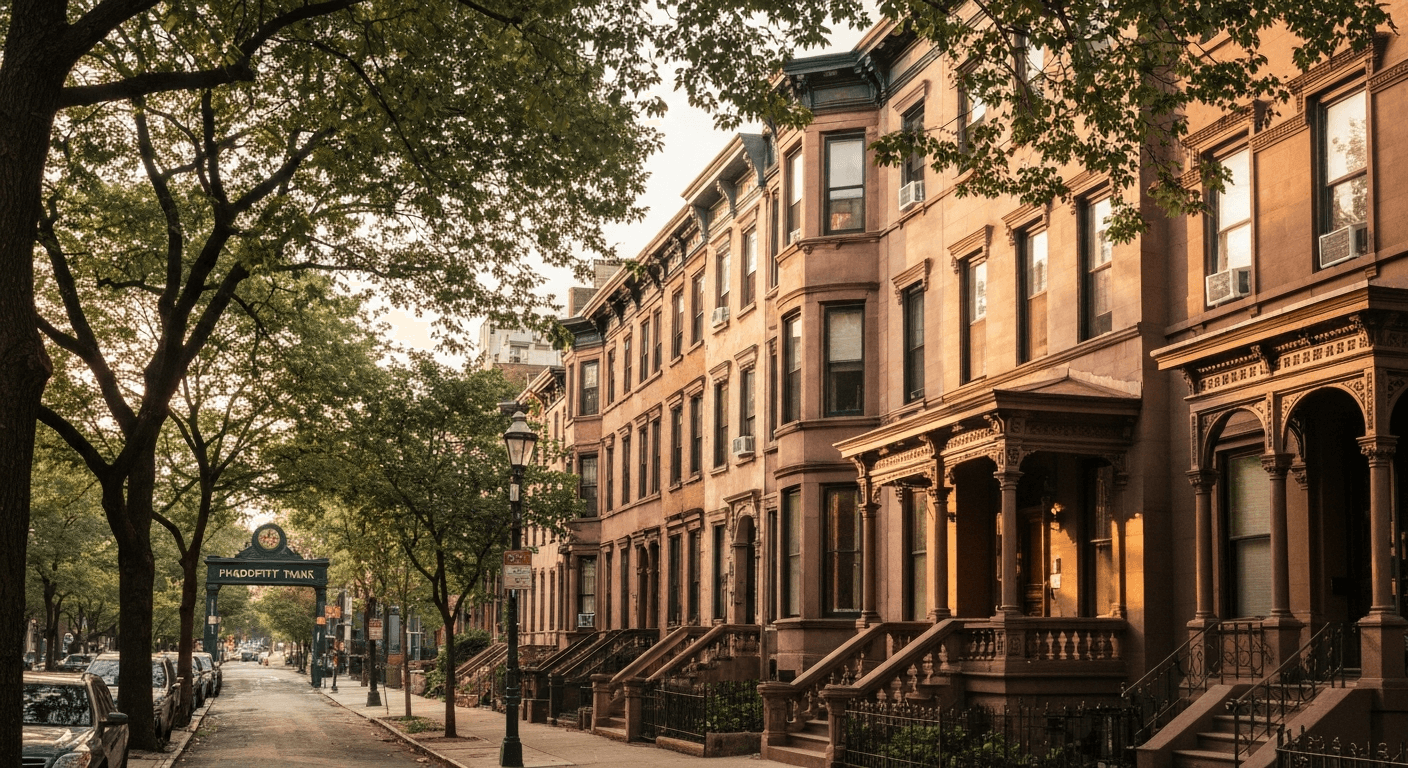
Park Slope has long held the unofficial title of Brooklyn's family neighborhood of choice — but that description undersells its breadth and appeal. This is a neighborhood of extraordinary Victorian and Italianate brownstone architecture, of tree-canopied streets sloping gently toward Prospect Park, of engaged parents and dog walkers on 5th and 7th Avenues, of wine bars and artisan coffee shops and restaurants that hold their own against anything in Manhattan, and of a real estate market that has delivered decade after decade of steady, reliable appreciation. Bounded by Prospect Park to the east, 4th Avenue to the west, Atlantic Avenue to the north, and the Prospect Expressway to the south, Park Slope offers something increasingly rare in New York City: genuine neighborhood life at a human scale.
The area's tree-lined streets — Carroll Street, Montgomery Place, and Garfield Place are among the most beautiful residential blocks in any American city — showcase some of the finest examples of late 19th-century residential architecture outside of a museum. Prospect Park itself, designed by Frederick Law Olmsted and Calvert Vaux (the same visionary team behind Central Park), gives Park Slope residents year-round access to 585 acres of meadows, forests, a lake, a carousel, a boathouse, the Nethermead, and a world-class zoo. The combination of architectural beauty, parkland access, family amenities, strong schools, and excellent subway connections has made Park Slope one of the most consistently desirable neighborhoods in Brooklyn for over four decades — and the fundamentals that drive that demand show no signs of weakening.
Farva Scott, Associate Broker at The Real Brokerage, brings deep expertise to the Park Slope market. This guide covers everything you need to know about buying and living here — from the neighborhood's history and market dynamics to the school options, transportation, and the insider knowledge that separates savvy buyers from those who learn hard lessons after closing.
Park Slope's history mirrors the arc of Brooklyn itself. The neighborhood was developed primarily between the 1870s and 1910s, as wealthy Manhattanites and well-to-do Brooklyn residents built grand rowhouses and brownstones on the grid of streets laid out alongside the newly created Prospect Park. Developer William Childs and the Litchfield family were among the early landholders, and the construction boom that followed the opening of the Brooklyn Bridge in 1883 accelerated growth dramatically. By 1900, Park Slope was one of the most fashionable addresses in New York, home to Brooklyn's business elite who commuted to Manhattan via the bridges and elevated railways.
The grand mansions along Prospect Park West and the elegant rowhouses of the so-called "Gold Coast" blocks — between Prospect Park West and 8th Avenue, roughly from Union Street to 9th Street — represent the pinnacle of this Victorian prosperity. Architects like C.P.H. Gilbert, Lauritzen & Voss, and Montrose Morris produced extraordinary facades of brownstone, limestone, and brick that survive in remarkable condition today. The neighborhood entered a period of decline in the mid-20th century as suburbanization drew families to Long Island and New Jersey, and many buildings were subdivided or fell into disrepair. The 1960s and 1970s saw artists and progressives move in, attracted by low rents and generous spaces.
By the 1980s, a sustained renovation wave had begun, fueled by young professionals who recognized the architectural quality and the extraordinary park access. The Park Slope Food Co-op, founded in 1973 at 782 Union Street, became a neighborhood institution — a symbol of the community's cooperative, collectively-minded character that endures today. The Co-op now has over 17,000 members and remains one of the largest and most successful food cooperatives in the United States, offering members access to organic and sustainably sourced groceries at below-retail prices. Today, Park Slope is fully gentrified and highly polished — an engaged, politically active community that invests deeply in its schools, its parks, and its civic institutions. The Park Slope Historic District, established in 1973 and expanded to cover a large swath of the neighborhood, protects the core Victorian streetscapes from inappropriate alteration.
Park Slope is one of Brooklyn's premier real estate markets, delivering consistent appreciation and deep liquidity that makes it attractive to both owner-occupants and long-term investors. As of 2025-2026, the median sale price for a brownstone or townhouse in Park Slope ranges from approximately $2.5 million to over $6 million for the finest full-width Gold Coast examples on streets like Garfield Place, Carroll Street, and 2nd Street between Prospect Park West and 8th Avenue. The Gold Coast designation — informally applied to the blocks nearest Prospect Park with the most impressive streetscapes and best park access — commands a meaningful premium over equivalent properties on comparable blocks further west.
Single-family conversions — where an owner has recombined a subdivided brownstone into a single home — are highly prized and can reach $5 million to $8 million for a fully renovated, full-width building on a prime block. More commonly, buyers purchase two-to-four family brownstones — typically a parlor-floor and garden-level owner's unit plus one to three rental apartments above — for $2.5 million to $4.5 million. Rental income from the upper apartments can cover $3,000 to $6,000 per month, providing meaningful offset to carrying costs while the owner occupies a generous garden-to-parlor floor duplex.
Condominiums represent a growing share of the Park Slope market. Buildings and conversion projects throughout the neighborhood offer one-bedrooms from approximately $700,000 to $1 million and two-bedrooms from $1.1 million to $2 million and beyond. New construction condos along 4th Avenue — a corridor that has seen significant development over the past decade with buildings featuring doorman service, rooftop terraces, parking, and modern finishes — provide an alternative to the townhouse market at often lower prices per square foot, appealing to buyers who prefer lower-maintenance living. Co-ops are plentiful in Park Slope, particularly in the larger apartment buildings along 8th Avenue, Prospect Park West, and the commercial streets. Co-op prices are typically more affordable per square foot than condos, with one-bedrooms starting around $450,000 and two-bedrooms from $700,000 to $1.2 million.
Park Slope's rental market is competitive, reflecting strong demand from young professionals, families relocating from Manhattan, and graduate students from NYU, Pratt, and other nearby institutions. One-bedrooms average $3,000 to $3,800 per month; two-bedrooms run $3,800 to $5,200 per month; three-bedrooms in quality buildings or brownstone rentals range from $5,000 to $8,000 per month. For investors, Park Slope offers moderate cap rates with excellent tenant quality and very low vacancy risk. Price appreciation has been roughly 4 to 7 percent annually over the past decade, with the Gold Coast blocks outperforming the broader market. Days on market for well-priced properties typically run 30 to 60 days, with multiple offers still common for desirable townhouses and renovated co-ops.
Life in Park Slope is anchored by Prospect Park. The park's main entrance at Grand Army Plaza — marked by the magnificent Soldiers' and Sailors' Memorial Arch, a dramatic triumphal arch modeled after the Arc de Triomphe — leads into 585 acres of Olmsted and Vaux masterwork. Weekend mornings bring thousands of Park Slope residents to the park for runs on the 3.35-mile perimeter path, picnics on the sweeping Long Meadow, paddleboating on Prospect Lake, and visits to the Prospect Park Zoo — a beloved small-scale zoo operated by the Wildlife Conservation Society, perfectly sized for families with young children. The LeFrak Center at Lakeside offers ice skating and hockey in winter, roller skating in summer, and excellent café facilities year-round.
The Boathouse at Prospect Lake hosts community events and the New York Transit Museum's satellite gallery. The Prospect Park Bandshell in the park stages the Celebrate Brooklyn! Performing Arts Festival each summer — a beloved free outdoor concert series drawing major acts from jazz, hip-hop, classical, and global music. The Drummer's Grove near the Parkside entrance draws musicians and dancers every Sunday afternoon, creating a spontaneous, joyful gathering that feels like old New York.
Along 7th Avenue — Park Slope's most charming commercial strip — independent boutiques, cafés, restaurants, and bars create a genuinely walkable neighborhood Main Street experience. Gorilla Coffee on 5th Avenue is a Park Slope institution for espresso. Rose Water on Union Street is a beloved neighborhood anchor for elegant contemporary American cuisine. Miriam Restaurant on Prospect Park West offers wonderful Israeli-Mediterranean food in a warm, neighborhood setting. Scottadito Osteria Toscana on Union Street is a romantic Italian staple for special occasions. The Long Island Bar on Atlantic Avenue is a superbly restored 1951 cocktail bar and dining room that has become a Brooklyn destination in its own right. Dinosaur Bar-B-Que on Union Street satisfies serious barbecue cravings.
5th Avenue, running parallel to 7th, is a more diverse and energetic commercial strip — particularly south of 9th Street, where Mexican taquerias, Haitian restaurants, Caribbean grocery stores, and newer bars and coffee shops reflect the neighborhood's cultural diversity and vitality. The Park Slope Food Co-op on Union Street is open to members only but offers extraordinary organic and local groceries at below-retail prices; the membership waitlist is long, but the benefits are genuine. The Grand Army Plaza Greenmarket operates every Saturday year-round, offering exceptional produce, cheese, meat, bread, and flowers from regional farms. Fitness options are abundant: Brooklyn Boulders climbing gym on Bond Street, Prospect Park running clubs, yoga studios, Pilates, and multiple boutique fitness concepts line the commercial strips.
Park Slope is served by Brooklyn Community School Districts 13 and 15, and its public schools are among Brooklyn's strongest and most celebrated. PS 321 William Penn School on 7th Avenue is arguably the most sought-after elementary school in Brooklyn — a large, deeply engaged parent community, exceptional academic programming, strong arts integration, and a vibrant after-school and extracurricular landscape. Buyers specifically target the PS 321 attendance zone, and properties within it command a noticeable premium. PS 39 Nicolas Copernicus on Sixth Avenue and PS 107 John W. Kimball on 8th Avenue are other highly regarded elementary options with strong academic profiles.
For middle school, MS 51 William Alexander on 5th Avenue is one of the top-ranked middle schools in Brooklyn, known for rigorous academics and a broad range of extracurricular activities. The Urban Assembly School for Law and Justice serves students interested in social justice and legal careers. For high school, Brooklyn Technical High School in Fort Greene — accessible by the B45 bus or a short subway ride — is a frequent choice for Park Slope families, as are Stuyvesant High School in Manhattan and Bard High School Early College Manhattan.
Private schools in and near Park Slope are excellent. The Berkeley Carroll School on Lincoln Place is a well-regarded independent school from Pre-K through 12th grade, located directly in Park Slope, with strong academic programming and a genuine commitment to community. Poly Prep Country Day School in Bay Ridge (with a shuttle from Park Slope) offers a more traditional independent school experience with strong athletics. Packer Collegiate Institute in Brooklyn Heights and St. Ann's School are both accessible by subway or car. For higher education, NYU Tandon School of Engineering is minutes away in DUMBO, and Long Island University Brooklyn is nearby.
Park Slope is exceptionally well-served by public transit — with five subway lines serving the neighborhood, it is one of Brooklyn's most accessible areas for Manhattan commuters. The F and G trains serve the 4th Avenue/9th Street and 7th Avenue stations, with the F providing direct service to West 4th Street in approximately 20 minutes and to Jay Street-MetroTech in about 8 minutes. The 2 and 3 express trains serve Grand Army Plaza and Bergen Street stations, connecting to 14th Street/Union Square in under 15 minutes and to Times Square in under 20 minutes. The B and Q trains serve 7th Avenue and Prospect Park stations, connecting to Midtown via the Manhattan Bridge.
The D train stops at 7th Avenue, offering additional express service to Midtown and the Bronx. The R train serves 4th Avenue/9th Street, adding another Manhattan connection. With this remarkable transit coverage, Park Slope commuters have more options than most Brooklyn neighborhoods. For cyclists, the neighborhood is highly bikeable — Prospect Park's 3.35-mile loop is a popular cycling route, and Citi Bike is well-distributed throughout. For drivers, the Prospect Expressway at the neighborhood's southern edge and the BQE nearby provide car access, though peak-hour congestion is a reality. Walk Score for Park Slope ranges from the mid-80s to mid-90s depending on location.
The Park Slope market offers a compelling buy argument for families and long-term residents. The combination of brownstone living, 585 acres of Olmsted parkland, and some of the best public schools in Brooklyn creates a demand profile that has kept appreciation consistent for decades. For families purchasing a two-to-four family brownstone, the live-and-invest model works particularly well — rental income from upper-floor apartments can cover $3,000 to $6,000 or more per month, providing meaningful offset to mortgage and maintenance costs while the owner builds equity in a neighborhood with strong appreciation fundamentals.
For condo buyers, Park Slope offers strong value relative to comparable Manhattan neighborhoods, with genuine community amenities and school quality that Manhattan neighborhoods at the same price point rarely match. The rental market is competitive — renters in Park Slope pay significantly above-average Brooklyn rents, and turnover tends to be low, meaning desirable apartments move quickly when they become available. For those not yet ready to buy, renting in Park Slope is a good way to experience the neighborhood and understand its micro-markets before committing. Most experienced Park Slope brokers advise buyers with a three-year or longer horizon to buy rather than rent.
Park Slope is exceptional for families with children, offering the trifecta of outstanding public schools (especially PS 321), 585 acres of Olmsted parkland, and safe, walkable streets that feel genuinely livable rather than merely tolerable. Young professionals moving from Manhattan find Park Slope a natural transition — significantly more space, lower price per square foot, and a genuine sense of community that can be hard to find in even the most desirable Manhattan neighborhoods. The neighborhood is deeply progressive and politically engaged, making it a natural home for activists, academics, non-profit professionals, journalists, and public servants.
Writers, novelists, and creative professionals have long called Park Slope home, drawn by the café-rich environment, the Prospect Park inspiration, and the intellectual density of a neighborhood that still maintains its bookstore (Community Bookstore on 7th Avenue is a beloved independent). Retirees and empty nesters downsizing from suburban homes find renovated co-ops and brownstone condos in Park Slope to be ideal — walkable, cultured, and beautifully connected to both nature and the city. Investors are well-served by the neighborhood's consistent performance, strong tenant pool, and low vacancy rates. Park Slope is perhaps less suited to young singles seeking intense nightlife — it tilts domestic and family-oriented — though 5th Avenue south of 9th Street has a genuinely lively bar and restaurant scene for those who want evening energy.
Buyers entering Park Slope should understand the neighborhood's micro-market dynamics before making an offer. The Gold Coast blocks — those between Prospect Park West and 8th Avenue, from Union Street to 9th Street — command a premium that can run 15 to 25 percent above otherwise comparable blocks further from the park. Decide early in your search whether that premium is justified by your lifestyle and budget, or whether you would be equally happy two blocks west at a meaningfully lower price. When purchasing a brownstone, always budget for $50,000 to $150,000 or more in deferred maintenance on pre-war buildings — brownstone pointing, roof replacement, plumbing updates, and window work are common costs that should be factored into your offer price.
Get a thorough inspection by an inspector experienced with pre-war masonry construction; a general home inspector may miss issues specific to 19th-century Brooklyn rowhouses. If buying a townhouse with existing tenants, review all leases carefully and determine whether any are rent-stabilized. Under New York City rent stabilization laws, covered tenants have significant protections that restrict your ability to occupy or renovate even after purchasing the building. For co-op purchases, scrutinize the building's reserve fund, underlying mortgage, and monthly maintenance calculation carefully — buildings on 4th Avenue and closer to 3rd Avenue can carry more transitional-market risk but offer better per-square-foot value.
Act decisively on quality product in Park Slope — well-priced townhouses and renovated co-ops in desirable buildings move quickly, often within a week of listing. Have your pre-approval, attorney, and inspector lined up before you begin your search so you can move without delay when the right property appears.
Park Slope delivers one of the most complete neighborhood experiences in New York City — exceptional schools, 585 acres of Olmsted parkland, some of the finest brownstone streetscapes in America, and a community culture that is engaged, warm, and enduring. Whether you are a young family looking for the best public school in Brooklyn, an investor seeking a reliable income-producing brownstone, or a buyer trading up from a cramped apartment to a genuine home with space to breathe, Park Slope has a compelling offer. The market has rewarded buyers consistently for four decades and shows no signs of losing its fundamental appeal.
The real question is not whether to buy in Park Slope — it is when and where. To navigate that question with confidence and avoid the common pitfalls that catch unprepared buyers, reach out to Farva Scott, Associate Broker at The Real Brokerage. Farva brings deep Brooklyn market knowledge, a client-first philosophy, and the network to find you the right property at the right price. Visit farvascott.com or call (914) 417-9215 today to begin your Park Slope real estate journey.