SoHo Real Estate Guide: Living, Buying & Investing in SoHo, NY
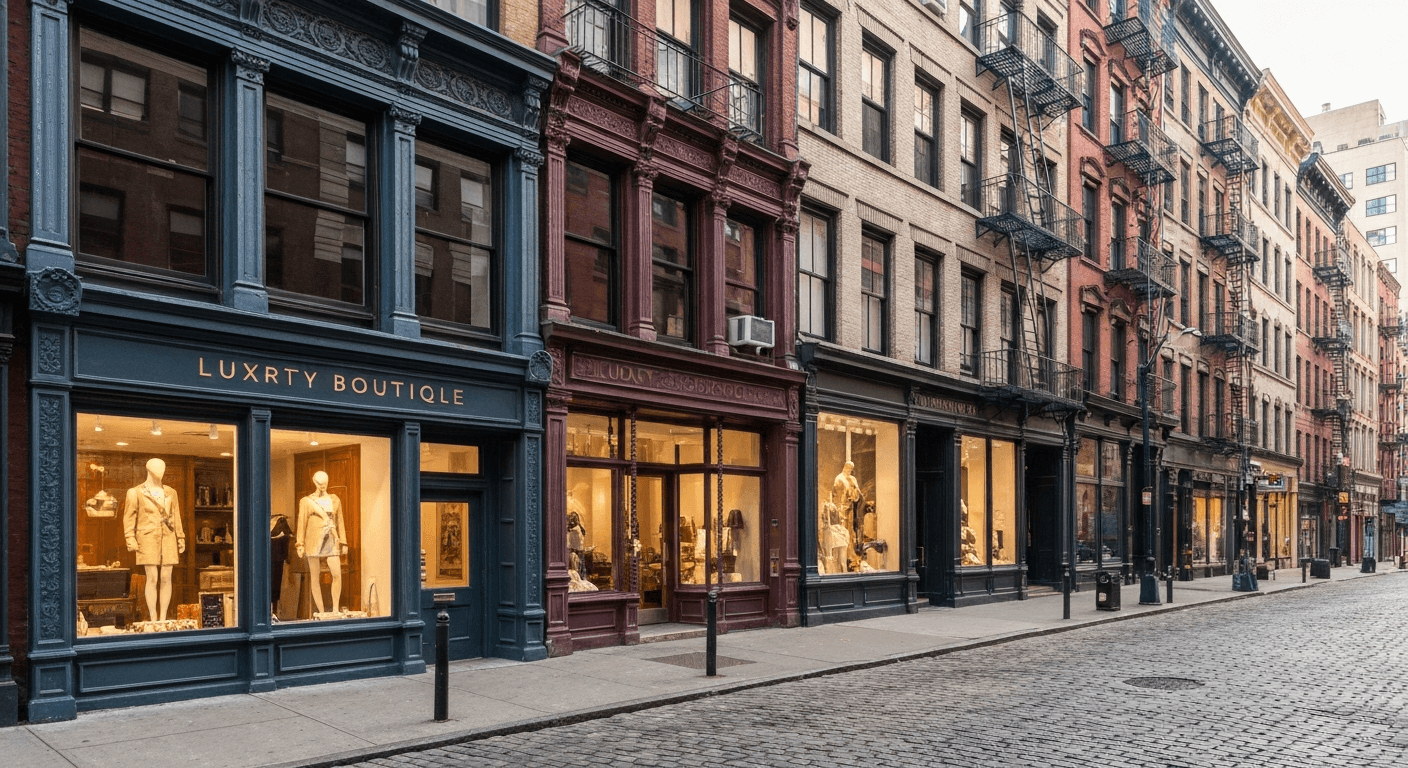
Nowhere in New York City does history, art, architecture, and commerce collide more spectacularly than in SoHo. Short for "South of Houston Street," this compact but endlessly compelling neighborhood stretches from Houston Street south to Canal Street, between Sixth Avenue and Lafayette Street, forming a grid of remarkable cast-iron-fronted buildings that together constitute the largest concentration of cast-iron architecture in the world. Walking down Broadway or Mercer Street on a weekday morning—past gleaming flagship stores occupying the ground floors of gorgeously ornate 19th-century warehouses, past gallery owners rolling up metal shutters to reveal curated exhibitions inside—you feel the neighborhood's layered identity all at once: industrial past, artistic interlude, luxury present.
SoHo is a neighborhood of reinvention. What was once a manufacturing and trading district known as "Hell's Hundred Acres" for its frequent factory fires became, in the 1960s and 1970s, the epicenter of New York's avant-garde art world as painters and sculptors colonized the abandoned loft buildings. That artist colony in turn gave way to the boutiques and galleries that made SoHo a global shopping and cultural destination in the 1980s and 1990s. Today, SoHo is one of the most expensive and sought-after real estate markets in Manhattan, where the authentic loft apartments that artists once lived in now sell for millions and the brand-name flagship stores occupy the historic storefronts. Through all of these transformations, the architecture has remained—and it is the architecture, above all, that makes SoHo extraordinary.
For home buyers and real estate investors, SoHo presents a uniquely compelling proposition: a neighborhood with an international profile, an architectural heritage that cannot be replicated, consistently strong demand, and a lifestyle that balances world-class shopping and dining with surprising residential intimacy on its quieter side streets. Whether you are drawn to a sprawling industrial loft with 12-foot ceilings and exposed brick, a boutique condominium in a converted warehouse, or the investment potential of a building in one of New York's most globally recognized zip codes, SoHo rewards thoughtful buyers.
SoHo's history begins long before the cast-iron buildings that define it today. In the early 19th century, the area was one of Manhattan's most fashionable residential districts—the wealthy families of Federal-era New York built their townhouses here before migrating northward as the city expanded. By the mid-1800s, the neighborhood had transformed entirely: the residential population had moved north, and the streets around Broadway below Houston had filled with the commercial buildings and warehouses that served Manhattan's booming garment and light manufacturing economy.
The cast-iron buildings that now define SoHo were the cutting-edge construction technology of their era. Fabricated from prefabricated iron components that could be bolted together on site, these buildings offered large, open floor plates, high ceilings, and facades of extraordinary decorative elaborateness at a fraction of the cost of traditional stone or brick construction. The iron facades were painted to mimic stone, often in shades of gray or cream, and featured elaborate cornices, arched windows, and decorative columns that gave these commercial buildings an architectural dignity usually reserved for civic monuments. Buildings like the Haughwout Building at Broadway and Broome Street—which installed the world's first safety elevator in 1857—stand today as architectural landmarks of international significance.
The neighborhood's decline in the mid-20th century, as manufacturing moved away from Manhattan, paradoxically created the conditions for its artistic renaissance. By the 1960s, the buildings stood largely empty, and rents were exceptionally cheap. Artists including Donald Judd, Chuck Close, and Roy Lichtenstein moved into the raw loft spaces, illegally at first (zoning did not permit residential use), and created studios that became the beating heart of the minimalist and conceptualist art movements. The Village Voice and other publications celebrated SoHo as the new bohemia, drawing gallerists, critics, and collectors. Paula Cooper, Leo Castelli, and dozens of other legendary gallery owners opened spaces on West Broadway and Prince Street. In 1971, New York City rezoned SoHo to allow artist-in-residence loft conversions, formally recognizing what had already become a fact on the ground.
The art-world success that SoHo achieved brought commercial attention, and through the 1980s and 1990s, major retail brands began opening flagship stores in the neighborhood's former factory spaces. The combination of architecture, foot traffic, and cachet proved irresistible. Today, SoHo's Broadway, Spring Street, and Prince Street corridors host a remarkable concentration of luxury and designer retailers alongside independent boutiques, concept stores, and contemporary art galleries that maintain the neighborhood's cultural credibility.
SoHo's real estate market reflects the neighborhood's extraordinary scarcity of supply and global demand. Unlike most of Manhattan, where real estate is a mix of pre-war buildings and modern towers, SoHo is dominated almost entirely by 19th-century cast-iron and brick loft buildings that were never designed for residential use and cannot be reproduced. This architectural singularity, combined with the Cast-Iron Historic District protections that prohibit demolition or unsympathetic alteration of the facades, means that the supply of authentic SoHo lofts is permanently fixed.
The defining property type in SoHo is the loft apartment—typically occupying one floor (or a partial floor) of a former warehouse or factory building, characterized by open floor plans, high ceilings (10–14 feet in original buildings), large industrial windows, exposed brick or concrete columns, and wide-plank hardwood floors. These raw industrial spaces have been converted with varying degrees of sophistication: some units retain their rough industrial character; others have been finished to extraordinary standards with custom kitchens, spa-caliber bathrooms, and gallery-quality artwork and finishes.
Pricing for SoHo lofts is among the highest in Manhattan. Entry-level one-bedroom or studio lofts—typically smaller units in converted buildings—begin around $1.2 million to $1.8 million. More desirable two-bedroom lofts with good light and updated finishes typically trade in the $2.5 million to $4.5 million range. Three-bedroom and larger full-floor lofts regularly sell for $5 million to $12 million or more, depending on size, finish level, and the specific building and block. The most exceptional properties—full-floor lofts with original architectural details, corner exposures, and contemporary renovations—can command $15 million or more.
Condominiums in newer or fully converted buildings are also available in SoHo, with prices generally in line with or slightly above those for comparable loft units due to greater flexibility (easier financing, no board restrictions). New development in SoHo is extremely limited by the neighborhood's historic district protections, making existing inventory all the more valuable.
Investment fundamentals in SoHo are strong, though the entry price points are high. The neighborhood's consistent international appeal—SoHo is one of the most recognized neighborhood names in the world—means that buyer demand comes from across the globe, insulating the market from purely local economic fluctuations. Rental demand for SoHo lofts is robust: one-bedroom lofts rent for $4,500 to $6,500 per month; two-bedrooms command $7,000 to $12,000 monthly. Cap rates are low (typically 2–3%) due to the high purchase prices, but appreciation over the long term has been strong and consistent, making SoHo lofts reliable long-term holds for patient investors.
SoHo's lifestyle offering is one of the most sophisticated in New York City. The neighborhood's shopping is legendary: Broadway between Houston and Canal is lined with flagship stores for Louis Vuitton, Prada, Chanel, Gucci, and dozens of other luxury brands. Spring Street hosts a rotating mix of high-end boutiques, concept stores, and new-brand flagships. Mercer Street and Greene Street offer a more curated, independent shopping experience, with distinctive home goods, gallery-adjacent retail, and artisan food shops mixed in among the boutiques.
The dining scene in SoHo is exceptional and diverse. Balthazar on Spring Street is perhaps the most famous restaurant in the neighborhood—a grand French brasserie that has been a SoHo institution since 1997 and remains one of the best places in New York for weekend brunch or a late-night meal. Raoul's on Prince Street is a moody, romantic French bistro that has served as a neighborhood gathering spot for decades. Don Angie on Hudson Street delivers creative, deeply satisfying Italian-American cooking. Houseman on Greenwich Street serves farm-to-table New American fare with serious wine credentials. Boqueria on Spring Street brings Spanish tapas culture to the neighborhood, while Parm on Mulberry Street does classic red-sauce Italian with modern precision. For coffee, Balthazar Bakery, Jack's Stir Brew, and Blue Bottle Coffee (with its gorgeous Prince Street location) are neighborhood favorites.
The gallery scene that originally defined SoHo's artistic identity has migrated in part to Chelsea and other boroughs, but a significant number of galleries remain, particularly on West Broadway and the side streets around Prince and Spring. The Drawing Center on Wooster Street is a world-class institution focused on drawings and works on paper. Ronald Feldman Gallery and Anna Kustera Gallery maintain SoHo's tradition of serious contemporary art presentation. The Museum of Ice Cream and other experiential venues have also found homes in SoHo's large commercial spaces, catering to the neighborhood's enormous tourist foot traffic.
Families in SoHo are a real but minority constituency in a neighborhood that skews younger and toward non-traditional households. The primary public school serving SoHo is PS 130 (Hernando de Soto) on Hester Street, which has strong academic ratings and serves families from SoHo and the surrounding area. PS 3 (Charrette School) on Hudson Street in the West Village is another option accessible to SoHo families. For middle school, District 2 students have access to the same competitive screened programs as the rest of lower Manhattan, and the specialized high school pipeline—Stuyvesant, LaGuardia, Bronx Science—is well represented among SoHo families.
Private school is the more common choice for SoHo families given the neighborhood's demographics. Nearby options include the Little Red School House and Elisabeth Irwin High School in the West Village, Corlears School and Bank Street School for early childhood, and the diverse array of independent schools accessible throughout lower Manhattan. The nearby Tribeca neighborhood is home to PS 234, which draws SoHo families who choose public elementary school.
Transportation access from SoHo is very good, with several subway lines serving the neighborhood. The N, Q, R, and W trains stop at Prince Street and at Canal Street on Broadway, providing express access to Midtown (about 20 minutes to 42nd Street) and to Downtown Brooklyn. The C and E trains stop at Spring Street on Sixth Avenue, offering another route to Midtown. The A, C, and E trains at Canal Street and Varick Street provide access to the West Side and to JFK Airport. The 1 train stops at Houston Street and Canal Street, connecting to the Upper West Side and Downtown.
SoHo is also extremely walkable and bike-friendly. The neighborhood's compact layout and proximity to other downtown neighborhoods—the West Village is a 5-minute walk west, Tribeca is immediately to the south, Nolita and Little Italy are steps east—means that many daily errands, dining outings, and social engagements are achievable entirely on foot. The Citi Bike network has dense coverage throughout SoHo and the surrounding area. The Holland Tunnel entrance at Canal and Varick provides direct car access to New Jersey, and the BQE is accessible from Canal Street for Brooklyn and Queens-bound travelers.
In the current SoHo market, the rent-vs-buy calculation heavily favors buying for those with the capital to do so. Renting a two-bedroom loft in SoHo typically costs $8,000 to $12,000 per month—a figure that, over five years, represents $480,000 to $720,000 in rent paid with no equity accrued. Given the neighborhood's historical appreciation, buyers who can sustain the carrying costs are almost always better off owning. For shorter-term residents (under three years), renting makes more sense given the transaction costs of buying and selling in New York City.
SoHo attracts a distinctive and international set of buyers and residents. Creative professionals—architects, designers, art directors, fashion executives, gallerists, filmmakers—are the neighborhood's spiritual core and remain a significant buyer demographic. Finance professionals and tech executives drawn by the lifestyle and the asset value of the real estate are well represented. International buyers—from Europe, Asia, and Latin America—are a major force in the market, attracted by SoHo's global name recognition and the relative stability of Manhattan real estate as an asset class. Celebrities and high-net-worth individuals have long chosen SoHo lofts for their combination of privacy, style, and proximity to the cultural life of downtown New York.
Investors in SoHo tend to be long-term oriented, understanding that the high entry price points require patience and a multi-decade investment horizon to fully realize appreciation potential. The neighborhood's permanent scarcity of supply and its global demand base make it one of the most defensible real estate investments in New York.
Buying in SoHo requires navigating some unique market dynamics. First, understand that many SoHo loft buildings are condominiums rather than co-ops, which means the board approval process is generally less rigorous—but buyers should still review building financials, reserve funds, and any pending assessments before going to contract. Some buildings in SoHo maintain "artist-in-residence" certifications that technically require buyers to certify that they use the space for artistic work; in practice, enforcement has become rare, but buyers should be aware of this legacy zoning quirk.
Second, inspect carefully. The buildings in SoHo are old—many date from the 1860s to 1890s—and while the cast-iron facades are landmarked and maintained, the mechanical systems, plumbing, and electrical infrastructure inside individual apartments can vary widely. A thorough inspection by a licensed engineer familiar with SoHo's building stock is essential.
Third, understand the light situation. Many SoHo buildings have interior units with limited natural light—a significant quality-of-life consideration in apartments that otherwise offer spectacular architectural character. North-facing units on lower floors of deep buildings can be quite dark. Prioritize south or west exposures and higher floors when possible.
Fourth, move decisively. Like the Village, SoHo's desirable inventory moves quickly. The combination of limited supply and strong buyer demand means that well-priced properties receive multiple offers quickly. Pre-approved buyers with strong financial profiles are best positioned to compete.
If SoHo's extraordinary loft buildings, world-class dining, and global cultural cachet call to you, now is the time to explore your options. Farva Scott, Associate Broker at The Real Brokerage, specializes in lower Manhattan's most distinctive neighborhoods and can help you find the SoHo loft or investment property that perfectly fits your goals. Reach out at (914) 417-9215 or visit farvascott.com to start your SoHo real estate journey today. The right space—high ceilings, wide-plank floors, and afternoon light streaming through original warehouse windows—could be exactly one phone call away.