Spanish Harlem Real Estate Guide: Living, Buying & Investing in East Harlem, NY
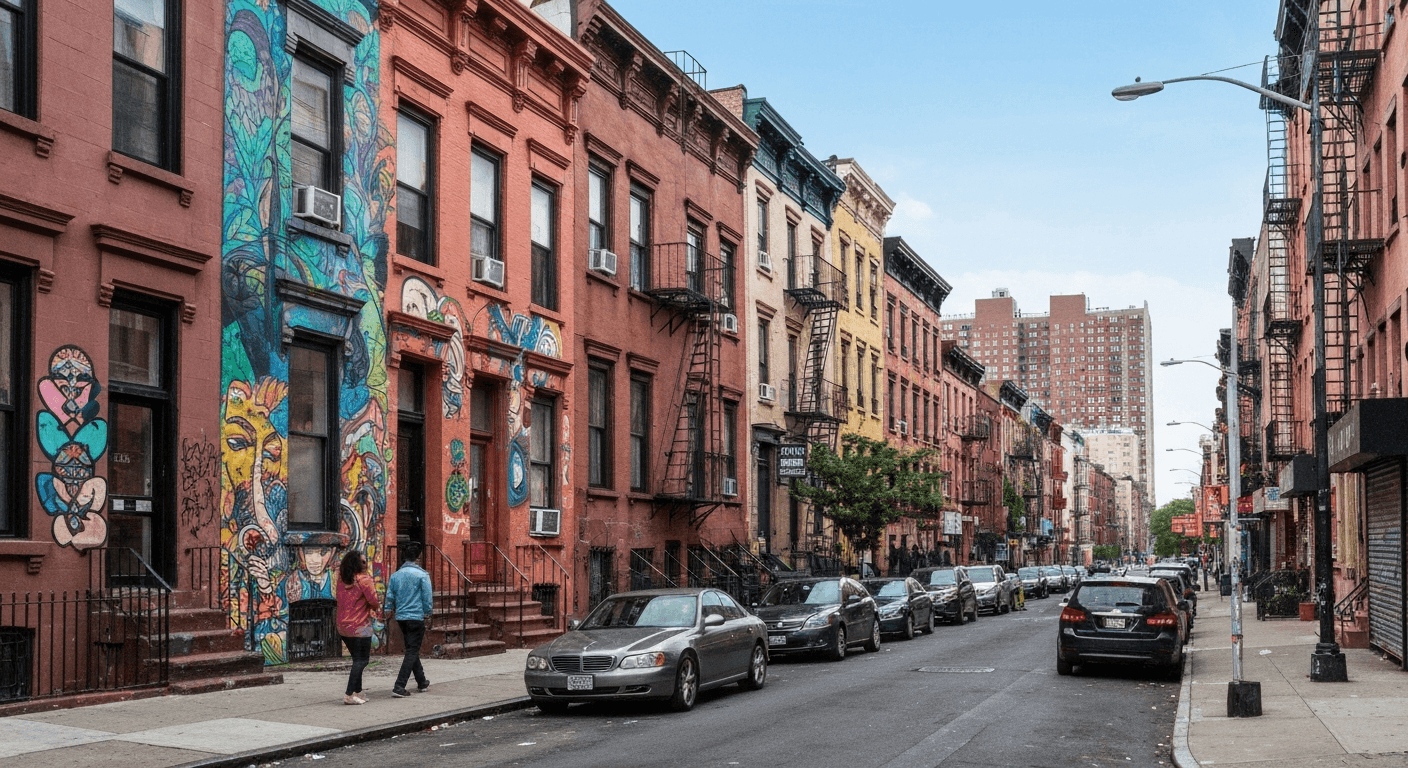
On the northeastern edge of Central Park, where Park Avenue's gleaming residential towers give way to colorful murals and the aroma of roasting pernil drifts from open storefronts, you'll find one of New York City's most vibrant and underappreciated neighborhoods: Spanish Harlem. Known by its residents as El Barrio—"the neighborhood"—and formally designated East Harlem, this community occupying the territory between 96th Street and the Harlem River, east of Fifth Avenue, is a place where a rich Latino cultural heritage meets the pulse of a rapidly evolving real estate market.
For decades, Spanish Harlem was overlooked by buyers who focused their attention on the blocks to the west or south. Today, those buyers are paying the price—in a very literal sense—while the early movers who recognized El Barrio's potential are sitting on significant equity. Spanish Harlem offers Manhattan real estate prices that remain among the most accessible in the borough, combined with a cultural depth, culinary vibrancy, and community spirit that no amount of new construction can manufacture.
From the murals on East 106th Street to the ball fields of Jefferson Park, from the legendary tables at Rao's to the bustle of La Marqueta beneath the Park Avenue rail viaduct, Spanish Harlem is a neighborhood that rewards those who take the time to know it. For buyers and investors who want to plant a flag in a Manhattan neighborhood before the rest of the market fully catches up, the moment to act is now.
This is the comprehensive guide to buying, investing, and living in Spanish Harlem—everything you need to make an informed, confident decision about one of Manhattan's most compelling real estate opportunities.
Neighborhood Overview & History
Spanish Harlem's history is a story of waves: of immigrants arriving, of communities establishing themselves, of cultures colliding and blending into something entirely their own.
The neighborhood that would become East Harlem first developed as a dense immigrant enclave in the late 19th and early 20th centuries. Italian immigrants settled heavily along First and Second Avenues east of Fifth Avenue, establishing businesses, churches, and social clubs on every block. The neighborhood was known for decades as "Italian Harlem," and the presence of institutions like Our Lady of Mount Carmel Church on East 115th Street and the legendary Rao's restaurant—established in 1896 and still operating at 455 East 114th Street—survive as living remnants of that remarkable era.
Beginning in the late 1920s and accelerating dramatically through the 1940s and 1950s, Puerto Rican families arrived in large numbers, transforming the neighborhood's character entirely. East Harlem became the heart of New York City's Puerto Rican community—a cultural and economic anchor for what would become the largest Puerto Rican diaspora community in the United States. The neighborhood earned the name El Barrio, and its streets vibrated with salsa music, bodegas, botanicas, and social clubs.
The cultural legacy of this Puerto Rican identity is woven into the neighborhood's very streets. The mural at East 106th Street and Lexington Avenue—"The Spirit of East Harlem" by Hank Prussing—is one of the city's most iconic pieces of public art. La Marqueta, the covered market that once stretched the length of Park Avenue between 111th and 116th Streets, was a commercial and cultural hub for decades, offering fresh produce, Caribbean groceries, and a gathering place for the community.
Today, East Harlem is experiencing the same demographic and economic transformation that reshaped West Harlem in the preceding decades. The neighborhood's main commercial corridor along East 116th Street bustles with activity—old-school Latin restaurants and pharmacies alongside new coffee shops, fitness studios, and boutique retailers. The area around the 125th Street corridor and Second Avenue has attracted significant commercial investment, and the neighborhood's adjacency to the Upper East Side makes it increasingly attractive to a new generation of price-conscious buyers.
The Real Estate Market
Spanish Harlem represents one of the most compelling entry-point opportunities in all of Manhattan real estate. While neighborhoods like the Upper East Side, Upper West Side, and even central Harlem have experienced dramatic price appreciation over the past decade, East Harlem has lagged slightly—meaning buyers today have access to Manhattan prices that can feel almost surprising in their accessibility.
Co-ops
Co-operative apartments remain the most common ownership structure in Spanish Harlem. Studios in well-maintained buildings are available from approximately $175,000 to $300,000, with many buildings requiring as little as 10% to 20% down. One-bedroom co-ops typically range from $280,000 to $475,000, while two-bedrooms are priced from $400,000 to $700,000 in solid buildings with good financials.
Monthly maintenance fees in Spanish Harlem co-ops often include heat and hot water, and average $600 to $1,100 per month for a one-bedroom unit. The financial analysis for ownership in many of these buildings shows monthly carrying costs competitive with or even lower than current market rents—a rare circumstance in Manhattan real estate.
Condos
New construction condo development has been accelerating in East Harlem over the past five years. Buildings along East 125th Street, the Second Avenue corridor, and near the East River waterfront have brought modern amenities—fitness centers, rooftop terraces, concierge services—to the neighborhood. One-bedroom condos in new buildings typically range from $450,000 to $700,000, while two-bedrooms run $700,000 to $1.1 million. Several buildings carry 421-a property tax abatements that meaningfully reduce monthly carrying costs during the abatement period, making the ownership calculus even more favorable.
Multi-Family Properties
East Harlem contains a significant stock of three- and four-story walk-up tenements and small multi-family buildings that present compelling investment opportunities. A four-unit building on a residential side street can still be found in the $1.2 million to $2.2 million range—price points that make the math on rental income far more attractive than in downtown Manhattan neighborhoods.
Market Trends
Spanish Harlem's prices have increased approximately 12% to 15% over the past three years, driven by spillover demand from the Upper East Side and central Harlem, strong subway connectivity via the Lexington Avenue express lines, and accelerating investment in commercial infrastructure. Days-on-market have fallen sharply for well-priced listings, particularly for co-ops under $500,000 and move-in-ready condos under $750,000. Multiple-offer situations, once rare in this neighborhood, have become common for attractively priced properties.
Investment Outlook
Of all the Manhattan neighborhoods covered in this guide, Spanish Harlem arguably presents the most significant near-term upside potential. The neighborhood has been on the right side of a decade-long appreciation trend, and several macro factors suggest continuation: the continuing discussion of the Second Avenue Subway extension to 116th and 125th Streets, the ongoing expansion pressure from the Columbia University Medical Center campus to the north and west, and the Upper East Side's identity as a stable high-value corridor that now directly borders East Harlem at 96th Street.
For patient investors or first-time buyers willing to hold for five or more years, Spanish Harlem may offer the best risk-adjusted opportunity in Manhattan north of 96th Street.
Lifestyle & Amenities
Spanish Harlem's lifestyle is defined by its cultural richness—the neighborhood has a lived-in authenticity that newer, more thoroughly gentrified neighborhoods simply cannot replicate. This is a place where residents know their neighbors, where block associations are active and engaged, and where the street life is genuinely alive at every hour of the day.
Food and Dining
Let's start with the obvious: Rao's. Located at 455 East 114th Street, this legendary Southern Italian restaurant has been operating since 1896, and a table is so coveted that regulars pass their reservation nights down to family members like heirlooms. The food is exceptional—linguine with white clam sauce, meatballs in Sunday gravy, lemon chicken—but the atmosphere is the main event. It is, without qualification, one of the most unique dining experiences in New York City.
Beyond Rao's, the neighborhood's culinary landscape is a celebration of Latin American food culture. La Fonda Boricua on East 106th Street is one of the city's best Puerto Rican restaurants, serving mofongo, pernil, and arroz con pollo in a warm, community-centered dining room where regulars have been eating for decades. El Paso Taqueria has multiple locations in the neighborhood and serves some of Manhattan's most authentic Mexican street food—tacos al pastor, quesadillas, tamales—at prices that seem almost too reasonable. Patsy's Pizzeria, the original coal-fired Neapolitan pizza restaurant at 2287 First Avenue at 117th Street (dating to 1933), produces a pie that rivals anything Brooklyn has to offer and is one of New York City's great food institutions.
For morning coffee and pastries, a growing number of independent coffee shops along Second Avenue and 116th Street serve the neighborhood's morning commuter crowd.
Parks and Recreation
Jefferson Park, spanning First and Second Avenues between 112th and 115th Streets, is the neighborhood's central outdoor gathering place, with baseball fields, basketball courts, a running track, a well-maintained playground, and free summer concerts that draw residents from across the neighborhood. The Thomas Jefferson Park Pool—one of the city's first public outdoor pools, opened in 1936—operates from late June through early September and is a beloved neighborhood institution. Randall's Island, accessible by footbridge from East 103rd Street and the FDR Drive, offers an extraordinary 488-acre park with athletic fields, a golf course, festival grounds, and pastoral riverfront paths along the East River and Harlem River.
Culture and Community
El Museo del Barrio, located at Fifth Avenue and 104th Street at the southern end of Museum Mile, is the nation's leading Latino cultural institution, with a permanent collection that spans pre-Columbian artifacts, Puerto Rican santos, and contemporary Latin American and Caribbean art. The neighborhood's tradition of community muralism—visible on virtually every major block—makes walking the streets feel like touring a continuously evolving open-air gallery.
Shopping and Daily Errands
La Marqueta under the Park Avenue elevated rail structure continues to operate as a public market, selling fresh produce, Caribbean groceries, and cultural goods. The 116th Street commercial corridor is lined with everything from bodegas and beauty supply stores to clothing boutiques and specialty food shops. Several national grocery chains have entered the neighborhood in recent years, improving food access and reducing the "food desert" conditions that historically affected parts of East Harlem.
Schools & Education
Spanish Harlem is served by Community School District 4 (CSD 4), which has a distinctive national history as a laboratory for public school innovation. In the 1970s and 1980s, CSD 4 pioneered school choice mechanisms that influenced education reform policy throughout the United States.
Public Schools
PS 57 James Weldon Johnson on East 115th Street is one of the neighborhood's established elementary schools with strong family involvement. PS 102 Jacques Cartier on East 99th Street serves the southern end of the neighborhood, near the 96th Street boundary with the Upper East Side. PS 7 Samuel Stern on East 131st Street serves northern East Harlem. For middle school, Wagner Middle School (located just south of the neighborhood at East 76th Street but serving many East Harlem students through the city's school choice program) offers strong academic programming.
Charter Schools
East Harlem has benefited significantly from charter school expansion over the past twenty years. KIPP NYC has operated schools in the neighborhood for years, with strong academic outcomes and active family engagement. East Harlem Scholars Academy Charter School and Success Academy East Harlem serve elementary-age students and are popular choices for families who secure seats through the city's annual lottery process.
Higher Education
The Mount Sinai Medical Center complex, while primarily a medical institution, has growing degree-granting educational programs and employs tens of thousands of people in and around the neighborhood. City College of New York and Columbia University are both accessible by subway within 15 to 20 minutes from central East Harlem.
Transportation & Commute
Spanish Harlem benefits from some of Manhattan's most direct express subway service—a practical advantage that significantly enhances the neighborhood's appeal for working commuters.
Subway
The 4, 5, and 6 trains run along Lexington Avenue, the neighborhood's most important transit spine. The 6 local train stops at 96th, 103rd, 110th, 116th, and 125th Streets, while the express 4 and 5 trains stop only at 86th Street and 125th Street—making them extraordinarily efficient for commuters heading to Midtown or Downtown Manhattan. From 116th Street and Lexington Avenue, the 4 or 5 express reaches Grand Central Terminal at 42nd Street in approximately 12 minutes, one of the fastest subway commutes available from any Manhattan neighborhood above 96th Street.
The 2 and 3 trains run along Park Avenue through the northern portion of East Harlem, providing service to Times Square, Penn Station, and Brooklyn via the express lines.
The Second Avenue Subway
The Q train currently terminates at 96th Street and Second Avenue—effectively at Spanish Harlem's southern boundary. The planned Phase 2 extension of the Second Avenue Subway, which would bring Q service to 106th, 116th, and 125th Streets directly through the heart of East Harlem, is partially funded and under discussion, though no firm construction timeline is currently confirmed. Completion of this extension would dramatically improve transit options for residents and is widely expected to have a meaningful positive impact on property values throughout the neighborhood.
Buses and Cycling
The M15 and M15 SBS express bus routes run the length of First and Second Avenues, one of the most frequent bus corridors in New York City. The M116 crosstown bus connects East and West Harlem along 116th Street. Citi Bike docking stations are available throughout the neighborhood, and the East River Greenway provides a protected cycling path along the water.
Commute Time to Midtown: 12–20 minutes by express subway.
Buying vs. Renting
The rent-versus-buy calculation in Spanish Harlem has never been more clearly in favor of ownership for qualified buyers—a statement that becomes more true with each passing year as rents rise and equity accumulates.
Current market rents for a one-bedroom apartment in East Harlem typically range from $2,200 to $3,000 per month for a reasonably modern and well-maintained unit. Two-bedroom apartments rent for $2,800 to $3,800 per month. These are significant monthly expenses that build no equity, create no tax benefits, and are subject to increases at lease renewal.
Against those rental costs, consider: a one-bedroom co-op purchased at $325,000 with 20% down ($65,000) carries a monthly mortgage payment of approximately $1,300 at current rates, plus maintenance fees of $700 to $900 per month, for a total carrying cost of $2,000 to $2,200 per month. That figure is competitive with or modestly above market rent—but with equity building every single month and appreciation history strongly in the buyer's favor.
For multi-family investors, the rent-to-price ratio in East Harlem remains among the strongest in all of Manhattan. A four-unit building generating $12,000 to $16,000 per month in gross rent, acquired at $1.5 million, represents a cash-flow scenario that simply does not exist in most other Manhattan neighborhoods at any price point.
Who Should Live Here
Spanish Harlem is a neighborhood for people who want to live in Manhattan on real-world terms—who value cultural authenticity, community connection, and financial prudence alongside convenience and access to opportunity.
First-Time Buyers will find East Harlem one of the most accessible entry points into Manhattan homeownership. The combination of lower price points, smaller minimum down payment requirements at some co-op buildings, strong charter school options, and a rental market that supports financial flexibility make the ownership case here more achievable than almost anywhere else in the borough.
Investors looking for income-producing properties will appreciate the multi-family stock, strong and reliable rental demand, and price points that allow for positive cash flow—genuinely rare in Manhattan real estate.
Families are drawn by the cultural richness, the variety of school options (particularly the strong charter school landscape), the parks and athletic facilities, and the genuine community that comes from a neighborhood with deep, multigenerational roots.
Healthcare Professionals benefit enormously from proximity to Mount Sinai Medical Center and Hospital, which anchors the neighborhood's southern edge at East 98th Street and Fifth Avenue and employs thousands of people who create sustained demand for nearby housing.
Cultural Creatives who want to be embedded in New York City's living Latino cultural heritage—from El Museo del Barrio to the neighborhood's murals, music, and food traditions—will find in East Harlem a home that few other city neighborhoods can match.
Tips for Buying in Spanish Harlem
Research the co-op building thoroughly before falling in love with a unit. Spanish Harlem has a mix of well-managed and less-managed co-op buildings. Request recent board meeting minutes, review the building's annual financial statements and reserve fund status, and check for any underlying liens or outstanding assessments before proceeding.
Understand the 421-a tax abatement landscape. Several newer condo developments in East Harlem were built with 421-a property tax abatements that significantly reduce monthly tax costs for qualifying buyers—but these abatements have fixed expiration dates. Know exactly when the abatement on any specific unit expires and model your carrying costs both with and without it to avoid unpleasant surprises.
Act fast in the sub-$500,000 market. Properties priced competitively under $500,000 in Spanish Harlem attract intense buyer interest and frequently receive multiple offers. If you find a property that meets your criteria, plan to move within 48 to 72 hours of your first showing.
Visit on a weekend. Spanish Harlem is a neighborhood that reveals its full character on Saturday and Sunday, when street life is richest, markets are open, and parks are full. Visit during a weekend to get an authentic feel for community rhythm before committing.
Budget for renovation. Many of the most affordable properties in the neighborhood benefit from cosmetic or moderate renovation updates. Factor realistic renovation costs into your offer strategy rather than discovering them after closing.
Conclusion: Make Your Move in El Barrio
Spanish Harlem occupies a rare position in New York City real estate: a neighborhood with a powerful, authentic cultural identity, excellent express subway access, genuine community roots that span generations, and prices that still make real economic sense for Manhattan buyers. As the city continues to evolve and prices escalate across every borough, El Barrio stands as one of the last true entry points into Manhattan homeownership at a scale that actually builds wealth.
The buyers who are here today recognized the neighborhood's trajectory and moved with conviction. Don't be the person who looks back in five years and wishes they had acted sooner.
If you're ready to explore Spanish Harlem's real estate opportunities, Farva Scott, Associate Broker at The Real Brokerage, is your expert guide to this market. Visit farvascott.com or call (914) 417-9215 to schedule your consultation.