Tribeca Real Estate Guide: Living, Buying & Investing in Tribeca, NY
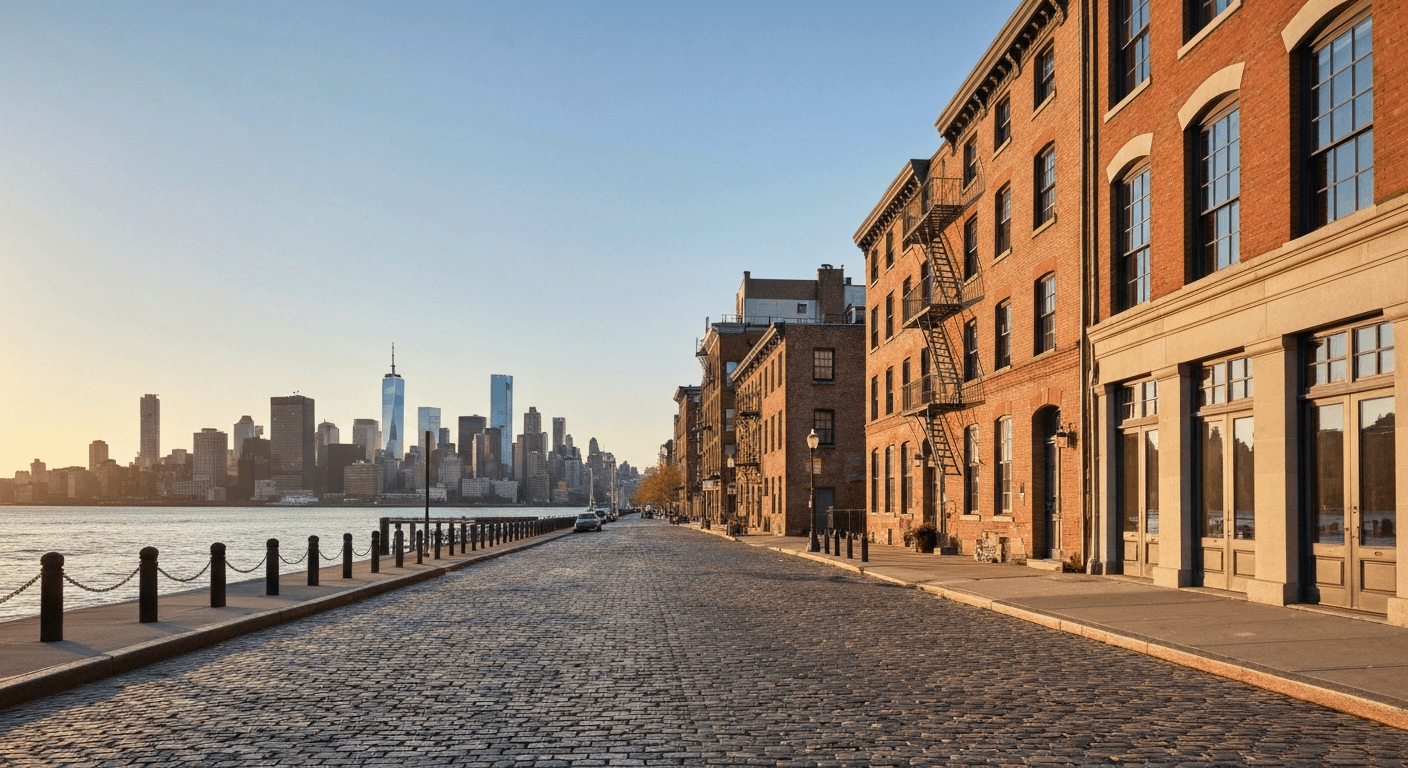
If you want to understand what happens when extraordinary wealth meets extraordinary architecture in one of New York City's most thoughtfully reimagined neighborhoods, you need to spend some time in Tribeca. The name is an acronym—Triangle Below Canal—describing the wedge-shaped territory bounded by Canal Street to the north, Chambers Street to the south, Broadway to the east, and the Hudson River to the west. Once one of Manhattan's most purely industrial districts, a place of warehouses and loading docks, Tribeca has undergone the most spectacular residential transformation in New York City's recent history, emerging as the city's wealthiest residential neighborhood by median household income and one of the most coveted addresses in the world.
Walking down Hudson Street or Harrison Street on a quiet Tuesday morning, past beautifully restored 19th-century brick and granite warehouse buildings where doormen in tailored suits stand at attention, past boutique coffee shops and Michelin-starred restaurants occupying former factory floors, the sense of calm and arrival that Tribeca projects is distinctive and unmistakable. This is a neighborhood for people who have found what they were looking for—who want space, privacy, a sense of community, and proximity to everything downtown Manhattan has to offer, without the tourist crush of SoHo or the collegiate energy of Greenwich Village.
For home buyers and investors, Tribeca represents the apex of lower Manhattan real estate: the neighborhood where the most expansive loft apartments, the highest ceilings, the most sought-after addresses, and the most stable long-term investment fundamentals converge. From converted warehouse lofts on Laight Street to gleaming glass-and-steel towers along the Hudson, Tribeca's real estate is extraordinary in its breadth and ambition. This guide provides everything you need to know about buying, living, and investing in Tribeca, New York.
Tribeca's evolution from industrial district to residential paradise is one of Manhattan's great urban transformation stories. Through most of the 19th and early 20th centuries, the neighborhood was the city's industrial and commercial heart—a dense district of warehouses storing goods offloaded from the nearby Hudson River piers, factories producing textiles and other manufactured goods, and the wholesale food and grocery markets that fed Manhattan. The neighborhood's extraordinary architectural heritage—massive Federal-style warehouses from the 1820s and 1830s, elegant Italianate cast-iron buildings from the 1860s, robust Romanesque Revival commercial structures from the 1880s and 1890s—was a product of successive waves of commercial development that now constitutes one of the most remarkable concentrations of 19th-century commercial architecture in the United States.
By the mid-20th century, Tribeca's industrial economy had collapsed. The piers were obsolete, the manufacturing had moved, and the warehouses stood empty. It was, paradoxically, the perfect moment for artists and early residential pioneers to move in. In the 1970s and early 1980s, the same forces that were transforming SoHo to the north were at work in Tribeca: cheap rents, enormous raw spaces, and a city government willing to allow residential conversions to stem the drain of population. Robert De Niro—the neighborhood's most famous early residential adopter—began investing in Tribeca real estate in the 1980s, eventually founding the Tribeca Film Festival, the Tribeca Grill, and a constellation of related hospitality businesses that helped define the neighborhood's identity and accelerate its evolution into a destination.
The Tribeca Historic Districts—there are multiple sections designated by the NYC Landmarks Preservation Commission—protect some 60 square blocks of the neighborhood's most significant buildings, ensuring that the architectural character that makes Tribeca unique will be preserved. At the same time, Tribeca has welcomed thoughtfully designed new construction along its western waterfront edge, creating a range of housing options from authentic 19th-century conversions to contemporary glass towers.
Tribeca's real estate market is defined by superlatives. The neighborhood consistently ranks as one of the most expensive zip codes in the United States by median real estate transaction price, with median condo and co-op sales prices regularly exceeding $3.5 million. The neighborhood's inventory is relatively small—Tribeca's residential building stock is constrained by the neighborhood's physical boundaries and its historic district protections—which means that supply is permanently limited relative to robust demand.
The dominant property type in Tribeca is the converted loft—vast, open-plan apartments occupying full or partial floors of former warehouse buildings, typically characterized by ceilings of 12 to 18 feet, original structural columns and posts, oversized windows overlooking cobblestone streets or the Hudson River, and wide-plank hardwood floors. These lofts range in size from modest one-bedroom conversions of 1,200 to 1,500 square feet to palatial full-floor residences of 5,000 to 10,000 square feet or more. Unlike SoHo lofts, which often retain a rougher industrial character, the best Tribeca lofts have been renovated to residential standards that rival the finest new construction anywhere in the world—chef's kitchens with restaurant-grade appliances, spa bathrooms with radiant heat floors, temperature-controlled wine cellars, home theaters, and private terraces.
Entry-level pricing in Tribeca reflects the neighborhood's extraordinary desirability. A studio or junior one-bedroom loft starts at approximately $1.2 million to $1.8 million. One-bedroom apartments with good light and updated finishes typically trade in the $1.8 million to $3 million range. Two-bedroom lofts—the most competitive market segment—are priced from $3 million to $6 million depending on size, floor, light, and finishes. Three-bedroom lofts range from $5 million to $12 million. Full-floor residences and penthouses command $12 million to $30 million or more, and several of the most spectacular properties in Tribeca's history have traded above $50 million. The most expensive residential buildings in Tribeca—including 443 Greenwich Street, 56 Leonard Street (the iconic Herzog & de Meuron "Jenga Tower"), and 70 Vestry Street—have hosted transactions among the most valuable in New York City history.
New condominium development in Tribeca, concentrated along the Hudson waterfront and on a few blocks within the non-landmarked portions of the neighborhood, has added glass-tower inventory with spectacular river views and modern amenities including full-service concierge, private gyms, pools, and children's playrooms. These new towers—while architecturally distinct from the converted warehouses—have attracted a new generation of buyers seeking contemporary amenities alongside Tribeca's extraordinary lifestyle benefits.
Investment fundamentals in Tribeca are among the strongest in Manhattan. The neighborhood's consistently high demand from domestic and international ultra-high-net-worth buyers, combined with extreme scarcity of supply, has produced appreciation rates that substantially outperform broader market averages. Rental demand is robust: two-bedroom Tribeca apartments rent for $8,000 to $15,000 per month, and three-bedroom lofts command $15,000 to $30,000 monthly. The market is also highly liquid relative to other ultra-luxury neighborhoods—Tribeca apartments attract global buyer pools, ensuring that sellers are rarely without motivated qualified buyers.
Tribeca's lifestyle offering is world-class by any measure. The neighborhood's dining scene is one of the most celebrated in New York City. Nobu at 105 Hudson Street is perhaps the most famous restaurant in the neighborhood—Robert De Niro's partnership with chef Nobu Matsuhisa created an institution that helped put Tribeca on the global map and remains one of the world's most recognized restaurant brands. The Odeon at 145 West Broadway is Tribeca's original neighborhood bistro, a beloved gathering spot that opened in 1980 and has been serving dependable American food to the Tribeca community through every phase of the neighborhood's evolution. Locanda Verde at 377 Greenwich Street, Andrew Carmellini's Italian-American restaurant in the Greenwich Hotel, is consistently ranked among New York's best restaurants and is a regular host to the city's cultural elite. Racines NY on Hudson Street brings a French wine-bar sensibility to Tribeca; Blue Ribbon Sushi has been a downtown institution since it opened. Walker's on North Moore Street is the quintessential Tribeca neighborhood bar, where regulars have been gathering for decades.
The neighborhood also hosts the Tribeca Film Festival each spring, founded by Robert De Niro, Jane Rosenthal, and Craig Hatkoff in the aftermath of September 11, 2001, as part of the effort to bring life back to lower Manhattan. The Festival has grown into one of the world's premier cinematic events, transforming Tribeca's parks, theaters, and streets for ten days each year and reinforcing the neighborhood's identity as a creative and cultural hub.
For outdoor recreation, Tribeca residents have access to Hudson River Park, which runs the length of the neighborhood's western edge from Chambers Street north through SoHo and the West Village. Pier 25 within the park offers a miniature golf course, beach volleyball courts, a children's playground, and seasonal boat rentals—making it a genuine neighborhood amenity for families. The park's esplanade is one of the most beautiful walking and cycling routes in Manhattan. Washington Market Park at Chambers and Greenwich streets is a beloved community green space with a playground and farmers' market. Tribeca's streets themselves—many still paved with original Belgian block cobblestones on the lower blocks around Harrison, Jay, and Staple streets—are a pleasure to walk, offering an urban intimacy rare in Manhattan.
Tribeca has emerged over the past two decades as one of Manhattan's premier family neighborhoods, a transformation driven in large part by the neighborhood's extraordinary public school, PS 234. Located at 292 Greenwich Street, PS 234 (Independence School) is consistently ranked as one of the best public elementary schools in New York City and a primary reason families with children are willing to pay Tribeca's premium prices. The school's student-centered, project-based learning approach, combined with its consistently high academic outcomes, has created enormous demand: families routinely cite PS 234 as a deciding factor in their choice to buy in Tribeca.
For middle school, Tribeca families have access to MS 297 and the competitive screened programs throughout District 2, which serves lower Manhattan. Stuyvesant High School, located directly adjacent to Tribeca on Chambers Street between West Street and the West Side Highway, is one of the world's most academically renowned public high schools—the proximity is a significant attraction for families with high-achieving students preparing for the SHSAT. LaGuardia High School of Music & Art and Performing Arts in Lincoln Center is a popular high school choice for artistically gifted Tribeca students.
Private school options near Tribeca are numerous and diverse. Corlears School on Hudson Street is a boutique independent school with a strong early childhood program. Packer Collegiate Institute in Brooklyn Heights—a short walk across the Brooklyn Bridge—is a premier K-12 independent school favored by many Tribeca families. The Trevor Day School, Trinity School, and St. Ann's School in Brooklyn Heights are other options accessible to Tribeca residents.
Transportation in Tribeca is excellent, with multiple subway lines providing comprehensive access to the rest of Manhattan and beyond. The 1, 2, and 3 trains stop at Chambers Street on Broadway and at Franklin Street on Varick Street, providing the fastest connection to Midtown (approximately 20 minutes to Times Square on the 1 train). The A and C trains stop at Chambers Street at the World Trade Center complex, connecting Tribeca to JFK Airport via the A train connection at Howard Beach and to the Upper West Side and Washington Heights. The E train's Chambers Street stop provides an additional Midtown option. The J and Z trains stop at Chambers Street on Broadway, connecting to Brooklyn's Broadway corridor and Jamaica, Queens.
The PATH train at Chambers Street serves Hoboken and Jersey City commuters, making Tribeca particularly attractive to households with one member working in Manhattan and another across the Hudson. The ferry service at Pier 11/Wall Street connects Tribeca residents to Brooklyn, Queens, and New Jersey water-taxi routes. The Brooklyn Bridge, just blocks away, is one of New York's premier cycling routes, with dedicated bike lanes providing a scenic and practical commute alternative for residents working in Downtown Brooklyn or DUMBO. Car access is excellent: the Holland Tunnel at Canal and Varick connects Tribeca directly to New Jersey, and the BQE and Brooklyn Bridge provide fast access to Brooklyn.
The buy-vs-rent decision in Tribeca is straightforward for those with the financial capacity: buy if you can. Rental prices for quality Tribeca apartments are extraordinarily high—a two-bedroom loft rents for $10,000 to $18,000 per month on average—making the monthly carrying cost of a purchased property competitive with renting while building substantial equity and participating in long-term appreciation. The neighborhood's institutional investment appeal—demonstrated by the presence of some of the world's most sophisticated real estate investors among its property owners—validates the fundamental investment thesis for individual buyers.
Tribeca is a neighborhood that attracts a very specific type of buyer, and understanding who your neighbors will be is part of understanding the community you are joining. Finance professionals—hedge fund managers, private equity partners, investment bankers—are among the most prominent buyer demographics, drawn by Tribeca's combination of discretion, space, and proximity to Downtown financial institutions. Entertainment and media figures—film directors, producers, television executives, musicians, and celebrities—have maintained a consistent presence in Tribeca since Robert De Niro helped pioneer the neighborhood in the 1980s. Tech founders and entrepreneurs, many with offices in the Brooklyn Tech Triangle or in Hudson Square, are an increasingly prominent buyer group. International ultra-high-net-worth buyers from Europe, Asia, and the Middle East view Tribeca properties as trophy acquisitions with strong fundamental investment underpinnings.
Families with children who qualify for PS 234 or who are committed to the neighborhood's exceptional family lifestyle are a core demographic. The combination of the park, the school, the cobblestone streets, and a community that skews toward established, successful adults makes Tribeca feel, for a Manhattan neighborhood, remarkably family-oriented.
Buying in Tribeca requires careful preparation and experienced professional guidance. The most important things to know:
The market moves quickly. Even at multi-million-dollar price points, desirable Tribeca properties receive multiple offers and can go to contract within days of listing. Buyers should be fully pre-approved (for financed purchases) or have proof of funds prepared (for cash purchases) before beginning a serious property search.
Know the building type before you fall in love. Tribeca has a mix of co-op and condominium buildings, and the distinction matters significantly. Co-ops require board approval, limit subletting, and often have stricter financing requirements. Condominiums offer greater flexibility. Most of the newer luxury buildings in Tribeca are condominiums; many of the authentic converted warehouse buildings are co-ops. Your broker should clarify the building structure and rules before you tour.
Budget for the true monthly costs. Tribeca's carrying costs—common charges, real estate taxes (for condos) or maintenance (for co-ops)—are among the highest in Manhattan. A three-bedroom condo in a full-service Tribeca building might carry $4,000 to $8,000 per month in charges and taxes on top of any mortgage payment. Budget comprehensively.
Consider the view carefully. Tribeca's most valuable assets are its cobblestone street views, its Hudson River exposures, and its characteristic streetscapes. An apartment facing west toward the Hudson commands a significant premium but also offers one of Manhattan's most spectacular visual experiences. High-floor apartments in newer towers with river views are the neighborhood's most liquid and appreciating assets.
Use your inspection rights fully. As with all of lower Manhattan's historic buildings, mechanical systems, windows, and common elements in Tribeca's converted warehouses may be aging. A thorough inspection and a careful review of the offering plan and building financials will protect you from unexpected special assessments.
Tribeca is not just a neighborhood—it is a statement about what is possible when a city has the imagination and the resources to reimagine itself. From the cobblestone blocks of Harrison Street to the glass curtain walls of 56 Leonard, from PS 234's extraordinary school community to the extraordinary dining and cultural amenities that make every evening an adventure, Tribeca delivers a quality of life that is, quite simply, extraordinary.
Ready to make Tribeca your home? Farva Scott, Associate Broker at The Real Brokerage, brings unmatched expertise in Tribeca's complex and competitive real estate market. Whether you are searching for your first loft, a family residence near PS 234, or a trophy investment property, Farva will guide you to the right opportunity with insight, integrity, and results. Call (914) 417-9215 or visit farvascott.com to begin your Tribeca real estate journey today. In a neighborhood this exceptional, the right guide makes all the difference.