Upper East Side Real Estate Guide: Living, Buying & Investing in the Upper East Side, NY
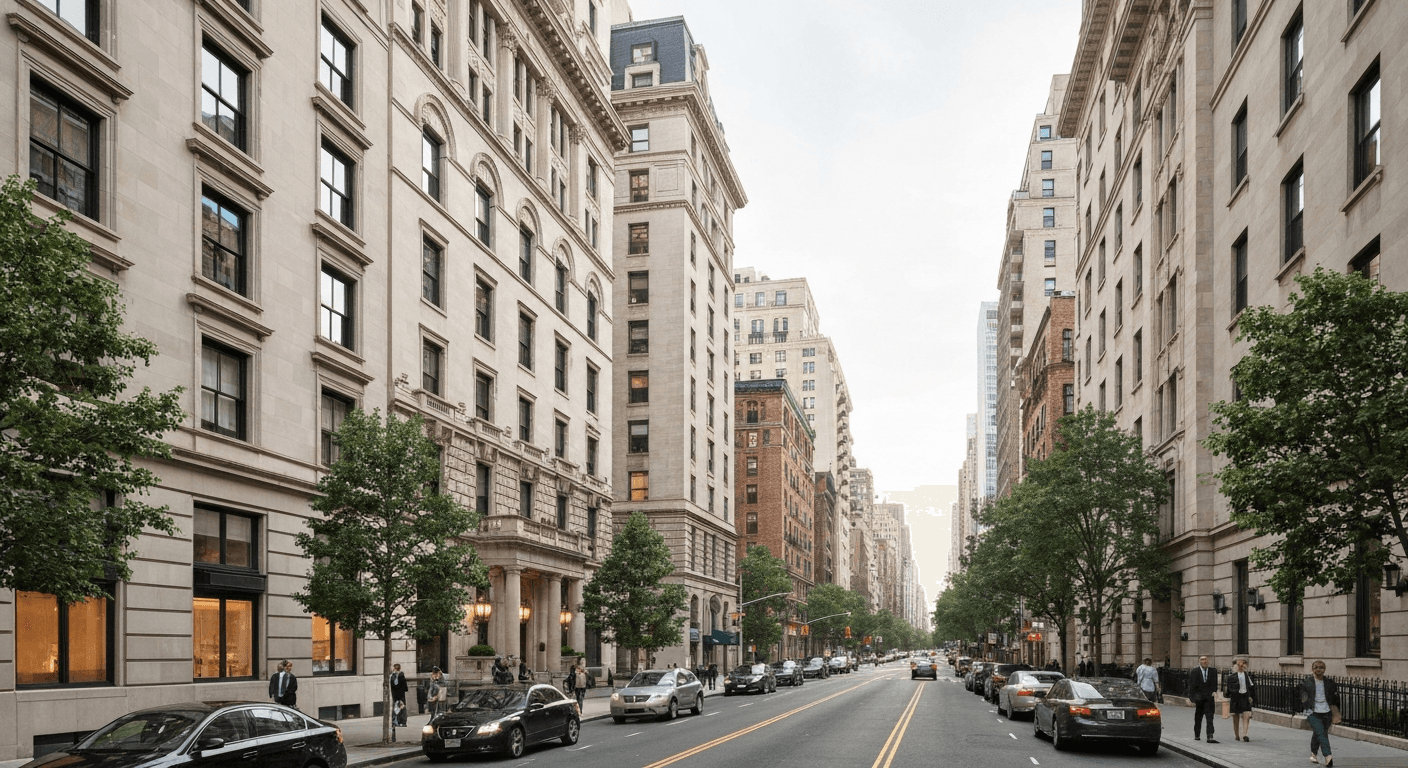
Fifth Avenue. Park Avenue. Museum Mile. Carnegie Hill. These words carry freight in the American cultural imagination that few geographic descriptors can match. They conjure images of elegance, old money, cultural aspiration, and the very particular type of New York confidence that comes from knowing you live in one of the most prestigious neighborhoods on the planet. The Upper East Side is all of this and more — a neighborhood that stretches from 59th Street to 96th Street between Central Park and the East River, containing within its 2.2 square miles some of the most valuable, most sought-after, and most architecturally significant residential real estate in the world.
But the Upper East Side has also evolved. The neighborhood that was once synonymous exclusively with Park Avenue penthouses and a certain kind of buttoned-up Manhattan formality has diversified and livened considerably. The Second Avenue Subway, which opened its first phase in January 2017 after decades of planning, transformed the eastern portion of the neighborhood — Yorkville and the avenues east of Lexington — by adding the Q train and dramatically improving transit access that had been lacking for generations. Young professionals have flooded into buildings along Second and Third Avenue. Families have discovered that the UES offers perhaps the single greatest concentration of elite educational options in the five boroughs. The neighborhood's restaurant and nightlife scene has shed its stuffy reputation in favor of a genuinely lively, multi-generational culture that spans everything from French brasseries to neighborhood sports bars.
Whether you are searching for a classic Park Avenue co-op, a Carnegie Hill townhouse, a first apartment east of Lexington, or an investment in one of the world's most liquid real estate markets, understanding the Upper East Side requires more than knowing the zip code. This guide provides everything you need to buy, invest, and thrive on the Upper East Side of Manhattan.
Neighborhood Overview & History
The Upper East Side's transformation into Manhattan's most prestigious residential address began in the 1880s and accelerated through the Gilded Age's final decades. Prior to the Civil War, the area between Fifth Avenue and the East River was home to German immigrant communities, breweries, slaughterhouses, and squatter settlements — an industrial frontier at the city's northern edge. The opening of Central Park in 1858 and the northward march of the city's wealthiest families transformed Fifth Avenue into what newspapers called Millionaire's Row, where Carnegie, Vanderbilt, Astor, and Frick built the mansions that would later become museums, consulates, and cultural institutions.
The Henry Clay Frick mansion — now the Frick Collection at 1 East 70th Street — stands as one of the most extraordinary survivors of this era, a Beaux-Arts limestone palace that houses one of the finest private art collections ever assembled, with Vermeer, Rembrandt, and Velázquez masterpieces in intimate gallery settings (currently operating from a temporary location at 945 Madison Avenue during mansion restoration). The Andrew Carnegie Mansion at 2 East 91st Street — now the Cooper Hewitt, Smithsonian Design Museum — is another landmark, as is the James B. Duke Mansion at 1 East 78th Street, now the New York University Institute of Fine Arts.
The Metropolitan Museum of Art, established at its current Fifth Avenue and 82nd Street location in 1880, anchored what would eventually be called Museum Mile — a stretch of Fifth Avenue from 82nd to 105th Street that now contains nine world-class museums. The Guggenheim at 88th and Fifth (designed by Frank Lloyd Wright, completed 1959) is one of the 20th century's greatest works of architecture. The Jewish Museum at 92nd and Fifth, the Museum of the City of New York at 103rd and Fifth, and El Museo del Barrio at 104th and Fifth round out a cultural corridor that has no parallel in any residential neighborhood in the world.
Park Avenue became the address of choice for the early-20th-century wealthy after the New York Central Railroad's rail yards were covered following the opening of Grand Central Terminal in 1913. The great apartment buildings — 740 Park Avenue, 778 Park Avenue, 820 Park Avenue, 960 Park Avenue — established the standard for what luxury urban living means in America, a standard that has not been superseded in over a century.
Yorkville, the neighborhood's eastern section centered on 86th Street east of Lexington Avenue, was long the heart of New York City's German and Hungarian immigrant community. Schaller & Weber German butcher shop, established in 1937 at 1654 Second Avenue, remains a living artifact of this heritage. Today, Yorkville is perhaps the most dynamic sub-neighborhood on the UES, with a younger demographic, active bar and restaurant scene, and strong momentum that the Second Avenue Subway has dramatically accelerated.
The Real Estate Market
The Upper East Side contains within its borders some of the most expensive real estate in the world alongside surprising value opportunities for buyers who know where to look. The neighborhood's geography is fundamentally divided by avenue, and understanding that gradient is essential to navigating the market intelligently.
On Fifth Avenue, apartments with Central Park views are priced in a category that competes with London's Mayfair and Paris's 16th arrondissement. Full-floor apartments in buildings like 1040 Fifth Avenue, 1 East 62nd Street, and 907 Fifth Avenue regularly trade in the $10 million to $40 million range. The limestone-clad pre-war buildings that line Fifth Avenue between 61st and 96th Streets represent the absolute pinnacle of New York apartment living, featuring 10-12 foot ceilings, gallery-sized rooms, servant's quarters adapted as home offices or guest rooms, and professional staff who know every resident by name.
Park Avenue commands similar prestige. The legendary address of 740 Park Avenue — occupied by some of America's wealthiest families over the past century — has seen individual unit sales exceeding $70 million. More attainably, a two-bedroom co-op on Park Avenue between 70th and 80th Streets might list between $2.5 million and $5 million depending on the building, floor, and condition. The Park Avenue corridor from 60th to 96th Streets is the most consistently high-value residential corridor in the United States by dollar-per-square-foot.
For buyers working with more moderate (for Manhattan) budgets, the Lexington Avenue corridor and the east side of the neighborhood — particularly the 70s, 80s, and 90s blocks between Lexington and Second Avenues — offers genuine value opportunities. Studio apartments in well-maintained co-ops on East 80th through 90th Streets can be found for $350,000 to $550,000. One-bedroom co-ops in this zone range from $500,000 to $900,000. Two-bedrooms in pre-war buildings between Lexington and Second range from $850,000 to $1.8 million — prices that represent real value for the quality of construction and the neighborhood's transit access and cultural amenities.
New construction condominiums have proliferated over the past decade, particularly in the 60s and 70s along the First and Second Avenue corridors where redevelopment has converted or replaced older mid-century buildings. Developments like 151 East 78th Street, The Kent at 200 East 95th Street, and 180 East 88th Street offer modern layouts, high-end amenity buildings, and condo flexibility at prices reflecting the neighborhood's premium status. One-bedroom condos in new buildings typically start around $1.5 million, with penthouses reaching $25 million or more in marquee towers with panoramic Central Park and East River views.
The Carnegie Hill sub-neighborhood — bounded roughly by 86th to 98th Streets between Fifth and Lexington Avenues — deserves special mention as perhaps the most family-oriented and architecturally cohesive section of the UES. Carnegie Hill's brownstones, townhouses, and distinguished pre-war apartment buildings command premium prices while offering a neighborhood scale and pedestrian intimacy that contrasts with the more institutional feel of the lower UES Park and Fifth Avenue corridors. Townhouses in Carnegie Hill have sold for $8 million to $20 million in recent transactions, and demand from families seeking the combination of Carnegie Hill's school access (Brearley, Chapin, Spence, and Dalton are all within walking distance), park proximity, and neighborhood character keeps the sub-market consistently competitive.
Lifestyle & Amenities
The Upper East Side's lifestyle combines an unparalleled concentration of cultural institutions with a neighborhood retail and dining scene that has transformed significantly over the past two decades. Museum Mile on Fifth Avenue provides a cultural calendar that could occupy a serious art-goer for an entire career. The Metropolitan Museum of Art's encyclopedic collection spans 5,000 years of human creativity across 2 million square feet of gallery space — it is the largest art museum in the Western Hemisphere and one of the greatest in the world, and Upper East Side residents have it as their neighborhood museum. Admission is pay-what-you-wish for New York State residents, and the Roof Garden Café is one of the finest seasonal restaurant experiences in the city with Central Park views that stop conversation.
The Guggenheim at Fifth Avenue and 89th Street presents modern and contemporary art within architecture that is itself a masterwork — Frank Lloyd Wright's spiraling white concrete ramp is as much the experience as anything on its walls. The Frick at 70th and Fifth (temporarily at 945 Madison) houses one of the finest small art collections on earth in an atmosphere of aristocratic intimacy that no major museum can replicate. Admission is modestly priced, and the galleries feel personal in a way that the Met's scale precludes.
Madison Avenue between 60th and 96th Streets is New York's premier luxury shopping corridor. Hermès at 62nd Street, Ralph Lauren's townhouse mansion at 72nd Street, Vera Wang, Giorgio Armani, and dozens of top international designers maintain flagship boutiques along this stretch. Auction houses Christie's and Sotheby's flank the lower neighborhood, and the avenue's antique dealers, art galleries, and specialty bookshops give shopping on Madison a depth and permanence that Fifth Avenue's more tourist-oriented retail lacks.
The Carlyle Hotel at 76th and Madison — where Café Carlyle presents legendary cabaret performances and Bemelmans Bar features Ludwig Bemelmans's iconic Central Park murals across every surface — remains one of New York's greatest luxury hospitality institutions and a quintessential Upper East Side experience. Dinner at the Carlyle's restaurant and an evening of jazz at Café Carlyle is as close to a specific Upper East Side ritual as anything the neighborhood offers.
Carl Schurz Park on East End Avenue at 84th Street provides riverside green space, playgrounds, and walking paths along the East River, with the official residence of New York City's mayor — Gracie Mansion, built in 1799 — sitting within its borders. The park is peaceful, well-maintained, and far less trafficked than Central Park, offering a genuinely local outdoor experience for East End Avenue and York Avenue residents.
Schools & Education
The Upper East Side is home to one of the highest concentrations of elite private schools anywhere in the United States. Along a stretch of east 80s and 90s streets — sometimes called the private school corridor — are located some of the country's most exclusive and academically rigorous educational institutions.
Chapin School (girls, K-12) at 100 East 84th Street, Brearley School (girls, K-12) at 610 East 83rd Street, and Spence School (girls, K-12) at 22 East 91st Street consistently rank among the most selective K-12 schools in the United States. Dalton School (coed, K-12) at 108 East 89th Street combines academic rigor with a progressive educational philosophy. Nightingale-Bamford (girls, K-12) on East 92nd Street and the Lycée Français de New York on East 75th Street (French-language bilingual education from pre-K through 12th grade) round out a private school landscape that families across the city navigate admissions for.
Other notable UES private institutions include the Rudolf Steiner School (Waldorf, K-12) on East 78th Street, the Hewitt School (girls, K-12) on East 75th Street, and the Birch Wathen Lenox School (coed, K-12) on East 77th Street. Tuition at these schools ranges from $50,000 to $65,000 annually, and competition for kindergarten spots rivals selective college admissions in intensity.
For families seeking exceptional public education, District 2 and District 4 schools serve the UES. P.S. 6 (Lillie Devereaux Blake School) on East 81st Street between Madison and Park Avenues is consistently one of the highest-rated elementary schools in the city and is the zoned school for many of the UES's most prestigious addresses. Eleanor Roosevelt High School at 411 East 76th Street is a screened public high school with strong academic standing and dedicated arts and sciences programs. Hunter College High School, one of the city's specialized public high schools (admission by competitive examination at 7th grade), is located at 71st Street and Lexington Avenue in the heart of the neighborhood.
Transportation & Commute
The Upper East Side's transit connectivity was significantly upgraded by the opening of the Second Avenue Subway (Q line) Phase 1 in January 2017 — the largest expansion of the NYC subway system since the 1930s. The Q train now serves the UES at Second Avenue stations at 72nd, 86th, and 96th Streets, providing direct express service to Midtown at 57th Street in approximately 10 minutes, to Grand Central at 42nd Street in approximately 15 minutes, and to Lower Manhattan's Fulton Street area in approximately 30-35 minutes.
The 4/5/6 Lexington Avenue lines provide the neighborhood's other primary subway service, with local (6 train) and express (4 and 5 trains) stopping at 59th Street, 68th Street-Hunter College, 77th Street, 86th Street, and 96th Street along Lexington Avenue. The 4 and 5 express trains reach Grand Central-42nd Street in approximately 8 minutes from 86th Street — one of the fastest subway commutes available from any Manhattan residential neighborhood. For Wall Street commuters, the 4/5 express from 86th Street reaches Fulton Street in approximately 20 minutes.
The F train at 63rd Street and Lexington Avenue provides another route to Midtown and Brooklyn. Multiple bus lines — M1, M2, M3, M4 (along the Museum Mile Fifth Avenue corridor), M15 and M15 SBS (along First and Second Avenues), M72, M79 SBS, M86 SBS, M98, M101, M102, and M103 — provide comprehensive coverage. The M15 and M15 SBS provide the most frequent First and Second Avenue coverage and are the primary surface transit for residents on the eastern avenues.
For commuters to Connecticut or Westchester County, the Metro-North New Haven and Harlem Lines depart from Grand Central Terminal at 42nd Street, accessible in approximately 10 minutes by subway from any UES station. Citi Bike docking stations are available throughout the neighborhood, and Carl Schurz Park and the East River esplanade provide cycling and pedestrian paths along the waterfront.
Buying vs. Renting
On the Upper East Side, the buy-versus-rent calculus is most favorable for long-term buyers in the mid-range of the market — the $700,000 to $2 million range where co-op and condo inventory is most liquid and rental equivalents are most expensive. A two-bedroom co-op at $1.5 million with 20% down carries a mortgage plus maintenance of approximately $7,000-8,000 per month — a number that begins to compare favorably with the $6,500-7,500 monthly rental rate for a comparable furnished two-bedroom in a good building, particularly when the tax deductibility of co-op maintenance (the portion attributable to underlying mortgage interest) is factored in.
At the luxury tier — $5 million and above — the financial calculus is less clear-cut. Ultra-luxury rentals in the same buildings can provide flexibility advantages to renters that shift the rent-versus-buy analysis. For buyers at this level, the decision to purchase often reflects non-financial considerations: the desire for permanence, the ability to renovate to personal taste, and the straightforward reality that ownership in one of the world's most stable real estate markets is, over a multi-decade horizon, as safe a store of value as any asset class available.
For first-time buyers and younger professionals, the Second Avenue corridor represents the UES's best value opportunity. The Q train has reduced the transit discount that previously made Second and Third Avenue buildings less competitive than their Lexington Avenue counterparts, and well-informed buyers are taking advantage of this relative value window before it closes entirely.
Who Should Live Here
The Upper East Side attracts a specific set of New Yorkers for whom refinement, cultural access, and prestige matter — but the neighborhood's profile has genuinely broadened and diversified in recent years. Legacy residents — families with multi-generational ties to specific Park and Fifth Avenue buildings — continue to anchor the neighborhood's traditional core.
Families are perhaps the Upper East Side's most important demographic driver, and the one that distinguishes this neighborhood most clearly from other luxury Manhattan options. The concentration of elite private schools creates a school-motivated buyer pool unlike anywhere else in the city: parents buy apartments to access school communities as much as for the apartments themselves, and the calculus of private school enrollment and real estate location on the UES is inseparable in many families' decision-making. The UES's leafy residential side streets, quiet character, and immediate Central Park access make it genuinely excellent for raising children, and the neighborhood's culture of family investment — in education, in real estate, in community institutions — creates stability that reinforces itself over generations.
Established professionals in finance, law, medicine, and media are strongly represented. The UES's hospital cluster — NewYork-Presbyterian/Weill Cornell Medical Center at 68th and York, Lenox Hill Hospital at 77th and Park, and Hospital for Special Surgery at 70th and the river — employs tens of thousands of healthcare workers who create sustained housing demand throughout the neighborhood.
The Yorkville sub-neighborhood increasingly attracts young professionals in their 30s who want UES addresses without legacy UES price points — a trend that the Q train has accelerated and that continues to bring energy, new restaurant openings, and a more active street life to the eastern avenues.
Tips for Buying in the Upper East Side
The Upper East Side's top-tier co-op buildings are among the most selective in the world. Buildings like 740 Park Avenue and 720 Park Avenue require prospective buyers to be introduced through existing shareholders; board packages run hundreds of pages and include letters from bankers, lawyers, and social contacts. Even in less exclusive buildings, UES co-op board packages are extensive and boards investigate financials thoroughly. Buyers should be prepared to demonstrate assets equal to at least twice the purchase price in many buildings, and in the most prestigious institutions considerably more.
Condo inventory offers an important alternative for buyers who cannot navigate co-op requirements — international buyers, buyers with non-traditional income structures, those who need to move quickly, or buyers who want to rent the unit after purchase. Several of the neighborhood's newer condominium buildings offer boutique condo options with UES addresses and professional management at prices that remain competitive with comparable-quality co-ops.
Pay attention to the distinction between Carnegie Hill (86th-98th, west of Lexington), Yorkville (east of Lexington, primarily), the lower UES (61st-79th Streets), and the mid-UES (80th-96th Streets). Each sub-zone has different price levels, building types, school access, and buyer profiles. Understanding these distinctions helps calibrate price expectations and identify opportunities where value has not yet fully aligned with fundamentals.
Work with a broker who has specific Upper East Side experience and building relationships. The most desirable properties in the most prestigious buildings are frequently placed with select brokers before reaching public listing platforms. Neighborhood specialization is not a marketing claim on the UES — it is a genuine competitive advantage in a market where access to the right opportunities can be the difference between finding your home and watching someone else buy it.
Conclusion
The Upper East Side is where New York real estate reaches its apex — where Park Avenue addresses and Fifth Avenue park views command the world's attention, where Museum Mile delivers culture at the highest level, and where families invest in a neighborhood they plan to pass down to the next generation. Whether you're searching for a first co-op on East 88th Street, a family townhouse in Carnegie Hill, a pied-à-terre near the Met, or an investment in one of the world's most liquid and stable real estate markets, the Upper East Side delivers a depth and permanence of value that few neighborhoods anywhere can match.
Farva Scott, Associate Broker at The Real Brokerage, knows the Upper East Side deeply and can guide you through every stage of a purchase — from identifying the right building and sub-neighborhood through board approval, negotiation, and closing. Call (914) 417-9215 or visit farvascott.com today to begin your Upper East Side search.