Washington Heights Real Estate Guide: Living, Buying & Investing in Washington Heights, NY
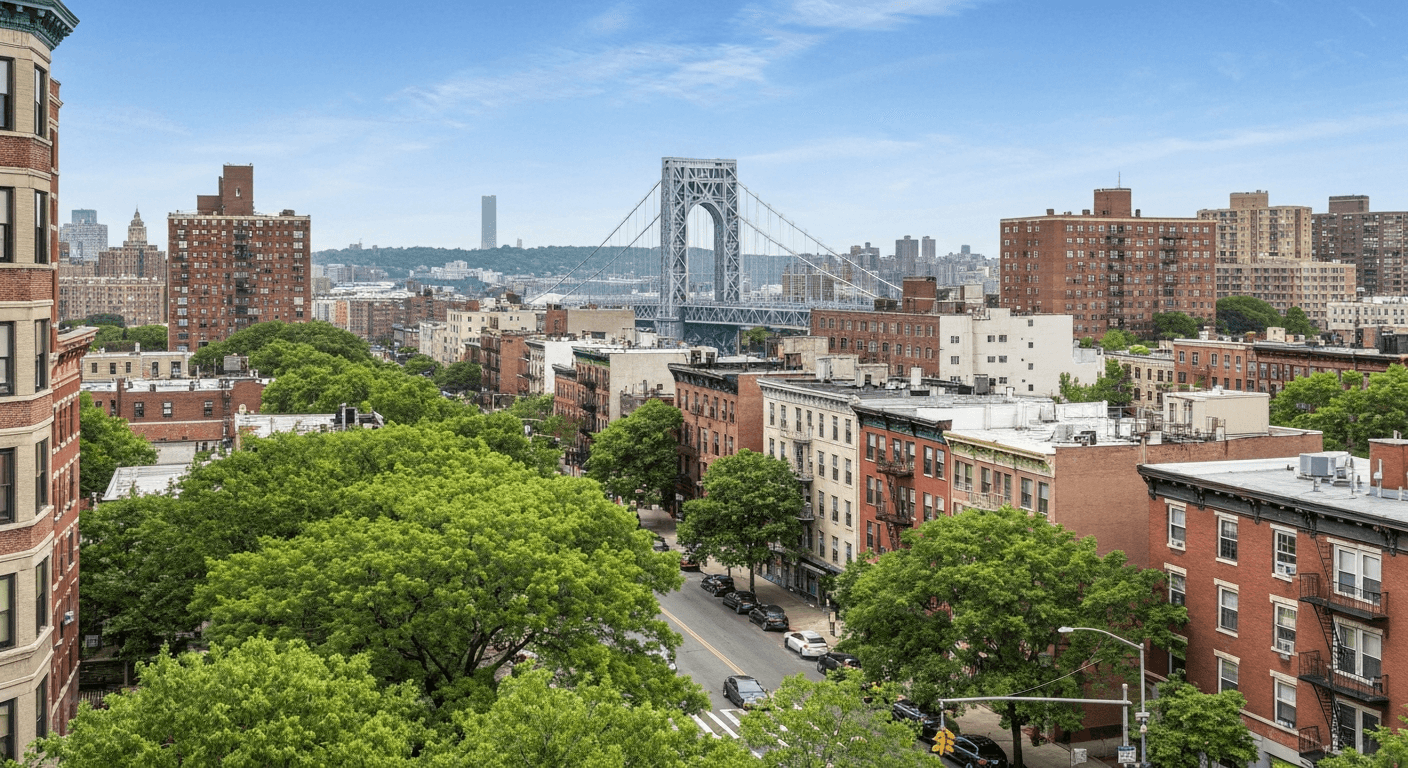
Perched on the rocky northern tip of Manhattan, where the island narrows and rises dramatically above the Hudson River, Washington Heights is a neighborhood that rewards exploration. Bounded by 155th Street to the south and Dyckman Street to the north, running from the Hudson River on the west to the Harlem River Drive on the east, Washington Heights is a community of breathtaking contrasts: towering apartment buildings on the rocky bluff overlooking one of the world's most magnificent urban vistas, medieval art treasures housed in a reconstructed castle within a 67-acre park, and some of Manhattan's most affordable real estate in an era when Manhattan affordability has become almost mythological.
Washington Heights is primarily known as a Dominican neighborhood—the cultural and commercial heart of the largest Dominican diaspora community in the United States—and that identity drives much of what makes it genuinely special. The aromas of pollo guisado and tostones wafting from open restaurant windows, the music pouring from social clubs and storefronts along 181st Street, the murals celebrating Dominican heritage across building facades: these are the sensory signatures of a neighborhood that has maintained its authentic character through decades of urban change.
But Washington Heights is also transforming. A new generation of buyers—healthcare professionals working at nearby NewYork-Presbyterian Hospital and the Columbia University Irving Medical Center campus at 168th Street, young families priced out of central Harlem, and investors who have followed the neighborhood's appreciation trajectory—are driving demand for a housing stock that remains remarkably affordable by Manhattan standards.
If you are a buyer who believes that value and quality of life are not mutually exclusive in New York City, Washington Heights may be exactly the neighborhood you have been searching for. This is the comprehensive guide to living, buying, and investing here.
Neighborhood Overview & History
Washington Heights takes its name from Fort Washington, a Revolutionary War fortification built on a rocky ridge above the Hudson River in 1776. The fort fell to British forces in November of that year in one of the Continental Army's most devastating defeats—more than 2,800 American soldiers were captured in a single engagement—but the name and the memory persisted, and the neighborhood that grew up around the site carries its history with quiet pride.
The neighborhood's modern character was shaped by waves of 20th-century immigration. Irish and Jewish immigrants settled the area heavily in the early and mid-20th century, and the neighborhood retains some architectural and institutional echoes of that era. Beginning in the 1960s and accelerating through the 1970s and 1980s, Dominican immigrants arrived in large numbers, transforming Washington Heights into the cultural hub of the Dominican American experience. Today the neighborhood's commercial corridors on Broadway, St. Nicholas Avenue, and 181st Street are unmistakably Dominican: the restaurants, botanicas, barbershops, record shops, and social clubs create a sensory environment unlike anywhere else in Manhattan.
The northern section of the neighborhood, above approximately 181st Street, transitions gradually into Inwood, Manhattan's northernmost neighborhood, and the gentle blending of the two communities creates interesting micro-market dynamics for buyers paying attention to neighborhood boundaries.
The neighborhood is divided roughly into two sections by the presence of the Columbia University Irving Medical Center and NewYork-Presbyterian Hospital, which occupy a massive footprint between 165th and 168th Streets along Broadway and Fort Washington Avenue. This medical district—one of the largest in the Western Hemisphere—is the economic engine of the neighborhood, employing tens of thousands of healthcare workers who create sustained, year-round demand for nearby housing.
Perhaps the neighborhood's greatest architectural and cultural treasure is Fort Tryon Park—a 67-acre landscape on the western bluff of Manhattan, designed by the Olmsted Brothers (the firm behind Central Park) and opened in 1935. Within the park sits The Cloisters, a branch of the Metropolitan Museum of Art housed in a genuine medieval monastery assembled from components brought to America from France and Spain. It is one of the most extraordinary cultural institutions in New York City, and Washington Heights residents have it as their literal backyard.
The George Washington Bridge, which connects Washington Heights to Fort Lee, New Jersey via the bluff at 178th Street, is one of the most elegant suspension bridges ever built and an unmistakable architectural feature of the neighborhood's skyline.
The Real Estate Market
Washington Heights offers Manhattan real estate at prices that would have seemed impossible to buyers shopping in central or lower Manhattan—and still seem surprising to those who encounter them for the first time. This is a market that rewards buyers willing to look past neighborhood preconceptions, and the financial logic for ownership here is genuinely compelling.
Co-ops
The backbone of the Washington Heights housing market is the mid-20th century co-operative apartment. The neighborhood contains hundreds of co-op buildings ranging from modest walk-up structures to full-service buildings with doormen, elevators, and landscaped lobbies. Studios in Washington Heights co-ops are available from approximately $130,000 to $250,000, with monthly maintenance fees typically ranging from $550 to $950 per month.
One-bedroom co-ops generally list from $225,000 to $400,000, making them among the lowest-cost entry points into Manhattan co-op ownership available anywhere in the borough. Two-bedroom co-ops are priced from $350,000 to $600,000, and three-bedroom units—increasingly rare in the market below 96th Street—can still be found from $500,000 to $850,000, a price point that would be entirely unattainable in virtually any other Manhattan neighborhood.
Many Washington Heights co-ops require 20% down and conduct board reviews, though some buildings have less stringent financial requirements than co-ops in more expensive neighborhoods. Flip taxes—fees paid to the co-op corporation upon sale, typically ranging from 1% to 3% of the sale price—are common and should be factored into your total cost of ownership calculations.
Condos
New condo construction has accelerated in Washington Heights over the past five years, particularly near the 181st Street commercial corridor, along the Broadway spine, and in the blocks adjacent to the Columbia University Irving Medical Center campus. New one-bedroom condos typically range from approximately $400,000 to $600,000, while two-bedrooms run from $575,000 to $850,000. Three-bedroom new construction condos are available from $800,000 to $1.2 million—a price point representing extraordinary value when compared to equivalent units in neighborhoods south of 96th Street. Several newer buildings benefit from 421-a property tax abatements that can significantly reduce monthly carrying costs during the abatement period.
Multi-Family Properties
Washington Heights contains a substantial stock of three- to six-family walk-up buildings on residential side streets throughout the neighborhood. Prices for these income-producing properties range from approximately $1 million to $2.5 million depending on size, condition, location, and current income. A well-occupied multi-family building in Washington Heights can produce rental yields of 5% to 7%—among the strongest returns available anywhere in Manhattan and a powerful argument for investors seeking income alongside appreciation.
Market Trends
Washington Heights has experienced consistent price appreciation over the past five years, with median co-op prices rising approximately 10% to 15% over that period. The neighborhood benefits from multiple macro tailwinds: the Columbia University Irving Medical Center campus continues to expand, creating sustained professional housing demand; A train express service connects the neighborhood to Midtown in under 30 minutes; and the broader New York City affordability crisis has pushed buyers steadily uptown in search of livable prices without leaving Manhattan.
Investment Outlook
For investors with a five-plus-year horizon, Washington Heights presents some of the strongest fundamentals in Manhattan: prices well below the borough median, strong and reliable rental demand from hospital workers, medical students, Columbia affiliates, and community residents, and a neighborhood in the early stages of the appreciation curve that transformed central Harlem in the preceding decade.
Lifestyle & Amenities
Washington Heights is not a neighborhood that impresses through polish or manufactured glamour. Its appeal is something deeper and more durable: an authentic urban community with extraordinary natural beauty, cultural richness, and the kind of neighborhood loyalty that comes from generations of families having built their lives here.
Food and Dining
Washington Heights is a destination neighborhood for anyone who loves authentic Dominican cooking at its finest. Malecon, the neighborhood's most famous restaurant, has been serving roasted chicken, chicharrones de pollo, and grilled meats from its location on Broadway near 175th Street since 1995. The lines outside on weekend evenings are the only marketing the restaurant needs. The food is simply extraordinary—especially the garlicky roasted chicken, which has a devoted following that extends far beyond the neighborhood.
Cachapas y Mas on Dyckman Street is famous for its Venezuelan corn cakes stuffed with queso blanco and pulled pork, a dish that has attracted food writers and curious eaters from across the city. El Nuevo Caridad on Broadway near 181st Street is a longtime neighborhood favorite for traditional Dominican cooking. La Casa del Mofongo on Broadway serves the neighborhood's namesake dish—garlicky fried plantain mashed with broth and topped with your choice of protein—in generous portions at reasonable prices.
Beyond Latin food, the neighborhood's medical center adjacency has brought a growing number of casual restaurants, cafes, and quick-service spots to the blocks around 168th Street, serving the thousands of healthcare workers, students, and visitors who pass through daily.
Parks and Outdoor Space
Washington Heights may offer the single best access to natural green space of any Manhattan neighborhood. Fort Tryon Park, occupying 67 acres on the western bluff, is a masterpiece of landscape design. The Olmsted Brothers firm (of Central Park and Prospect Park fame) designed it in the 1930s, and it remains one of New York City's most beautiful and least crowded parks. The heather garden—the largest publicly maintained heather garden in the northeastern United States—is extraordinary in late summer. The views of the Hudson River and the dramatic New Jersey Palisades from the park's ridgeline walking paths are among the most spectacular urban vistas available anywhere in the world.
Inwood Hill Park, just north of the Washington Heights boundary, adds another 196 acres of old-growth forest, rocky outcroppings, and riverside paths along the Harlem River—terrain that feels genuinely wild in the middle of New York City.
Fort Washington Park, running along the Hudson River waterfront below the bluff, provides additional green space and is home to the Little Red Lighthouse, a tiny 19th-century navigational structure tucked beneath the George Washington Bridge that is one of New York City's most charming and least-publicized landmarks.
Culture and Arts
The Cloisters is beyond compare. This branch of the Metropolitan Museum of Art, housing the museum's medieval European art collection within a reconstructed monastery complex in Fort Tryon Park, is one of the most remarkable cultural institutions in any city in the world. The building itself—assembled from genuine medieval European architectural elements—is the art. The collection, which includes the famous Unicorn Tapestries, is extraordinary. Washington Heights residents visit for free with a standard Met admission and walk or take the short A train ride to get there.
Shopping and Daily Life
The 181st Street commercial corridor is the neighborhood's commercial spine—a dense, lively stretch of shops, restaurants, services, and markets that provides virtually every daily need within a few blocks. C-Town Supermarkets, Associated Food Stores, and several bodegas provide grocery options throughout the neighborhood. A growing number of national retailers have opened on 181st Street in recent years, reflecting increasing commercial confidence in the area.
Schools & Education
Washington Heights is served by Community School District 6 (CSD 6), which encompasses the northernmost sections of Manhattan.
Public Schools
PS 5 Ellen Lurie School on Academy Street is one of the neighborhood's stronger elementary schools, with an active family community and dedicated teaching staff. PS 152 Dyckman Valley School on Nagle Avenue serves the northern portion of the neighborhood near the Inwood boundary. PS 189 Daniel Carter Beard on Ellwood Street offers bilingual programming particularly suited to the neighborhood's predominantly Spanish-speaking community.
For middle school, IS 218 Salomé Ureña School on Cabrini Boulevard offers bilingual and dual-language programs and is one of the most important educational institutions in the neighborhood—named after the celebrated Dominican poet and educator, it reflects the neighborhood's deep investment in its cultural heritage while providing strong academic preparation.
High Schools
Gregorio Luperón High School on Audubon Avenue is a specialized public high school focused on recent immigrants who are English language learners—one of the city's most distinctive and important educational programs, serving a population that mainstream schools often fail to support adequately. The High School for Law and Public Service on West 156th Street draws students from across upper Manhattan. George Washington Educational Campus on Audubon Avenue is the neighborhood's large comprehensive high school.
Higher Education and Medical Training
Columbia University Irving Medical Center at 168th Street is one of the nation's premier academic medical centers, with fully accredited programs in medicine, nursing, dental medicine, and public health through the Vagelos College of Physicians and Surgeons and the Mailman School of Public Health. The Medical Center's presence is the single largest driver of housing demand in Washington Heights and provides extraordinary educational opportunity for neighborhood residents pursuing careers in healthcare and biomedical research.
Transportation & Commute
One of Washington Heights' most compelling practical advantages is its subway connectivity. The neighborhood is served by some of the fastest express subway routes in the entire Manhattan system.
Subway
The A train runs the entire length of Washington Heights along the central Broadway/St. Nicholas Avenue corridor, with stops at 155th Street, 163rd Street–Amsterdam Avenue, 168th Street (serving the medical center), 175th Street, 181st Street, 190th Street, and Dyckman Street (207th Street). The A express train is one of the fastest routes in the subway system—from 181st Street to Columbus Circle at 59th Street takes approximately 20 to 25 minutes, and to Fulton Street in Lower Manhattan approximately 35 to 40 minutes.
The 1 train (IRT Broadway–7th Avenue Line) runs parallel to the A train along Broadway, providing local service with stops at 157th, 163rd, 168th, 181st, 191st, and 207th Streets. The 1 train connects seamlessly to the Upper West Side, Midtown, and all points south along the Broadway corridor.
The C train supplements A train service on the same corridor with slightly different stop patterns.
Buses
The M4 express bus runs south along Broadway to Midtown with limited stops. The M100 and M101 provide coverage along Amsterdam Avenue. The Bx6 crosses the Washington Bridge to the Bronx, and the M3 runs south along Amsterdam Avenue to Midtown.
George Washington Bridge Bus Station
At 178th Street and Fort Washington Avenue, the George Washington Bridge Bus Terminal is a major interregional hub, providing service to destinations throughout New Jersey, Rockland County, and communities along the I-95 corridor. For residents who commute to northern New Jersey for work, Washington Heights is one of the most strategically well-positioned neighborhoods in the city.
Walkability and Cycling
The Hudson River Greenway provides protected cycling access south to the rest of Manhattan, and Citi Bike has expanded its network of docking stations throughout the neighborhood.
Commute Time to Midtown: 20–30 minutes by A express train.
Buying vs. Renting
The buy-versus-rent equation in Washington Heights is straightforwardly in favor of ownership for qualified buyers—in a way that is increasingly rare in any New York City neighborhood, and genuinely unusual in Manhattan.
Current market rents for a one-bedroom apartment in Washington Heights range from $1,800 to $2,600 per month, depending on building quality and specific location. A two-bedroom rents for $2,500 to $3,500 per month. These are among the lowest rents in Manhattan—but they still represent significant monthly expenses that accumulate no equity for the renter.
Against those rental costs, consider: a one-bedroom co-op purchased at $275,000 with 20% down ($55,000) carries a monthly mortgage payment of approximately $1,100 at current rates, plus monthly maintenance of $650 to $800, for a total carrying cost of approximately $1,750 to $1,900 per month. That figure is competitive with or below comparable rent—with equity building every month and a decade of appreciation history behind the asset class.
For multi-family property buyers, the income-property economics in Washington Heights are among the most compelling in the entire borough. A three-family building generating $7,500 per month in gross rental income, purchased at $1.4 million, creates a financial structure—with mortgage amortization, income, and appreciation combined—that would be impossible to replicate in most other Manhattan neighborhoods at any price point.
Who Should Live Here
Washington Heights draws a distinctive mix of residents, and the neighborhood's combination of affordability, space, natural beauty, and community make it work for a remarkably wide range of lifestyles and life stages.
Healthcare Professionals are the neighborhood's fastest-growing demographic. The proximity to NewYork-Presbyterian Hospital and Columbia University Irving Medical Center—combined with the ability to live in a spacious apartment at a fraction of downtown Manhattan prices—makes Washington Heights an obvious choice for physicians, nurses, researchers, and allied health professionals who value both quality of life and financial prudence.
Families find in Washington Heights something genuinely precious in Manhattan: space. Larger two- and three-bedroom apartments, access to Fort Tryon Park and Inwood Hill Park, bilingual school options for Spanish-speaking households, and a genuinely family-oriented community culture where children play outside and neighbors know each other make the neighborhood one of Manhattan's best choices for households raising children.
Value-Oriented Buyers who want Manhattan—with A train access, Central Park proximity via express, and a genuine neighborhood identity—without downtown prices will find that Washington Heights delivers on every dimension that matters.
Dominican American Community Members who want to be embedded in the heart of one of the most vital cultural communities in the United States will find Washington Heights not just a neighborhood but a home in the fullest sense of the word.
Investors who believe that the appreciation wave moving steadily northward along Manhattan has not yet fully priced in Washington Heights' fundamentals will find here an acquisition opportunity with a clear thesis, strong rental demand, and compelling economics.
Tips for Buying in Washington Heights
Understand co-op underlying mortgages. Some older co-op buildings in Washington Heights carry significant underlying mortgages on the building itself, which can affect how much individual shareholders can borrow and what lenders will offer. Work with a lender who has specific co-op experience and understands how underlying mortgages affect shareholder financing.
Review the building's financials carefully. Washington Heights co-ops range from beautifully managed, financially strong operations to buildings with deferred maintenance, reserve fund deficiencies, or governance challenges. Request the last three years of financial statements, review reserve fund adequacy, and ask about any planned or special assessments before proceeding.
Visit at different times of day. Some blocks in Washington Heights experience significantly different noise and activity levels at different hours. Broadway and the blocks surrounding the George Washington Bridge approach can be noisy during morning and evening rush hours. Visiting a building multiple times before committing—including on a weekday morning—will give you an accurate picture of what daily life there actually looks like.
Work with a broker who genuinely knows upper Manhattan. The micro-market differences in Washington Heights are significant. The blocks between Cabrini Boulevard and the Hudson River bluff have a completely different character and price dynamic from those adjacent to Broadway. A broker with real neighborhood knowledge can save you from a costly mismatch between expectation and reality.
Look for 421-a abatements in new construction. In newer condo buildings, these property tax benefits can reduce your monthly carrying costs by $400 to $800 per month during the abatement period—a meaningful financial benefit that can make the difference between a comfortable carrying cost and a stretched one.
Conclusion: Washington Heights Is Waiting for You
Washington Heights is one of New York City's most overlooked real estate opportunities—and simultaneously one of its most authentic neighborhoods. Where else in Manhattan can you walk from a medieval art museum to a park designed by the creators of Central Park, to a stretch of Dominican restaurants serving some of the best roasted chicken in the city, then take an express train to Midtown in twenty minutes—all without leaving a single borough?
The buyers who have been here for years know something the broader market is only now beginning to recognize: Washington Heights offers a quality of life and a financial proposition that few Manhattan neighborhoods can match at any price, and that no other neighborhood can match at these prices.
The window is still open. But it will not remain open indefinitely.
Ready to explore Washington Heights? Farva Scott, Associate Broker at The Real Brokerage, knows this market and is ready to guide you through every step of your buying journey. Visit farvascott.com or call (914) 417-9215 to schedule your consultation today.