Williamsburg Real Estate Guide: Living, Buying & Investing in Williamsburg, NY
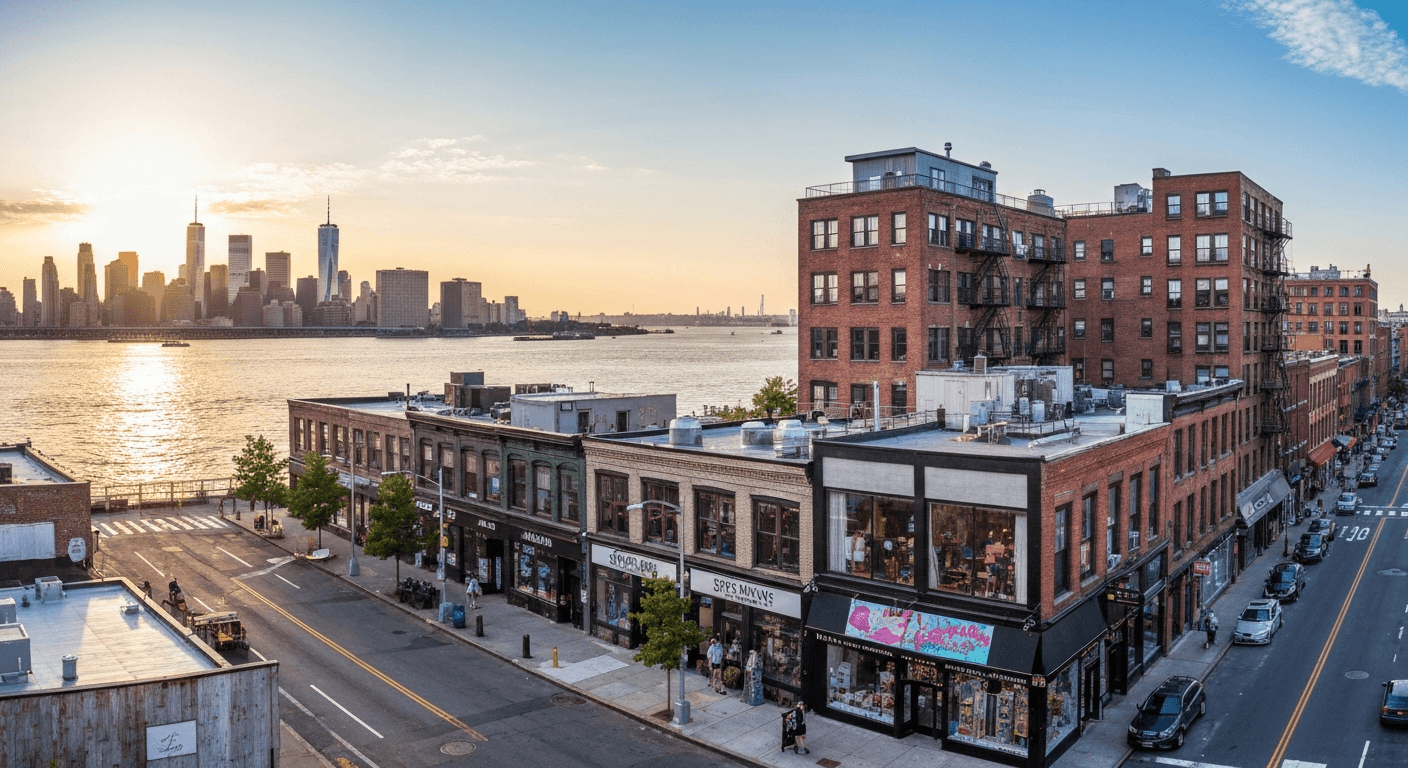
Williamsburg is the neighborhood that redefined what Brooklyn could be. Over the last two decades, this former industrial waterfront on the East River has transformed into one of the most culturally dynamic, architecturally diverse, and real estate-active neighborhoods in all of New York City. Today, Williamsburg attracts a global audience of buyers, renters, and investors who are drawn by its extraordinary mix of art, food, music, architecture, and waterfront beauty—set against a skyline backdrop that rivals anything in Manhattan.
Bedford Avenue is the heartbeat. From the Brooklyn waterfront west of Kent Avenue all the way east to Myrtle-Broadway, Williamsburg pulses with a creative energy that has proven remarkably durable. What began as the migration of artists seeking cheap loft space in the 1990s has evolved into one of the most complete and sophisticated urban neighborhoods in the country, with world-class restaurants, a thriving nightlife scene, excellent transit connections, and a real estate market that has delivered consistent appreciation for the better part of 25 years.
For buyers and investors in 2024, Williamsburg remains compelling—not as an emerging neighborhood where you are getting in early, but as an established prime Brooklyn address where quality property continues to appreciate, rental yields remain strong, and the fundamentals of walkability, transit, culture, and water access provide long-term support for values. This comprehensive guide covers everything you need to know about living, buying, and investing in Williamsburg, Brooklyn.
Neighborhood Overview & History
Williamsburg occupies the northwestern corner of Brooklyn, directly across the East River from Manhattan's Lower East Side and Alphabet City. The neighborhood is bounded by the East River to the west, Flushing Avenue and Broadway to the south, Bushwick Avenue to the east, and Greenpoint to the north. The Williamsburg Bridge, completed in 1903, connects the neighborhood directly to Delancey Street in Manhattan and remains one of the most iconic transit connections in New York City.
Williamsburg's history is one of successive waves of immigration and industrial transformation. In the 19th and early 20th centuries, the neighborhood was a major manufacturing center—the Domino Sugar refinery on the waterfront, whose landmarked brick façade still stands today at 292 Kent Avenue, was for decades the largest sugar refinery in the world and defined the industrial character of the Brooklyn waterfront. The area was also home to waves of Jewish, Polish, German, and Italian immigrants, whose communities shaped the neighborhood's built environment.
The postwar period brought significant change. As manufacturing declined and residents moved to the suburbs, Williamsburg experienced disinvestment throughout the 1970s and 1980s. The Hasidic Jewish community on the south side of the neighborhood maintained deep roots, while the north side and waterfront areas became increasingly industrial and underutilized.
The transformation began in earnest in the 1990s, when the combination of low rents, large raw loft spaces in former factories, and proximity to Manhattan via the L train attracted the first wave of artists, musicians, and creative workers. The opening of galleries, clubs, and record labels along Bedford Avenue made Williamsburg a national reference point for alternative culture.
The zoning changes of 2005, which rezoned much of the Williamsburg waterfront from manufacturing to residential use, unleashed an enormous wave of development. Luxury towers along Kent Avenue and the East River have added thousands of high-end apartments, while the conversion of former warehouse buildings into boutique condominiums has preserved much of the neighborhood's industrial character. Today, Williamsburg is one of the most valuable residential addresses in Brooklyn and the defining neighborhood of the borough's transformation.
The Real Estate Market
Williamsburg's real estate market in 2024 is defined by premium pricing, genuine scarcity of certain property types, and strong underlying demand driven by the neighborhood's global reputation and its exceptional quality of life. Buyers should enter the market with a clear understanding of the different sub-markets that exist within the broader Williamsburg geography: North Williamsburg generally north of Broadway toward Greenpoint, the waterfront corridor along Kent Avenue and River Street, South Williamsburg including the Hasidic core south of Division Avenue, and East Williamsburg toward the Bushwick border along Morgan Avenue.
North Williamsburg and the waterfront command the highest prices in the neighborhood. New construction luxury condominiums in buildings like One Domino Square at 325 Kent Avenue, One North Fourth, and the towers along the Kent Avenue and North 5th Street waterfront corridor start at approximately $1,000 per square foot and can reach $1,800 per square foot or more for higher floors with Manhattan skyline and East River views. A 600-square-foot one-bedroom in a new waterfront building typically lists in the $900,000 to $1.3 million range. A 1,000-square-foot two-bedroom reaches $1.4 million to $2.2 million. Penthouse units in the most desirable buildings trade above $3 million.
The industrial-conversion market—boutique condominiums carved from former factory and warehouse buildings on North 6th Street, Wythe Avenue, and Berry Street—represents some of the most distinctive and sought-after inventory in all of Brooklyn. These properties feature soaring ceiling heights often 11 to 14 feet, original wood beams, cast-iron columns, large windows, and the kind of architectural character that new construction cannot replicate. Expect to pay $850 to $1,400 per square foot for loft-style units in well-converted buildings. One-bedrooms typically list from $700,000 to $1.1 million; two-bedroom lofts from $1.1 million to $2 million.
The townhouse market is limited but active. Single-family and multi-family brownstones and brick rowhouses on the tree-lined residential streets between Metropolitan Avenue and North 14th Street—on blocks like North 8th, North 9th, and Havemeyer Street—are among the most coveted properties in the neighborhood. Well-maintained single-family townhouses in this micro-market list from $2.5 million to $4.5 million. Multi-family buildings, typically two to four units, represent excellent investor opportunities with gross rental yields in the 3.5 to 5 percent range before expenses.
Rental market pricing reflects the neighborhood's status. Studio apartments in non-luxury buildings rent from $2,200 to $3,200 per month. One-bedrooms range from $3,000 to $4,500. Two-bedrooms in the most desirable locations and buildings range from $4,500 to $7,500. Luxury waterfront rentals command even higher numbers, with high-floor two-bedrooms in premium buildings reaching $8,000 to $12,000 per month.
Buyer competition in Williamsburg remains intense. Correctly priced properties in desirable buildings and locations regularly attract multiple bids, and many of the most popular conversions and new developments sell out during their initial offering period. Working with an experienced buyer's agent who has access to off-market and pre-market opportunities is essential in this environment.
Lifestyle & Amenities
The lifestyle in Williamsburg is arguably the best in Brooklyn, and that claim is increasingly made without irony. The neighborhood offers a density of restaurant, bar, cultural, and outdoor options that rivals many Manhattan neighborhoods, all within a more manageable neighborhood-scale geography.
Bedford Avenue from North 14th Street to Grand Street is the commercial core, lined with boutiques, bookstores, record shops, coffee shops, and restaurants. Marlow & Sons on Broadway has been one of the neighborhood's defining restaurants since it opened in 2004, serving farm-to-table American food in an intimate tavern setting. Lilia on Union Avenue is one of the most acclaimed Italian pasta restaurants in New York City and requires reservations weeks in advance. Llama Inn on North 7th Street pioneered the thriving Peruvian-Latin food scene in the neighborhood. L'industrie Pizzeria on North 7th Street consistently earns recognition as one of the best slice joints in the city.
Peter Luger Steak House, the legendary 1887 steakhouse on Broadway at Driggs Avenue, is a Williamsburg institution that attracts visitors from around the world and maintains a waitlist stretching weeks. Paul's Daughter on the waterfront at North 6th Street is beloved for its hot dogs and lobster rolls on the East River, a quintessential New York summer experience.
Nightlife in Williamsburg is centered on venues along Wythe Avenue and North 11th Street. Baby's All Right on Broadway is a mid-size music venue and bar that books national touring acts alongside emerging artists. Brooklyn Steel on Morgan Avenue, accessible via the L train at Morgan Avenue, is a major 1,800-capacity venue that brings A-list touring acts to the neighborhood. The Knitting Factory hosts smaller shows and DJ nights. For cocktails, Hotel Delmano on Berry Street has one of the most beautiful bar rooms in Brooklyn.
For outdoor life, East River State Park at North 8th Street offers direct waterfront access with sweeping Manhattan skyline views and is the site of Smorgasburg, the wildly popular outdoor food market running every Saturday and Sunday from spring through fall, attracting tens of thousands of visitors weekly. McCarren Park, between North 12th Street and Bayard Street, is the neighborhood's largest park and features a public pool, running track, athletic fields, tennis courts, a greenmarket, and free summer concerts and events. The Williamsburg Bridge provides bicycle and pedestrian access to Manhattan, and the Brooklyn Waterfront Greenway provides cycling connections north to Greenpoint and south toward DUMBO and Brooklyn Bridge Park.
Schools & Education
Williamsburg sits within Brooklyn's Community School Districts 14 and 32, and families have access to a mix of traditional public schools, charter schools, and specialized programs. PS 84, the José Celso Barbosa School on South 4th Street, is one of the neighborhood's anchor elementary schools and has shown strong performance particularly in its bilingual programs. PS 18, the Edward Bush School, serves the northern reaches of the neighborhood with strong early childhood programming.
For middle school, MS 50, the Brooklyn Bridge Academy at 183 South 3rd Street, serves much of South Williamsburg and has a strong arts integration program. Middle school students also compete for spots in District 15 and citywide gifted-and-talented programs accessible via the subway.
High school options include Brooklyn Technical High School, one of New York City's elite specialized high schools, located at Fort Greene Place in nearby Fort Greene and accessible via the G train from Metropolitan Avenue. Williamsburg Preparatory School is a charter high school within the neighborhood focused on college readiness. Many Williamsburg families also pursue options at Bard High School Early College or make the commute to Bronx Science or Stuyvesant.
For higher education, Pratt Institute in Clinton Hill and New York University in Manhattan are both within easy transit reach, and Brooklyn's Long Island University campus is a short bus or subway ride away. The New York City College of Technology (City Tech) in Downtown Brooklyn is also highly accessible via the J/M/Z or L train corridors.
Transportation & Commute
Williamsburg's transit connectivity is one of its greatest assets. The L train, running below Bedford Avenue, connects the neighborhood to Union Square at 14th Street in approximately 7 minutes, making Williamsburg one of the fastest subway commutes from Brooklyn to Manhattan. L train stops within the neighborhood include Bedford Avenue in North Williamsburg, Lorimer Street in the mid-neighborhood, and Graham Avenue at the east end, providing coverage across the neighborhood's width.
The J, M, and Z trains provide additional Manhattan connectivity from the Marcy Avenue and Hewes Street stations on the southern edge of the neighborhood, with the J and Z express reaching Fulton Street in lower Manhattan in approximately 15 minutes and Chambers Street in approximately 13 minutes. The M train provides service to Forest Hills in Queens, making Williamsburg a viable base for commuters working in multiple boroughs.
The Williamsburg Bridge, completed in 1903, carries both bicycle and pedestrian traffic into Manhattan's Lower East Side and provides a free, car-free alternative for commuters cycling to Manhattan—a popular choice given the flat, protected path. The bridge crossing takes approximately 10 to 15 minutes by bicycle under normal conditions.
Bus service supplements the subway with the B62 running along Bedford Avenue to Brooklyn Bridge, and the B48 providing a crosstown link to Greenpoint and Ridgewood. Ferry service from the Williamsburg and North Williamsburg landings at North 6th Street provides East River Ferry service to East 34th Street in Midtown Manhattan, Long Island City, and DUMBO, with a scenic waterfront commute of approximately 12 minutes to Midtown.
Walk scores in Williamsburg consistently register in the mid-to-high 90s, reflecting the extraordinary density of services, retail, and amenities within the neighborhood's walkable grid.
Buying vs. Renting
The buy-versus-rent analysis in Williamsburg is nuanced by the neighborhood's premium pricing. At $1,000 to $1,800 per square foot in the newer condo market, the monthly carrying costs of ownership—including mortgage, common charges, and taxes—are significantly higher than what buyers would encounter in less expensive neighborhoods. A $1.1 million one-bedroom with 20 percent down at current rates generates total monthly carrying costs of approximately $5,500 to $6,500.
Current rental prices for comparable one-bedrooms in new Williamsburg buildings run $3,500 to $4,500 per month, creating a meaningful rent-versus-buy gap at the premium end of the market. This means the financial case for buying in Williamsburg depends heavily on how long you plan to stay—the breakeven horizon is typically four to six years in this market—and on your confidence in continued long-term appreciation.
For buyers with a long horizon of seven or more years, the combination of equity accumulation, historical appreciation rates in Williamsburg—which have significantly outpaced inflation over the past 20 years—and the real optionality created by owning in one of Brooklyn's most desirable neighborhoods makes buying a compelling choice. In the industrial-conversion and older condo sub-markets, where prices per square foot are lower, the rent-versus-buy math improves considerably. For those uncertain about their stay duration, renting while monitoring the market is a prudent alternative that does not foreclose future buying options.
Who Should Live Here
Williamsburg has the rare quality of working for an unusually wide range of people, which is part of what drives its enduring desirability. The neighborhood's most prominent demographic remains young professionals in the tech, media, fashion, design, and financial sectors, many of whom are drawn by the L train's unbeatable commute to Union Square, Chelsea, and Midtown and by the social fabric of the neighborhood's bars, restaurants, and music venues.
Creative professionals—musicians, artists, photographers, filmmakers—have deeper roots in Williamsburg than almost anywhere else in New York City, and while the raw-loft-for-cheap era has passed, the cultural infrastructure those early arrivals created remains and continues to attract creative talent at every career stage.
Families are an increasingly important part of the Williamsburg buyer pool. The neighborhood's private outdoor spaces, its proximity to McCarren Park and East River State Park, and its improving school options make it workable for families, particularly those with access to private school options or with children eligible for specialized high schools.
International buyers—particularly from Europe, South America, and East Asia—are consistently active in the Williamsburg market, viewing New York City residential real estate as both a lifestyle asset and a long-term investment. The neighborhood's global reputation and its demonstrated track record of appreciation make it a reliable target for internationally-informed capital seeking a foothold in the New York market.
Tips for Buying in Williamsburg
The most important piece of advice for buyers in Williamsburg is to understand what you are actually buying. The difference between a genuine industrial-conversion loft with original structural character and a new construction building that aesthetically mimics that character is substantial—both in terms of price and in terms of the lived experience. Before making an offer on any converted building, inspect the common areas, the facade, the roof, and the mechanical systems carefully. Older conversions can carry deferred maintenance costs that impact common charges and the building's financial health over time.
For buyers targeting new construction along the waterfront, pay particular attention to sponsor sales versus resales. Sponsors in newer buildings often offer below-market pricing to move inventory quickly, particularly for units on lower floors or with less desirable exposures. Resales from early purchasers in those same buildings can provide comparable quality at better prices, and you have the benefit of reviewing several years of actual building operations before committing.
Be realistic about how price-per-square-foot varies across the Williamsburg geography. A building on Kent Avenue or North 5th Street commands a 30 to 40 percent premium over equivalent units on the same floor in a comparable building east of Bedford Avenue. For buyers on a budget, the blocks between Graham Avenue and Grand Street offer significantly better value for the money while remaining within the Williamsburg neighborhood and L train corridor.
Finally, work with a broker who can access pre-market inventory. The most sought-after Williamsburg properties—particularly loft conversions, townhouses, and premium waterfront units—often trade quietly through broker networks before appearing on public listing platforms. Establishing that relationship early is the single most effective way to access the best opportunities in this market.
Conclusion
Williamsburg has proven itself over and over again: the neighborhood delivers on the promise of an extraordinary life in Brooklyn. The combination of world-class food and nightlife, unbeatable transit access to Manhattan, stunning waterfront and park resources, and an architectural environment that blends historic industrial character with contemporary design at the highest level makes Williamsburg one of the most complete neighborhoods in New York City.
For buyers and investors, Williamsburg's proven track record of appreciation, strong rental demand, and global recognition as a desirable address make it as compelling in 2024 as it has ever been. The question is not whether Williamsburg is worth investing in—the question is which specific opportunity best matches your goals and timeline.
Ready to explore Williamsburg? Contact Farva Scott, Associate Broker at The Real Brokerage, for personalized market guidance and current listings. Visit farvascott.com or call (914) 417-9215.