Yorkville Real Estate Guide: Living, Buying & Investing in Yorkville, NY
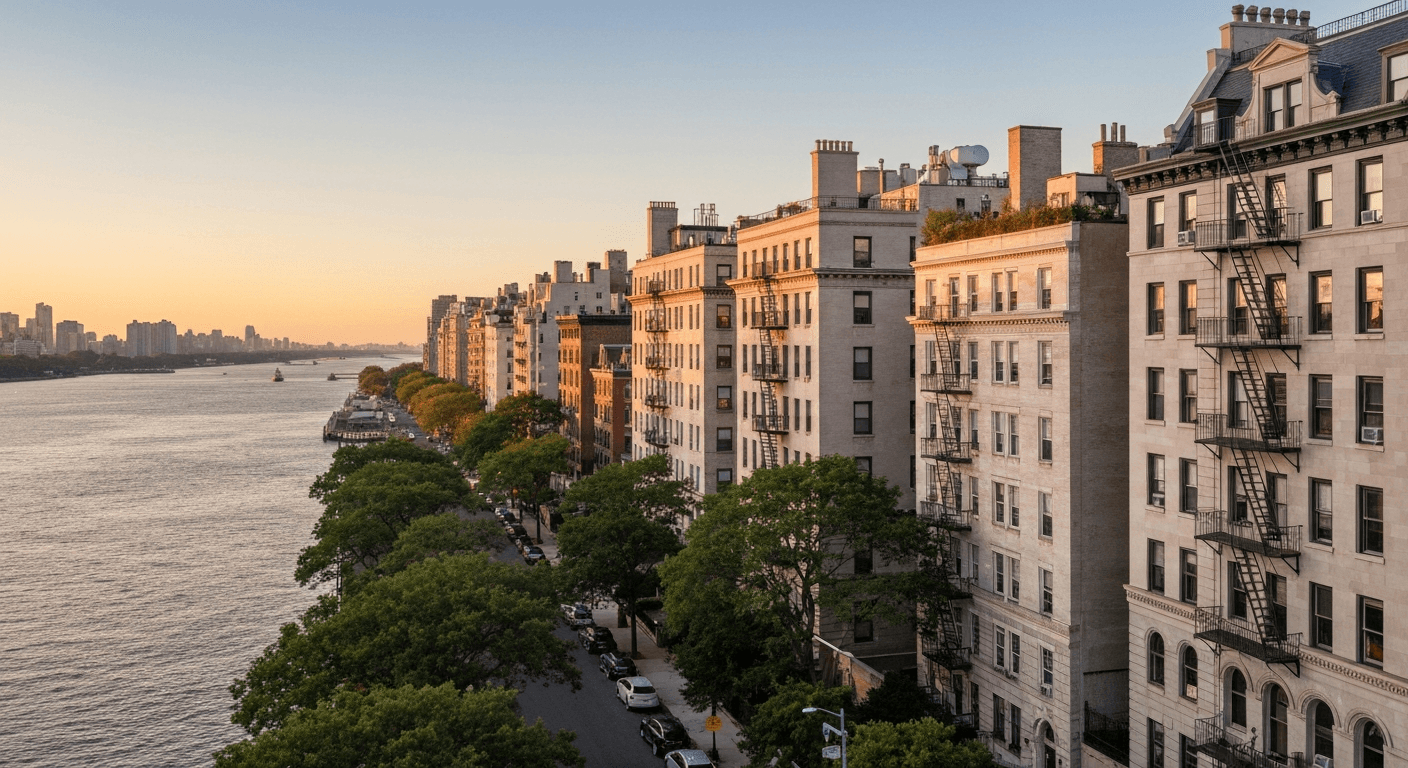
Yorkville is the Upper East Side's best-kept secret — a family-friendly, walkable, and authentically livable neighborhood stretching from roughly 79th Street to 96th Street between Lexington Avenue and the East River. Long overshadowed by the more celebrated sections of the Upper East Side to its south, Yorkville has emerged over the past decade as one of Manhattan's most compelling residential value opportunities for families, young professionals, and anyone seeking the classic New York apartment experience without the full Museum Mile price premium. The neighborhood has a genuine neighborhood feel — a quality increasingly rare anywhere in Manhattan — where dog walkers and stroller pushers share sidewalks, neighbors know each other by name, and the local coffee shop remembers your order.
The neighborhood's German and Hungarian immigrant heritage, which defined it for the first half of the 20th century, lives on in architectural details, a handful of surviving Central European bakeries and restaurants, and a quiet pride in community identity that sets Yorkville apart from more transient Manhattan enclaves. Today, however, the community is thoroughly cosmopolitan: Columbia Medical School and Weill Cornell families, long-time Upper East Side residents, newly arrived technology and finance professionals, and young couples making their first Manhattan purchase all coexist on streets lined with elegant pre-war limestone and brick buildings.
What makes Yorkville particularly compelling for buyers in 2026 is the combination of Second Avenue Subway connectivity (the Q train's 86th and 96th Street stations delivering residents to Grand Central in 12 minutes), relative price moderation compared to the 60s–78th Street Upper East Side corridor, strong public school options anchored by the proximity of Hunter College High School, and a neighborhood food and retail scene that has genuinely transformed over the past five years. Carl Schurz Park, Henderson Place, and John Jay Park anchor an outdoor lifestyle that feels almost suburban in quality while remaining unmistakably Manhattan. For buyers prioritizing livability, value, and long-term stability, Yorkville may represent the best deal remaining on the East Side.
Yorkville's identity as a distinct community stretches back to the 1840s and 1850s, when German immigrants — many of them craftsmen, brewers, and merchants — settled the farmland then lying on the outskirts of Manhattan's developed area. By the turn of the 20th century, 86th Street, known as "Germantown's Broadway," was lined with German theaters, delicatessens, beer halls, and social clubs that made it one of the most ethnically coherent commercial streets in the city. Newspaper accounts from 1910 describe 86th Street as smelling perpetually of sauerkraut and fresh-baked pumpernickel, and the neighborhood's German-American Athletic Club, German-Hungarian churches, and fraternal societies gave the community a cultural density that rivaled any in the city.
Hungarian immigrants added their own distinct layer, settling particularly in the blocks around First and Second Avenues in the 80s and 90s, bringing paprikash recipes, espresso culture, and a tradition of intellectual cafe life to the neighborhood's character. The Hungarian community's imprint is documented in the surviving Heidelberg Restaurant at 1648 Second Avenue and in the ornate architectural details of the neighborhood's older apartment buildings.
By mid-century, as second and third-generation German and Hungarian Americans moved to the outer boroughs and New Jersey suburbs, Yorkville became more broadly middle-class — inhabited by families, nurses and physicians from the nearby hospital corridor along York Avenue, civil servants, and teachers. The 1970s and 1980s brought relative urban neglect that touched much of Manhattan, but Yorkville's strong physical building stock protected its residential quality. The 1990s real estate revival reached Yorkville as Manhattan's residential market expanded northward and eastward, and the neighborhood benefited from its proximity to the established cultural institutions of the Upper East Side.
The transformative moment in Yorkville's modern history came in January 2017, when the MTA opened Phase 1 of the Second Avenue Subway, bringing Q train service to 96th, 86th, and 72nd Streets on Second Avenue. Overnight, the neighborhood's transit access improved more dramatically than any Upper East Side location had experienced since the original Lexington Avenue subway opened in 1918. Property values responded: average prices in Yorkville rose approximately 18 to 25 percent in the two years following the subway opening, according to StreetEasy and Miller Samuel data — and the appreciation has continued steadily through 2026.
Today, Yorkville's most distinctive landmarks include Carl Schurz Park — the magnificent 14.9-acre riverfront park at East End Avenue between 84th and 90th Streets, home to Gracie Mansion (the official residence of the Mayor of New York City) and sweeping views across the East River to Astoria and Randall's Island. Henderson Place, a charming enclave of 24 surviving Queen Anne-style townhouses built in 1882 on East 86th Street between York and East End Avenues, is one of Manhattan's most distinctive historic residential groups. The Yorkville Branch of the New York Public Library at 222 East 79th Street and the Church of St. Ignatius Loyola on Park Avenue at 84th Street are neighborhood anchors that give the community its civic gravity.
Yorkville's real estate market occupies a well-defined and attractive position in Manhattan's residential spectrum: premium enough to reflect its Upper East Side address and second-generation transit connectivity, but meaningfully more affordable than the 60s–78th Street corridor to its south. This gap — currently 15 to 30 percent on a per-square-foot basis — makes Yorkville one of the most logical trade-up destinations for buyers priced out of Carnegie Hill or the traditional Upper East Side who want to remain on the East Side with access to top-tier schools, park life, and the Weill Cornell Medical Center complex.
The housing stock is dominated by pre-war co-op apartment buildings — the classic large-scale doorman buildings of the 1920s and 1930s that line Park Avenue, the numbered side streets, and the avenues. These buildings typically offer the generous pre-war layouts that Manhattan buyers pay premiums for: 9 to 10-foot ceilings, large formal entry galleries, separate dining rooms, windowed kitchens, and generous storage. Buildings like 50 East 89th Street, 170 East 87th Street, 340 East 93rd Street, and the various co-ops along 83rd through 91st Streets represent the quintessential Yorkville residential experience.
These pre-war co-ops come with the quintessential co-op transaction complexity: strict board approval, financial requirements typically including 20 to 25 percent down payment minimum, post-closing liquidity requirements equivalent to two to three years of maintenance, and restrictions on subletting. Boards in Yorkville's most established buildings can be demanding, particularly regarding income verification for self-employed buyers.
Post-war condominiums became more prevalent in Yorkville than in some other UES sub-neighborhoods, particularly along First and Second Avenues in the 1960s and 1970s development cycle. These buildings — with their typical concrete-frame construction, lower ceilings, and simpler layouts — offer significantly easier purchase and ownership conditions: no board approval required, no subletting restrictions, full investor flexibility. For buyers who cannot satisfy co-op board requirements or who plan to invest and eventually sell or rent, Yorkville's post-war condo inventory is a natural focus.
As of mid-2026, price benchmarks in Yorkville are: one-bedroom co-ops from $550,000 to $950,000 depending on building tier, floor, and renovation quality; two-bedroom co-ops from $900,000 to $1.8 million; three-bedroom pre-war apartments from $1.5 million to $3.5 million in most buildings, with exceptional floor plans in white-glove buildings occasionally exceeding $4.5 million. Condominiums carry a 10 to 20 percent premium over comparable co-ops of the same vintage, reflecting the ownership flexibility differential. Luxury new development and recently converted product along East End Avenue and York Avenue at the premium end can reach $2,500 to $3,200 per square foot.
The rental market in Yorkville is robust and driven by demand from Weill Cornell Medical Center trainees and staff, graduate students from the cluster of academic institutions on the East Side, and young professionals. One-bedroom apartments rent for $3,200 to $4,500 per month; two-bedrooms command $4,500 to $6,500; three-bedrooms range from $6,000 to $9,500. These numbers support gross rental yields for investor-owned condominiums of approximately 3.5 to 4.5 percent — in line with broader Upper East Side norms.
Yorkville's lifestyle combines the outdoors-oriented quality of a park neighborhood with the walkable food and retail convenience of a mature Manhattan residential corridor. Carl Schurz Park is the neighborhood's crown jewel and its most powerful quality-of-life differentiator. The 14.9-acre park along the East River between 84th and 90th Streets offers manicured promenades, dog runs, children's playgrounds, and the only elevated esplanade on the East Side — providing unobstructed views of the Hell Gate Bridge arch, the Triborough Bridge, and the Astoria, Queens skyline across the river. The FDR Drive passes underneath the park, muffling traffic noise from the promenade level effectively. John Jay Park at 77th Street and Cherokee Place offers a public swimming pool — a genuine rarity on the Upper East Side — drawing thousands of neighborhood families during summer months.
The food scene along First and Second Avenues has genuinely matured over the past five years. Wibai Thai at 1605 First Avenue brings elevated Thai cooking to the neighborhood. Sable's Smoked Fish at 1489 Second Avenue remains a gold-standard Upper East Side institution for weekend brunch provisions — the line at 10 AM on Sunday mornings tells you everything you need to know. Heidelberg Restaurant at 1648 Second Avenue is one of the few surviving German restaurants in the neighborhood, a living artifact of Yorkville's ethnic heritage. The 92nd Street Y at 1395 Lexington Avenue offers not only fitness facilities but a nationally recognized cultural programming calendar: lectures by world leaders, concerts, comedy events, and children's programs that genuinely enrich neighborhood life year-round.
Coffee culture has taken hold with multiple independent shops: Cafe d'Avignon on East 88th Street, Canale Coffee on Second Avenue, and Birch Coffee nearby. The neighborhood's bar scene is casual and community-oriented — Iggy's at 1452 Second Avenue and Stumble Inn at 1454 Second Avenue are longtime local favorites. For upscale cocktails, DTUT at 1626 Second Avenue offers a cozy, living-room style bar with a strong whiskey and wine selection. The new developments along East 91st and 92nd Streets have brought additional dining and retail, and the stretch of Second Avenue between 80th and 90th Streets has evolved into a genuine neighborhood high street with boutique fitness studios, independent children's clothing shops, and specialty food retailers.
New York-Presbyterian Hospital/Weill Cornell Medical Center — one of the nation's premier academic medical centers, spanning York and East River at 68th to 71st Streets — is a major neighborhood employment center. Its proximity brings a consistent pipeline of medical professionals, researchers, and support staff who rent and ultimately buy in Yorkville.
Yorkville is part of Manhattan Community School District 2, and its schools are among the most sought-after in the city's public school system. Families moving to Yorkville frequently select the neighborhood specifically for its educational landscape, particularly its access to Hunter College High School at 71 East 94th Street — one of the nation's most prestigious tuition-free public schools for grades 7 through 12, admitting students through a competitive examination process. Hunter's presence in the neighborhood is a profound draw for academically ambitious families who want to remain in public education while accessing a curriculum that competes with the finest private schools.
At the elementary level, PS 158 Balgley at 1458 York Avenue is one of the neighborhood's highest-performing schools, with exceptional math scores, robust arts programming, and a deeply engaged parent community. PS 290 Manhattan New School at 311 East 82nd Street is a nationally recognized progressive public school with a literacy-based curriculum that draws families from across the district. PS 183 Robert Louis Stevenson at 419 East 66th Street (just south of the neighborhood) is another consistently strong option.
For middle school, IS 167 Robert F. Wagner at 220 East 76th Street maintains a strong reputation, particularly in science and mathematics preparation. The gifted and talented pipeline feeds into Hunter High and the specialized high school system. Stuyvesant High School and Bronx Science are accessible by Q and 4/5/6 trains. For families considering private education, Marymount School at 1026 Fifth Avenue, Chapin School at 100 East End Avenue, and Spence School at 22 East 91st Street are all within or bordering the neighborhood — an extraordinary private school concentration that gives Yorkville families choices available in very few other New York neighborhoods.
The Second Avenue Subway fundamentally changed Yorkville's transit calculus in January 2017, and the neighborhood's real estate values have reflected that change ever since. The Q train's 86th Street station on Second Avenue is the fastest direct subway connection from Yorkville to Midtown Manhattan since the old Second Avenue El was demolished decades ago. Travel times from the 86th Street Q station: Grand Central Terminal — approximately 12 minutes; Rockefeller Center — approximately 18 minutes; Penn Station via Times Square transfer — approximately 22 minutes; Fulton Street and the Financial District — approximately 32 minutes.
The 4, 5, and 6 express trains at the 86th Street Lexington Avenue station provide an additional option for Midtown commuters, reaching Grand Central in approximately 8 to 10 minutes — one of the fastest Midtown commutes available from any Upper East Side sub-neighborhood. The M86 Select Bus Service operates a crosstown route at 86th Street, crossing Central Park to the Upper West Side in approximately 20 minutes, connecting Yorkville to the 1, 2, 3, B, and C trains.
The FDR Drive — accessible from multiple on-ramps in Yorkville — provides car access south to the bridges, the Financial District, and Brooklyn and north to the Triborough Bridge for Queens and the Bronx. The East River Greenway along the waterfront provides a car-free cycling route from the Battery to upper Manhattan. Walk Score: 95. Bike Score: 72, with protected lanes on Second Avenue and the East River Greenway.
For buyers with a five-plus-year horizon and sufficient capital for a 20 percent down payment, buying in Yorkville makes strong financial sense compared to renting. The rental premium over ownership costs is significant: a two-bedroom apartment that rents for $5,500 per month often has a purchase price of $1.2 to $1.4 million, with total carrying costs of approximately $6,500 to $7,500 per month (mortgage plus co-op maintenance) — a modest premium over renting that comes with substantial equity building and tax deduction benefits that effectively close much of the gap for buyers in meaningful income brackets.
For buyers financing at the conforming loan limit with a 20 percent down payment on a $1.1 million two-bedroom co-op, the monthly mortgage payment at current rates of approximately 6.75 percent runs roughly $5,800 per month, with maintenance fees of $1,500 to $2,000. Total carrying cost of $7,300 to $7,800 compares to a market rent of $5,500 — a meaningful gap for short-term residents, but one that closes rapidly for those staying five or more years as equity accumulates and the property appreciates. Short-term residents (under three years) are better served by renting given the co-op approval complexity and transaction costs, which typically run 3 to 5 percent of purchase price.
Yorkville's residential profile is heavily weighted toward families with children — and for compelling reasons. The combination of Carl Schurz Park's riverfront recreation, John Jay Pool's summer swimming, Hunter High School's proximity, strong elementary and middle school options, low crime rates, and a walkable, human-scaled neighborhood streetscape make Yorkville among the strongest family neighborhoods in Manhattan by any metric. Young professionals and couples in their late 20s and 30s are increasingly drawn by the relative value compared to the southern UES: a first-time buyer who cannot stretch to Carnegie Hill or the low-80s can often find a well-located one-bedroom in Yorkville for $550,000 to $750,000.
Empty nesters and retirees represent another substantial constituency. Long-time Upper East Side residents who have raised their children in larger pre-war apartments frequently choose to downsize within the neighborhood, moving up First and Second Avenues to Yorkville where prices are modestly lower while the amenities they value — Weill Cornell Medical Center, 92nd Street Y programs, park life, museum access from the 4/5/6 at 86th Street — remain immediately accessible. International buyers, particularly from Germany, Switzerland, and Central Europe, find Yorkville's classic Manhattan elegance and historical European community resonance deeply appealing as a long-term hold.
The single most important thing to understand before buying a co-op in Yorkville is that the board approval process is the critical variable that determines whether a deal closes regardless of price, condition, or financing. Boards in Yorkville's established pre-war buildings are thorough and sometimes demanding: standard packages include two to three years of tax returns, recent pay stubs or self-employment income documentation, a detailed net worth statement, bank statements, two to three personal reference letters, and sometimes employer verification letters. Post-closing liquidity requirements can be particularly strict in older buildings — some require cash equivalents of 24 months of maintenance post-close.
Work with a buyer's broker who has specific experience with Upper East Side co-op transactions and knows the individual building cultures and board preferences. This market knowledge is genuinely valuable: a well-connected broker will know which buildings are accommodating to self-employed buyers, which have recently tightened their financial requirements, and which allow pied-à-terre use or investor purchases. This saves significant time and prevents the frustration of application rejections after weeks of due diligence.
On building selection, buildings on the east-west side streets between Lexington and Third Avenue tend to be the most prestigious and hold value most reliably. Buildings on First Avenue and York Avenue represent better price-per-square-foot value but may experience more tenant turnover and offer less cachet at resale. The blocks between 83rd and 91st Streets — particularly between Second and Third Avenues — represent Yorkville's sweet spot for the combination of neighborhood quality, transit access (Q train at Second Avenue), and relative value within the Upper East Side market.
Yorkville is the neighborhood for buyers who want the full Upper East Side experience — pre-war architecture, riverfront parks, world-class schools, Weill Cornell medical access, and authentic Manhattan neighborhood life — without the full Museum Mile premium. The Second Avenue Subway has permanently improved its connectivity, and the neighborhood's strong school fundamentals, stable community character, and supply-constrained housing stock make it a sound long-term investment alongside a genuinely exceptional place to live.
Whether you're a family seeking a forever home near Carl Schurz Park and Hunter High School, a young professional ready to leave renting behind, or an investor seeking stable, appreciation-backed returns on the East Side, Yorkville deserves your serious attention in 2026.
Farva Scott is an Associate Broker at The Real Brokerage with expertise across Manhattan's residential market, with particular depth on the Upper East Side. Call her at (914) 417-9215 or visit farvascott.com to begin your Yorkville search. The right apartment is waiting.